








Every Morning, the Town Forgot One Person Until Only the Forgotten Remembered Each Other
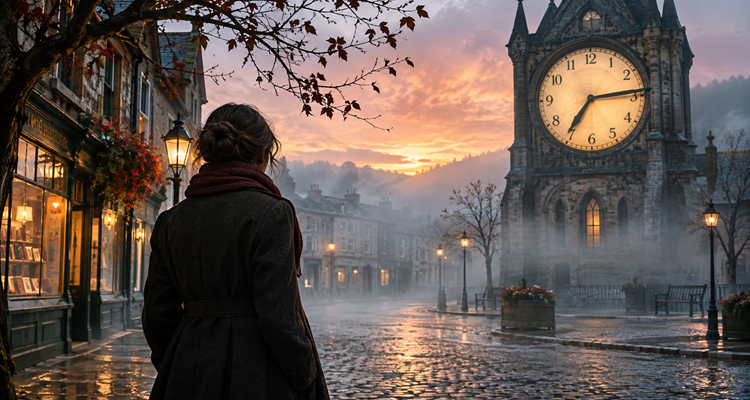
At 7:13 every morning, someone in Bellwether disappeared from everyone else’s memory.
Not from the streets. Not from their own body. Not even from the photographs hanging on the walls.
They simply became a stranger to everyone who had ever loved them.
And for thirty-seven years, nobody noticed.
Until the forgotten began finding one another.
The Woman Nobody Knew
The first time Mara Venn was forgotten, her husband made her breakfast.
He placed two slices of toast on a blue plate, poured coffee into her favorite chipped mug, and kissed the top of her head as he passed her chair.
Then the church bell rang.
Seven times, followed by a strange, thin note that sounded like metal being dragged across glass.
Her husband stopped walking.
He looked at Mara.
“Who are you?”
She laughed because she thought he was joking.
“Daniel, don’t start.”
He backed toward the kitchen counter.
“How did you get into my house?”
Mara stared at him. They had been married for eleven years. His wedding ring was still on his finger. Their photograph hung above the fireplace.
“Daniel. It’s me.”
He glanced at the photograph.
In it, he stood beside a woman in a white dress. Her face was unmistakably Mara’s.
But his expression did not change.
“I don’t know that woman,” he whispered.
Mara reached for her phone.
Her mother’s number was the first she called.
A polite voice answered.
“I’m sorry,” her mother said. “Who is this?”
By noon, Mara had called everyone she knew.
Her sister. Her childhood best friend. Her employer. The woman who sold flowers outside the library.
Every conversation ended the same way.
No one remembered her.
Yet her name remained on her driver’s license. Her clothes still filled the bedroom wardrobe. Her fingerprints still opened her phone.
The world contained all the evidence that Mara Venn existed.
It simply no longer contained anyone who believed it.
The Man at the Bus Stop
At sunset, Mara returned to the house she could no longer enter.
Daniel had changed the locks.
She sat across the street, watching the kitchen window glow.
Someone sat beside her.
He was an elderly man wearing a brown coat, with a paper bag resting on his knees.
“First day?” he asked.
Mara turned.
“What?”
“Being forgotten.”
She felt something cold settle behind her ribs.
“How do you know?”
The man opened his bag and offered her a sandwich.
“Because you keep looking at that house as though it owes you an explanation.”
His name was Elias Rook.
He had been forgotten twenty-three years earlier.
“Twenty-three years?” Mara repeated. “How can that be possible?”
Elias watched a passing car.
“Bellwether forgets one person every morning. Always at seven thirteen. Sometimes it’s a child. Sometimes an old woman. Sometimes someone who moved away years ago.”
“Why?”
“That’s what we’re trying to discover.”
“We?”
Elias smiled without happiness.
“There are more of us.”
He stood and extended his hand.
“Come on. You shouldn’t spend your first night alone.”
The House of Unremembered Names
Beyond Bellwether’s abandoned railway station stood a boardinghouse with green shutters.
Inside were forty-six people.
Some were elderly. Others were young. One was a girl no older than nine.
Every person in the room had been forgotten.
And every person remembered everyone else.
Mara met a schoolteacher whose students had screamed when she entered her classroom.
A father whose daughter had reported him to the police as a stranger.
A woman who had spent fourteen years watching her own family grow older from across the street.
The youngest resident, a girl named June, sat at a table drawing houses.
“Who looks after her?” Mara whispered.
“We do,” Elias answered.
“What happened to her parents?”
“They forgot her when she was six.”
Mara looked again at the child.
“She’s been here three years?”
Elias nodded.
“She still remembers the smell of her mother’s hair.”
June looked up.
“I remember other things too.”
She turned her drawing around.
It showed a tall clock tower standing above a crowd of people without faces.
Beneath it, she had written:
THE CLOCK IS NOT COUNTING TIME.
Mara felt an inexplicable shiver.
“What is it counting?”
June lowered her pencil.
“Us.”
The Missing Forty-Seventh
That night, Mara learned the rules.
The forgotten could remember ordinary townspeople, but ordinary townspeople could not recognize the forgotten as people they had previously known.
Photographs and documents survived.
The forgotten could still buy food, rent rooms, and speak to strangers. But if they tried to reclaim their former lives, they were treated as impostors.
And there was one more rule.
Nobody forgotten could leave Bellwether.
“People have tried,” Elias explained. “The roads loop back. The trains stop. Walk through the forest for three days, and you’ll emerge beside the clock tower.”
Mara studied the boardinghouse’s enormous wall of names.
Hundreds had been written there.
Some had dates beside them. Others were crossed out.
“Why are there only forty-six of us?”
Elias hesitated.
“Because the others disappeared.”
“Where?”
“We don’t know.”
Mara stepped closer to the wall.
The oldest entry was dated thirty-seven years earlier.
Samuel Vale November 4.
Beneath it was a second name, almost completely scratched away.
She leaned forward.
The letters looked familiar.
Not because she knew the name.
Because she recognized the handwriting.
It was hers.
The Photograph in the Clock Tower
The next morning, Mara went to the town archives.
The archivist did not recognize her, but he allowed her to examine the records.
She found an old newspaper dated November 4, thirty-seven years earlier.
Its headline read:
BELLWETHER CELEBRATES COMPLETION OF MEMORIAL CLOCK
The photograph beneath it showed the mayor, the clockmaker, and a group of schoolchildren standing in the town square.
Mara examined the image.
Near the back stood a woman wearing a dark coat.
She had Mara’s face.
Not a resemblance.
The same face.
The same scar above her eyebrow.
The same small silver pendant she was wearing now.
Mara turned the newspaper over, searching for an explanation.
A handwritten note appeared in the margin.
If you are reading this, the town has started again.
Her hands began shaking.
Beneath it was another sentence.
Do not let Elias reach the final name.
What Bellwether Had Buried
Mara confronted Elias that evening.
He listened without interrupting.
Then he removed his glasses.
“I hoped you’d have more time.”
“Who am I?”
“You’re Mara Venn.”
“That’s not an answer.”
“No,” he admitted. “It isn’t.”
He led her beneath the boardinghouse, down a narrow staircase into a room filled with metal cabinets.
Each cabinet held hundreds of envelopes.
Every envelope bore a name.
Inside were photographs, letters, school reports, marriage certificates, and handwritten memories.
Mara opened one.
It belonged to a man named Peter Hollis.
The first page described his childhood. The second recorded his marriage. The third contained a list of his favorite songs.
The final page read:
Memory transfer complete.
“What is this?”
Elias stood by the doorway.
“Thirty-seven years ago, Bellwether suffered a disaster. An underground reservoir collapsed beneath the old school. Forty-eight children were trapped.”
Mara remembered nothing.
“The town built a machine to find them. A machine that could search every human memory in Bellwether for details about the tunnels.”
“How?”
“By connecting minds through the clock tower. The clockmaker believed memories could be transferred if the right electrical patterns were reproduced.”
“And did it work?”
“Not the way he intended.”
Elias touched one of the cabinets.
“The machine could move memories, but it couldn’t copy them. To preserve one person’s memories, it had to take them from everyone else.”
Mara looked at the envelopes.
“So every morning”
“One person becomes the sole keeper of their own past. Everyone else’s memories of them are taken and stored here.”
“Why keep doing it?”
“Because the machine never finished its first task.”
Mara felt the room tilt.
“What happened to the children?”
Elias did not answer.
Instead, he opened the final cabinet.
Inside were forty-eight small envelopes.
All but one had been sealed.
The remaining envelope bore a name.
MARA VENN.
The Child Beneath the Town
The memory came back in fragments.
Rain striking classroom windows.
A teacher shouting for everyone to get beneath their desks.
The floor cracking.
Cold water.
Darkness.
A little boy holding Mara’s hand.
And a voice promising that nobody would be left behind.
Mara stumbled against the cabinet.
“I was there.”
Elias nodded.
“You were one of the children.”
“But that was thirty-seven years ago. I’m thirty-four.”
“Your body is thirty-four,” he said. “Your memory is older.”
He explained that the machine had not simply stored memories. It had assembled living people around them, drawing on the town’s recollections of the missing children.
Each time the process failed, the machine began again.
Mara had lived several lives.
Different homes. Different families. Different husbands.
Each time, she had eventually discovered the truth.
And each time, the clock had reset her.
“Why me?” she asked.
“Because you were the last child we couldn’t find.”
“Who is we?”
Elias’s expression changed.
For the first time, Mara saw fear in his eyes.
“The people who built the machine.”
“You said you were forgotten twenty-three years ago.”
“I was.”
“But you remember the beginning.”
“Because I made sure I would.”
He reached into his coat and withdrew an old brass key.
“I was the clockmaker’s assistant.”
Mara stepped backward.
“You’re keeping it running.”
“I’m trying to stop it.”
“By forgetting more people?”
“By finding you.”
He held out the key.
“The machine has been searching for the memory of where the last child was trapped. It believes you know.”
Mara stared at the brass teeth.
Then she remembered the little boy’s hand slipping from hers.
And something worse.
She remembered that she had not been the child trapped beneath the school.
She had been the child who escaped.
Seven Thirteen
At dawn, Mara climbed the clock tower.
The stairs spiraled around enormous gears that moved without making a sound.
At the top stood a brass console.
Forty-eight lights surrounded a single switch.
Forty-seven glowed white.
One remained dark.
Mara inserted the key.
The console awakened.
A recording crackled through an ancient speaker.
It was a child’s voice.
Her own.
“If someone finds this, please tell them we tried.”
The gears began turning faster.
Outside, the town stirred.
People opened curtains. Cars started. Bakers arranged bread in their windows.
Mara looked down at the square.
Daniel stood outside the bakery, waiting for his morning coffee.
He appeared peaceful.
He had no idea his wife was standing above him.
The speaker crackled again.
“We couldn’t open the door. So we made a place where nobody would ever be alone.”
Mara closed her eyes.
She remembered the school.
The collapse.
The trapped children.
And the machine.
It had not been built by adults to rescue them.
The children had found it beneath the school, part of an experimental installation abandoned years earlier.
They had activated it themselves.
Their desperate wish had been simple.
Please don’t let us disappear.
The machine had obeyed.
It preserved the children by collecting memories from the living town.
Then it began constructing new lives around those memories, trying to give the children futures they had never reached.
Every forgotten adult was one of those constructed lives.
Every morning, another memory became strong enough to exist independently.
And when a forgotten person disappeared from the boardinghouse, the machine had not killed them.
It had returned them to the original memory.
To the children beneath the school.
Mara looked at the forty-eight lights.
The dark one was hers.
She could shut down the machine.
But every life it had sustained would end.
Elias. June. The schoolteacher. The father who still watched his daughter from afar.
All of them.
Or she could allow the machine to continue.
Bellwether would keep forgetting.
One person every morning.
Until there was nobody left to remember anyone.
The clock showed 7:12.
Mara placed her hand on the switch.
Then she noticed something carved into the brass beneath it.
Not an instruction.
A question.
WHAT IS A PERSON WITHOUT SOMEONE TO REMEMBER THEM?
She thought of Daniel.
Of June.
Of Elias.
And she understood that the machine had been asking the wrong question for thirty-seven years.
The Morning Everyone Remembered
At 7:13, the bell rang.
But this time, it did not choose a person.
Mara turned the switch halfway, forcing the machine to reverse the direction of its transfer.
The tower shook.
Glass shattered.
Every clock in Bellwether stopped.
Across town, people collapsed into chairs, onto pavements, against kitchen counters.
Memories returned.
A mother remembered the daughter she had lost three years earlier.
A man remembered the teacher who had taught him to read.
Daniel dropped his coffee as eleven years of marriage rushed back into his mind.
And in the boardinghouse, forty-six forgotten people felt something they had almost stopped hoping for.
Recognition.
Doors opened.
Families came running.
Names were shouted across streets.
People embraced strangers who were no longer strangers.
For one extraordinary morning, Bellwether remembered everyone.
But inside the clock tower, Mara watched the final light turn red.
The machine had enough energy for only one more transfer.
A choice appeared on the console.
PRESERVE THE TOWN.
PRESERVE THE CHILDREN.
Mara understood the cost.
The town’s restored memories could remain, but the forty-eight children whose stolen futures had sustained the machine would finally vanish.
Or the children could remain in the machine, and Bellwether would return to forgetting.
She thought of the girl who had held a little boy’s hand beneath the school.
She thought of the adults those children had become.
Then she made a third choice.
She opened the memory archive.
Every envelope.
Every recording.
Every life.
She released them into the town.
Not into one person at a time, but into everyone at once.
For a moment, Bellwether held thousands of lifetimes in its collective memory.
Then the tower went silent.
The Last Forgotten Person
Three months later, Bellwether removed the old clock.
In its place, the townspeople built a garden.
Forty-eight small stones lined the paths, each bearing the name of a child who had disappeared beneath the school.
The forgotten returned to their families.
Some relationships survived.
Others did not.
Recognition could restore a memory, but it could not restore all the years people had spent apart.
Daniel remembered Mara.
He remembered their wedding, their arguments, their holidays, and the way she always left books open facedown.
But Mara was gone.
No one had seen her after the clock stopped.
Elias searched the archives.
June searched the garden.
Daniel searched every street.
They found no trace.
Then, one morning, a letter arrived at the boardinghouse.
There was no return address.
Inside was a photograph of forty-eight children standing outside an old school.
On the back, someone had written:
We were never meant to stay forever.
But you were.
Remember each other.
Daniel carried the photograph to the memorial garden.
He placed it beneath Mara’s stone.
And for the first time in thirty-seven years, the clock tower did not ring at 7:13.
The town remembered.
The forgotten were no longer alone.
And somewhere beyond Bellwether, a woman walked into a café in a city she had never visited.
The waiter smiled.
“Good morning. What can I get you?”
She looked at the menu.
For a moment, she couldn’t remember her name.
Then she noticed a small silver pendant resting against her chest.
On its back were two engraved words.
MARA VENN.
She smiled.
“Coffee, please.”
Outside, a church bell began to ring.
She counted the chimes.
One.
Two.
Three.
Four.
Five.
Six.
Seven.
Then came a thin, metallic note.
The waiter stopped smiling.
He looked at her.
And asked:
“Have we met before?”
This content is published for informational or entertainment purposes. Facts, opinions, or references may evolve over time, and readers are encouraged to verify details from reliable sources.