





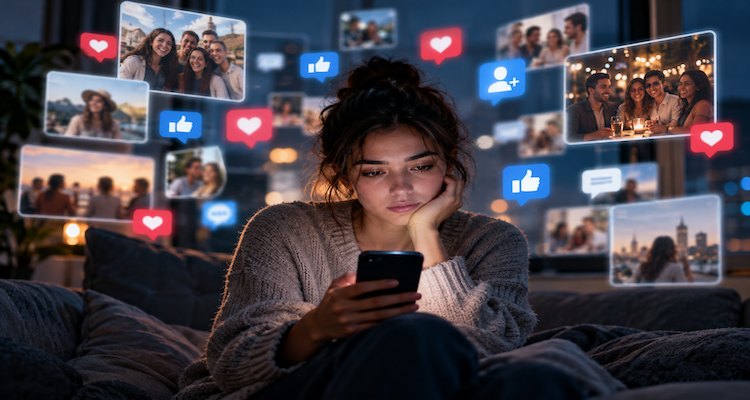




The Fear of Missing Out: How Social Media Shapes Modern Decisions
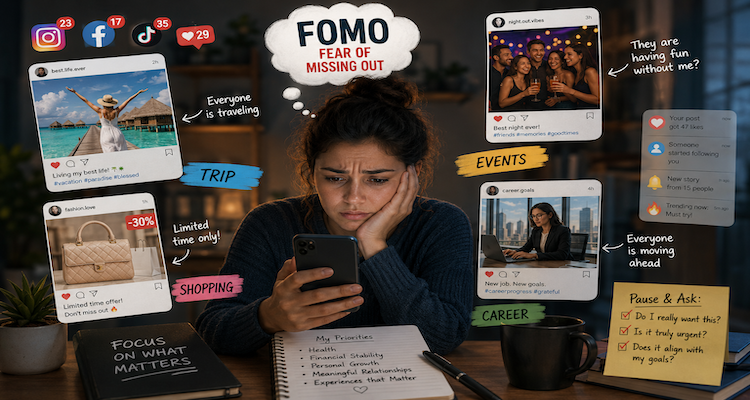
A restaurant chosen because it is trending, a product bought before a limited-time offer expires, or a trip booked after watching friends post holiday photos social media increasingly influences decisions that once felt entirely personal.
The psychological force behind many of these choices is commonly described as FOMO, or the fear of missing out. Research has linked FOMO with concerns about missing rewarding experiences that others may be having, while social networking platforms can make those experiences highly visible, measurable and difficult to ignore. The important issue is not simply that people spend time online. It is that the constant stream of updates can change how opportunities are perceived, compared and acted upon.
Key Takeaways
- FOMO can influence decisions by making other people’s experiences appear urgent, rewarding and personally relevant.
- Social media intensifies comparison by providing a continuous, curated view of what others are doing.
- Platform design can amplify urgency through notifications, visible engagement and constantly refreshed content.
- FOMO does not affect every user or decision equally; personality, context and patterns of platform use matter.
- Recognizing the difference between genuine interest and socially created urgency can improve everyday decision-making.
Why FOMO Changes Decisions, Not Just Screen Time
The original academic framing of FoMO described it as a concern that other people may be having rewarding experiences without us. That definition helps explain why the phenomenon can affect decisions far beyond the phone screen. The anxiety is often not simply about missing a post; it can be about missing the experience, opportunity, conversation, purchase or social moment represented by that post.
Social media changes the decision environment in three important ways.
First, it increases visibility. A person can now observe far more of other people’s activities than would have been possible through ordinary social interaction. Second, it compresses time. Stories disappear, trends move quickly and notifications encourage the sense that an opportunity may be temporary. Third, it turns private choices into social comparisons. A decision is no longer judged only by whether it suits the individual; it may also be measured against what appears to be happening elsewhere.
That combination can shift the question from “Do I actually want this?” to “What if everyone else experiences something better than I do?”
Social Media Creates an Endless Comparison Market
The modern version of comparison is unusually efficient. A single feed can present luxury travel, career achievements, new purchases, parties, fitness transformations and investment success within minutes.
The problem is not that every post is false. Many experiences are real. But social media presents a selective sample of reality. Users generally control what they share, when they share it and how it is framed. The result can make other people’s lives appear as a sequence of rewarding moments rather than the mixture of routine, disappointment and uncertainty that characterizes everyday life.
This matters for decision-making because perceived alternatives influence satisfaction. If a person constantly encounters attractive options, declining one option may feel less like an ordinary choice and more like a potentially costly mistake.
Research on FoMO has consistently found associations between higher FoMO and greater social networking use, while reviews of the literature also emphasize that the field is conceptually complex and that many relationships remain difficult to interpret causally.
That distinction is important. Social media does not automatically cause every instance of FOMO. People who are already prone to worry about exclusion or missed opportunities may also be more motivated to check social platforms. In some cases, the relationship may reinforce itself over time.
A three-wave longitudinal study published in 2025 found partial evidence of such a reciprocal pattern: FoMO at one point predicted later social media use, which in turn predicted later FoMO. The finding does not mean that every user enters this cycle, but it supports the idea that FoMO and platform use can interact rather than operate as a simple one-way relationship.
From Fear of Missing Out to Fear of Making the Wrong Choice
One of the more overlooked consequences of FOMO is that it can complicate decision-making even when people have more choices than ever.
Consider a consumer choosing between products. Reviews, influencer recommendations, flash sales and trending items can make postponing a purchase feel risky. The concern is no longer only, “Will I miss this deal?” It can become, “What if there is a better option that I have not found yet?”
That second problem is sometimes discussed as FoBO the fear of better options. Research examining consumer purchase intention has explored FoMO, FoBO and another related concern, FoDA, or fear of doing anything, as distinct forces that can influence decision-making.
Together, they reveal a broader problem of digital choice:
- Too little information can produce uncertainty.
- Too much information can also produce uncertainty.
- Constant exposure to alternatives can make commitment feel premature.
This helps explain why some people continue researching after they already have enough information to make a reasonable choice. The digital environment can make the search for the best possible decision feel more rational than accepting a good enough one.
Yet endless comparison has a cost: every additional option can create another reason to delay.
The Business Value of Urgency
FOMO is also relevant because businesses understand the commercial value of scarcity and social proof.
A countdown timer, a limited-edition product, a rapidly selling event or a visible queue of interested customers can all increase the perceived cost of waiting. These tactics existed long before social media, but digital platforms can distribute them continuously and personalize them at scale.
The crucial distinction is between genuine scarcity and artificially manufactured pressure. A concert genuinely has a limited number of seats. A product genuinely may be produced in a limited run. But urgency becomes more problematic when consumers are led to believe that an opportunity is disappearing without clear evidence that the limitation is real.
The broader lesson for consumers is simple: urgency is information, not proof. A timer or a trending label may justify further investigation, but it does not automatically mean that an immediate decision is in the buyer’s best interest.
Why FOMO Can Affect Social, Career and Lifestyle Choices
The influence of FOMO is not limited to shopping.
A person may accept an invitation despite needing rest because photographs from the event might later produce a sense of exclusion. Someone may pursue a career opportunity primarily because peers appear to be advancing. Another person may book an expensive trip because social media has made a particular destination seem like a cultural moment that cannot be missed.
None of these choices is necessarily irrational. Social influence can be useful. Recommendations help people discover restaurants, careers, communities and experiences they might otherwise never encounter.
The problem emerges when visibility becomes mistaken for importance.
Social media is optimized to make certain things visible. What is visible, however, is not always what is valuable to a particular person. A viral destination may not match a traveller’s interests. A popular product may not meet a buyer’s needs. A professional opportunity that looks impressive online may not fit someone’s long-term goals.
The decision-making skill that matters, therefore, is not avoiding influence altogether. That is unrealistic. It is learning to separate discovery from pressure.
FOMO Is Real, but the Research Requires Caution
It would be easy to describe FOMO as a single explanation for excessive social media use or declining well-being. The evidence does not support such a simple conclusion.
A 2024 scoping review covering 106 articles found substantial fragmentation in the FoMO literature. While researchers broadly agree on the central idea of an unpleasant feeling related to missed social experiences and activity comparison, questions remain about conceptual boundaries, measurement and causal relationships.
Similarly, a systematic review and meta-analysis involving 33 independent samples and 21,473 participants reported positive associations between FoMO, social networking site use and problematic social networking use. Association, however, does not establish that FoMO alone causes problematic behavior.
This nuance matters because the conversation around social media often swings between two extremes: either platforms are blamed for every psychological problem, or concerns about their influence are dismissed as moral panic.
The more useful position lies between them. Platform design, individual psychology, social context and patterns of use can all matter. The effect is unlikely to be identical for every person.
How to Make Decisions When Everything Feels Urgent
A practical response to FOMO does not require abandoning social media. It requires adding a pause between exposure and action.
Before making a decision triggered by something online, a few questions can help:
- Would I still want this if I had not seen someone else doing it?
- Is the opportunity genuinely time-sensitive, or does it merely look urgent?
- What problem or desire does this decision actually address?
- Am I choosing this because it fits my priorities, or because I dislike the idea of being left out?
- What is the cost of waiting for a day or two before deciding?
These questions are not designed to eliminate spontaneous decisions. Sometimes the right answer really is to act quickly. Their purpose is to distinguish genuine opportunity from emotionally amplified urgency.
Another useful habit is to reduce unnecessary triggers around important decisions. Turning off non-essential notifications, avoiding impulse purchases immediately after scrolling and researching significant choices away from a social feed can create enough distance for preferences to become clearer.
The Deeper Shift: Decisions Are Becoming More Public
Perhaps the most significant change is cultural rather than technological.
For much of human history, many decisions were shaped by family, friends, advertising and local communities. Social media has expanded the number of people, lifestyles and opportunities that can enter the comparison process. A decision about where to eat, what to buy or how to spend a weekend can now be influenced by people a user has never met.
This creates a paradox. Greater access to information can improve choices, but constant exposure to alternatives can also make satisfaction harder to achieve.
The answer is not to reject digital discovery. Social media can introduce people to valuable ideas, communities and opportunities. The challenge is recognizing that a platform’s ability to make something feel immediate does not determine its importance.
Conclusion
FOMO matters because it can quietly change the standard by which decisions are made. Instead of asking what is useful, enjoyable or meaningful, people can begin optimizing against the possibility that someone else may be having a better experience.
Social media did not invent comparison, scarcity or regret. What it has done is make all three easier to encounter throughout the day.
The most effective response is not necessarily to disconnect. It is to create a clearer boundary between what the feed says is worth noticing and what genuinely deserves a place in your life. In an environment built around endless alternatives, that distinction may become one of the most valuable decision-making skills people can develop.
This content is published for informational or entertainment purposes. Facts, opinions, or references may evolve over time, and readers are encouraged to verify details from reliable sources.