





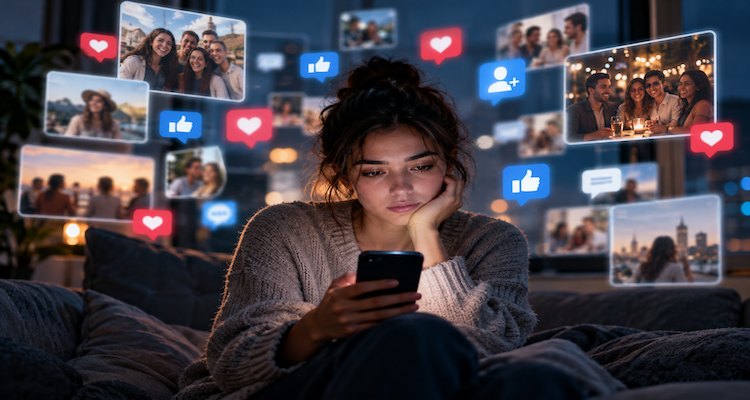




Going Viral by Accident: How Ordinary People Become Internet Famous Overnight
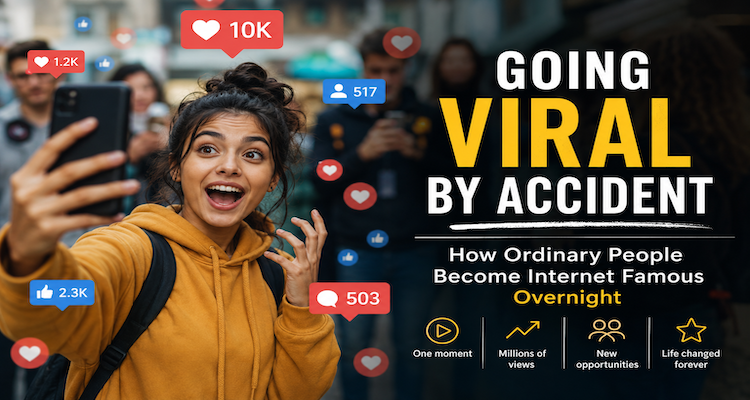
A short video of an awkward moment, an unexpected encounter, a funny reaction or an ordinary person caught in an unusual situation can disappear into the endless stream of social media or suddenly reach millions of people.
For the person in the video, the difference between those outcomes can be life-changing.
Internet fame was once associated mainly with celebrities, musicians, professional creators and people who deliberately built online audiences. Social media has changed that equation. Recommendation systems can expose content far beyond a person’s existing followers, while users can rapidly repost, remix, comment on and reinterpret the same moment. A person who never intended to become a public figure can find their face, voice or name circulating across platforms within hours.
But accidental virality is not simply a story about luck. It sits at the intersection of human attention, social behavior, influential accounts and platform distribution systems. And as recent research suggests, the consequences of sudden visibility can be far more complicated than the familiar dream of becoming “internet famous.”
Key Takeaways
- Ordinary moments can become viral when social sharing, recommendation systems and influential accounts create a rapid distribution cascade.
- Virality is difficult to predict because attention depends on networks, timing, audience behavior and platform decisions.
- Emotional reactions can influence sharing, but no single emotion or formula guarantees that content will spread.
- Sudden online fame can create opportunities while also exposing people to harassment, loss of privacy and unwanted attention.
- Influencers and high-status accounts can significantly change how far a piece of content travels.
- The growing phenomenon of short-lived online fame is reshaping what it means to become a public figure.
The internet can turn an ordinary moment into a public event
One reason accidental fame feels so unpredictable is that much of what people share online was never created as a polished media product.
Research from Pew Research Center found that everyday subjects including friends and family, funny moments and events people attended were among the most common kinds of videos posted by users. The broader lesson remains relevant even as platforms have changed: ordinary life has always been a major source of shareable material.
What has changed is the machinery surrounding distribution.
A video no longer needs to move only through a person’s friends or followers. Recommendation feeds can introduce content to strangers, who may then share it with entirely different communities. Once a post is picked up by a large account, media outlet, celebrity or influential creator, the scale can change again.
Research published in Scientific Reports in 2025 examined more than 55 million posts and 520 million reposts on Twitter/X and found evidence that reposts by highly influential users were more likely to generate further sharing. A relatively small group of influential accounts accounted for roughly half of the information flow within the repost cascades studied.
That means an ordinary person’s path to mass attention may depend partly on something they cannot see: who encounters the content first and whether someone with a large network decides to pass it along.
Virality is less like a formula and more like a chain reaction
There is a persistent belief that viral content follows a simple recipe. Make it emotional. Keep it short. Surprise people. Use a trend.
Those factors may matter, but research does not support the idea that there is one universal formula.
Emotion can influence what people choose to share. Studies have explored how emotional language and reactions relate to information diffusion, including the spread of rumors. One large study of more than 126,000 rumor cascades found that sentiment and specific emotional language were associated with differences in how true and false rumors spread.
Yet researchers have also warned against treating every observed relationship between emotional language and sharing as proof of a simple causal rule. A Nature Human Behaviour analysis questioning earlier evidence on “moral contagion” highlighted the risks of drawing overly strong conclusions from large observational social-media datasets.
The practical takeaway is important: emotion may contribute to virality, but emotion alone does not explain why one video reaches ten people and another reaches ten million.
A viral cascade can involve several forces at once:
- Initial audience response: Early viewers may watch, share, comment or ignore the content.
- Network effects: A post may cross from one community into another.
- Influential amplification: Large accounts can expose content to dramatically wider audiences.
- Platform distribution: Recommendation and ranking systems determine which content receives additional visibility.
- Cultural timing: A moment can become more relevant because it connects with an existing joke, event, debate or trend.
- Remixing: Other users may transform the original material into memes, reaction videos, parodies or commentary.
The original person may be only one part of the story. Once the internet begins adding its own interpretations, the content can develop a life beyond its creator’s control.
The rise of the accidental public figure
Traditional fame usually required institutions: television networks, film studios, record labels, publishers or major media organizations.
Viral fame can arrive without that infrastructure.
A 2025 study in the Proceedings of the ACM on Human-Computer Interaction examined how TikTok users reacted to sudden bursts of social-media attention. The research focused on the experience of people whose content unexpectedly “blew up,” exploring how sudden visibility affects the individuals behind viral posts.
This is an important shift because attention is no longer reserved for people who actively seek celebrity.
Someone can become known because of:
- a video recorded by someone else,
- an accidental appearance in a viral clip,
- a memorable reaction,
- a single comment or post,
- an unusual personal story,
- a moment that becomes a meme.
The internet then performs a strange transformation. A person who was previously anonymous becomes recognizable to thousands or millions of strangers, often before they have decided whether they want that recognition.
Their identity may also become simplified.
Online audiences tend to encounter the viral moment rather than the full person. The individual becomes “the person from that video,” “the person who said that,” or “the face behind the meme.” The internet remembers the fragment even when the person’s real life is far more complex.
Fame can arrive before consent catches up
The cultural image of virality often focuses on opportunity: followers, media appearances, brand deals or a new career.
Those outcomes are possible. But sudden visibility can also produce problems that are harder to reverse.
A viral post can expose someone to intense scrutiny. Strangers may search for personal information, contact employers, identify family members or flood social-media accounts with praise and abuse. The original context can disappear as clips are reposted with new captions or interpretations.
The problem becomes especially complicated when the viral subject did not upload the original material.
In those cases, the person at the center of the story may have little control over where the content travels. Deleting the original post may not remove copies, screenshots, remixes or reposts that have already spread across multiple platforms.
The experience also reveals a gap between visibility and agency.
A person can become highly visible without gaining meaningful control over their public image. Millions may know them, but they may have no established team, publicist, legal support or experience dealing with an audience.
That is one reason accidental fame should not automatically be treated as a prize.
Why influencers can change the trajectory of a viral moment
Not all shares are equal.
A repost from a friend and a repost from a major creator may look similar on a screen, but their network effects can be radically different.
The 2025 Scientific Reports study on prestige bias offers one explanation. It found that content reposted by influential users was more likely to be further shared than content reposted by non-influential users.
This helps explain why virality often appears spontaneous from the outside while containing important points of amplification inside the network.
An ordinary video may circulate quietly until:
- a niche community discovers it;
- a prominent account shares it;
- larger creators begin reacting to it;
- news organizations or aggregators pick it up;
- audiences encounter copies on multiple platforms.
At that point, the viral subject may no longer control the narrative. Each new layer of commentary can change what the original moment means.
The internet is creating new forms of temporary celebrity
Researchers are beginning to examine short-lived online fame as a distinct cultural phenomenon.
A 2025 paper in the Journal of Business Research uses the term “viratoid” to describe a form of online celebrity connected to viral attention and participatory culture. The authors build on the older idea of a “celetoid” a person who receives intense but often brief media attention and examine how ordinary consumers can accumulate what the researchers call celebrity capital in the social-media environment.
The terminology may not enter everyday language, but the underlying observation is useful.
The modern internet produces many kinds of temporary public figures.
Some successfully convert a viral moment into a long-term career. Others disappear from public attention almost as quickly as they arrived. Still others remain permanently associated with a meme or clip they never expected to define them.
This creates a different kind of celebrity economy. Fame is easier to trigger than it once was, but much harder to sustain—and sudden attention does not necessarily come with the resources needed to manage it.
The overlooked lesson: attention is not the same as influence
A viral person may receive millions of views without gaining a durable audience.
This distinction matters for creators, businesses and ordinary users alike.
A viral post measures a burst of attention. It does not automatically produce trust, loyalty, expertise or long-term relevance. A person can be famous for a day while having almost no influence over what happens next.
The same principle applies to businesses hoping to manufacture viral success. A viral campaign may generate enormous exposure, but attention that does not translate into a meaningful relationship with an audience can disappear quickly.
For individuals, the opposite problem may occur: the attention arrives before they have decided what they want to do with it.
That is why the most realistic question after an accidental viral moment may not be, “How do I get even more views?”
It may be:
“What level of public attention am I actually prepared to live with?”
Conclusion
Accidental internet fame is one of the clearest examples of how digital platforms have changed the relationship between ordinary life and public visibility.
A single moment can now move from a phone screen to a global audience through a chain of sharing, influential amplification, recommendation systems and cultural participation. But the process is neither fully predictable nor fully controlled. Research suggests that emotional response, social networks and influential accounts can all shape how information travels, while recent studies also highlight the human consequences of sudden attention.
The deeper shift is that becoming publicly recognizable no longer requires deliberately pursuing fame. Sometimes the internet chooses the person first.
And once that happens, the challenge is not simply surviving a viral moment. It is understanding that millions of views can create a public identity faster than the person behind it can decide whether they ever wanted one.
This content is published for informational or entertainment purposes. Facts, opinions, or references may evolve over time, and readers are encouraged to verify details from reliable sources.