










The Attention Economy: Who Is Really Controlling What We See Online?
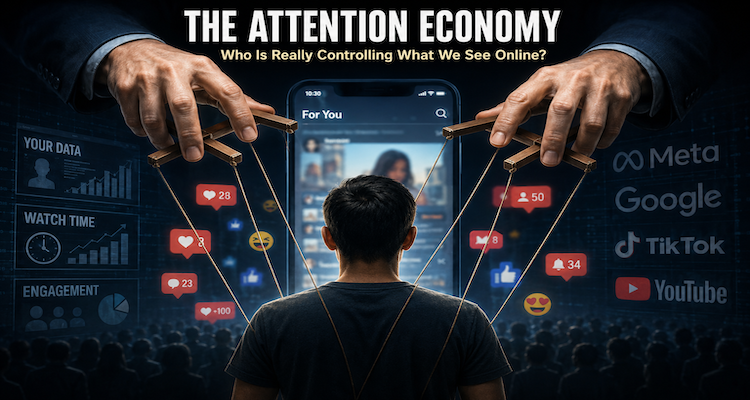
Open a social media app and the first decision has already been made: what appears on your screen. Some of it comes from people you chose to follow. Increasingly, however, much of it has been selected, ranked and delivered by systems designed to predict what will keep you watching, scrolling, clicking or returning.
That does not mean an algorithm is secretly controlling every thought or that users have no agency. The reality is more complicated and more important. What people see online emerges from a contest involving platforms, advertisers, creators, publishers, political actors, automated recommendation systems and users themselves. Yet these actors do not have equal power. The companies that design the ranking systems and define the business incentives behind them occupy a particularly influential position.
The debate has also moved beyond abstract concerns about “the algorithm.” European regulators are now examining whether highly personalised recommender systems and features such as infinite scroll, autoplay and notifications can create systemic risks. In July 2026, the European Commission preliminarily found Meta’s addictive design on Instagram and Facebook to be in breach of the Digital Services Act; the findings remain preliminary while the company exercises its rights of defence.
The deeper question is not simply whether algorithms control the internet. It is this: when attention has become a scarce and monetisable resource, who gets to decide what deserves it?
Key Takeaways
- Online feeds are shaped by a combination of algorithms, business incentives, advertisers, creators and user behaviour.
- Personalisation can increase engagement, but engagement is not the same thing as accuracy, public value or personal wellbeing.
- Recent EU action shows that recommender systems and addictive design are increasingly subjects of regulatory scrutiny.
- Users retain agency, but meaningful choice depends on how platforms design defaults, controls and alternatives.
- The real power struggle is increasingly about the rules that determine how attention is allocated.
The internet did not begin as an endless personalised feed
Earlier versions of the web were largely navigational. People typed an address, used a search engine, followed a hyperlink or visited a bookmarked website. Editors, webmasters and search rankings influenced discovery, but the user often made the first move.
The modern feed changed that relationship. Platforms increasingly organise information around prediction: what might you watch next, react to, share, buy or discuss?
This shift matters because recommendation systems are not merely filing cabinets for content. They actively rank and prioritise it. In an environment where more content is available than any individual could possibly consume, some form of selection is unavoidable. The crucial issue is therefore not whether selection occurs, but according to whose objectives.
A recommendation system may use many signals. These can include a user’s interactions, viewing history, connections, the characteristics of a piece of content and other contextual information. The exact systems vary across platforms and change over time. What users usually see is the output, not the full decision-making process.
That information gap is one reason transparency has become a major policy issue.
Under the European Union’s Digital Services Act, users of very large platforms have greater rights around recommender systems, including access to non-personalised feed options. The framework also requires greater transparency about how recommendations and advertising work.
Algorithms are powerful but they are not acting alone
It is tempting to describe “the algorithm” as if it were a single autonomous force deciding what society sees. That explanation is too simple.
Algorithms operate inside systems created by people and organisations. Someone decides what the platform should optimise. Someone chooses the metrics used to evaluate performance. Someone designs the interface, notification system and advertising model. Those decisions can influence the environment in which the recommendation system operates.
A useful way to understand the attention economy is to see it as a chain of influence:
Business model → product design → ranking incentives → creator behaviour → user behaviour → feedback data
Each stage affects the next.
If a platform rewards engagement, creators and publishers have incentives to produce material likely to generate interaction. Users then respond to what they are shown, and those responses create additional data that can influence future recommendations.
This does not mean every highly engaging piece of content is harmful or misleading. Entertainment, education and useful journalism can all attract substantial engagement. The problem is that engagement is a behavioural signal, not a universal measure of quality.
A 2026 theoretical study published in the Journal of Public Economics examined the trade-off between popularity-based ranking, engagement, misinformation and polarisation. Its model found that placing greater weight on social interactions could increase engagement while also increasing misinformation and polarisation under the assumptions of the model. That does not prove every real-world algorithm produces those outcomes, but it highlights an important structural tension: the objective that maximises attention may not be identical to the objective that best serves public understanding.
The hidden competition is over what gets rewarded
The attention economy does not only influence what users consume. It also shapes what gets produced.
Creators watch analytics. Publishers monitor traffic. Businesses study conversion rates. Political campaigns analyse reach. Advertisers measure response. These incentives can gradually shape editorial and creative decisions.
The result is a feedback loop in which visibility itself becomes a form of power.
A creator who understands the platform’s incentives may adapt more effectively than one who does not. A publisher that depends heavily on social referrals may face pressure to package information for distribution systems it does not control. A political message that triggers intense reactions may travel differently from one that requires slow reflection.
This is one reason the question of control should not be reduced to censorship.
Control can also operate through ranking.
A piece of content does not have to be removed to become effectively invisible. If it is consistently ranked below competing material, its reach may be limited without any formal ban. Conversely, a platform can dramatically increase the visibility of content without creating it.
For readers, this creates a subtle but important distinction between what exists online and what becomes easy to encounter online.
Those are not the same thing.
Personalisation can be useful and that is part of the challenge
The argument against algorithmic recommendations should not be overstated.
Without recommendation systems, users would face an even more overwhelming volume of information. Personalisation can help people discover music, educational videos, products, communities and reporting they might otherwise miss.
Research published in Telematics and Informatics in 2025 also illustrates why the issue is more nuanced than simply declaring personalisation harmful. In an experimental study involving 88 TikTok users, participants switched to a less personalised feed for one week. Their frequency and duration of use decreased, and they reported feeling more in control, but the less personalised experience was also perceived as less enjoyable.
That trade-off is revealing.
People may genuinely value the convenience and relevance produced by personalisation even while questioning the degree of control platforms exercise over the experience.
The policy challenge is therefore not necessarily to eliminate recommendation systems. It is to ask whether users have meaningful choices, whether the systems can be scrutinised and whether platforms are accountable for foreseeable harms associated with their design.
Why regulators are paying closer attention
European regulators have increasingly focused on the relationship between platform design, recommender systems and user wellbeing.
In February 2026, the European Commission preliminarily found TikTok’s addictive design to be in breach of the Digital Services Act, citing features including infinite scroll, autoplay, push notifications and highly personalised recommendation systems. The Commission emphasised that its findings were preliminary and did not determine the final outcome of the case.
The Commission reached similar preliminary findings regarding the addictive design of Instagram and Facebook in July 2026. The investigations place design choices not only individual pieces of harmful content under scrutiny.
That represents an important evolution in the debate.
For years, much of the public discussion focused on the question: Should this particular post be allowed online?
The newer question is broader: What happens when an entire system is designed to continuously predict and maximise attention?
The distinction matters because the risks may emerge from the interaction between ranking systems, interface design, notifications and user behaviour rather than from one isolated post.
The Digital Services Act also gives regulators tools to examine recommender-system transparency and systemic risks. The European Commission has requested information from major platforms about the parameters and functioning of their recommendation systems and their potential role in risks such as harmful “rabbit holes,” civic discourse problems and impacts on mental wellbeing.
News is now competing inside entertainment systems
Another consequence of the attention economy is that journalism increasingly competes for visibility alongside entertainment, influencers, advertising and personal updates.
Research from the Pew Research Center has documented how news-related content is encountered across major social platforms, reinforcing the role these services play in how many users come across information about current events.
This changes the environment in which journalism operates.
A newspaper homepage is built around an editorial hierarchy. A social feed may be organised around predicted relevance or engagement. Those systems can overlap, but they are not identical.
An editor may decide that a complex investigation deserves prominence because of its public importance. A recommendation system may have different signals to evaluate, including whether users historically watch, click, share or interact with similar material.
Neither model is perfectly neutral. Traditional media has always involved editorial judgment. The difference is that algorithmic distribution can operate at enormous scale, adapt rapidly to individual behaviour and remain difficult for ordinary users to inspect.
That makes media literacy more complicated than simply asking whether a source is trustworthy.
Readers may also need to ask:
- Why am I seeing this now?
- Is this appearing because I searched for it, chose to follow the source or because a platform predicted I would engage?
- What kinds of material might the ranking system be systematically showing me more often?
- What is absent from this feed?
These questions do not turn users into algorithm experts. They simply recognise that a feed is not the internet itself. It is a filtered view.
So who is really controlling what we see?
The honest answer is: no single actor controls everything, but control is unevenly distributed.
Platforms control the infrastructure and many of the ranking rules. Advertisers influence the economic incentives surrounding attention. Creators and publishers adapt to the systems that distribute their work. Users provide the behavioural signals that help personalise feeds. Governments and regulators increasingly influence the legal boundaries.
The most overlooked actor may be the business model.
A recommendation system does not exist in isolation from the organisation that deploys it. If attention drives advertising revenue, subscriptions, commerce or other commercial outcomes, the incentives surrounding attention become part of the design problem.
This is why arguments about algorithms can become misleading when they focus only on technical complexity.
The central issue is not simply, “How does the algorithm work?”
It is also:
What is it designed to optimise, what trade-offs does that objective create, and who has the power to change it?
The next battle may be over meaningful choice
The growing regulatory emphasis on non-personalised feeds and recommender-system transparency points toward a broader shift: users may increasingly demand not just the ability to leave a platform, but more control over how information is organised while they remain on it.
The EU already requires very large platforms to provide alternatives to profiling-based recommendation in relevant contexts, and its wider transparency framework is intended to make the systems governing online visibility more open to scrutiny.
But choice on paper is not always meaningful in practice.
A control buried inside multiple settings menus is different from a clear option presented at the moment a user chooses how to view a feed. Likewise, a chronological feed may offer an alternative, but it does not necessarily solve every problem associated with information overload.
The next phase of the attention economy may therefore depend less on whether algorithms disappear they almost certainly will not and more on whether users, researchers and regulators gain greater visibility into the trade-offs those systems make.
Conclusion
The attention economy is often described as a struggle between humans and algorithms. That framing misses the larger picture.
Algorithms are tools embedded within commercial, social and political systems. They respond to objectives, data and design choices created by people and organisations. Users influence those systems too, but they usually do so within environments whose basic rules they did not set.
The real question is not whether someone is controlling every item in your feed. It is whether the systems deciding what receives attention are transparent enough, accountable enough and flexible enough to serve interests beyond simply keeping people engaged.
That question is becoming harder to ignore. As regulators scrutinise recommender systems and addictive design, the debate is moving from individual posts to the architecture of attention itself.
For readers, the most practical lesson may be the simplest: your feed is not a neutral window onto the world. It is a version of the world assembled through choices some made by you, many made elsewhere.
This content is published for informational or entertainment purposes. Facts, opinions, or references may evolve over time, and readers are encouraged to verify details from reliable sources.