










Why Public Shaming Spreads So Quickly on Social Media
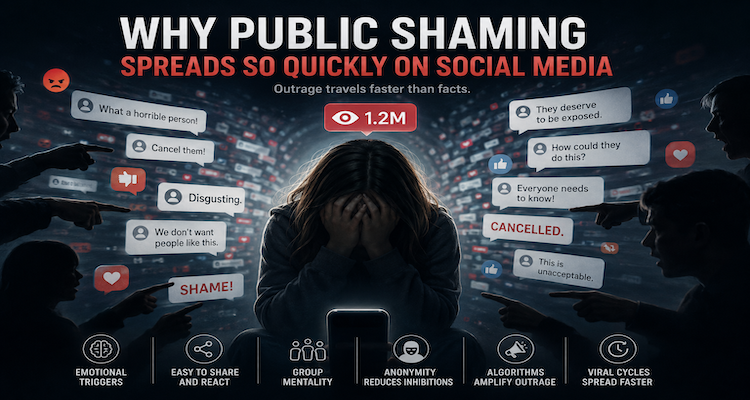
A stranger makes a mistake, an old video resurfaces, or a single post is interpreted as offensive. Within hours, the person can become the subject of thousands of comments, reposts, screenshots and demands for consequences.
Public shaming is not new. Communities have always used social disapproval to enforce social norms. What has changed is the speed, scale and permanence of digital communication. Social media can turn a local dispute into a global spectacle before the original context has been fully established.
The reason is not simply that people enjoy watching others being attacked online. Research suggests a more complicated interaction between human psychology and platform design. Moral outrage can encourage sharing, visible likes and reposts can reinforce particular forms of expression, and users may adapt their behavior to the emotional norms of the networks around them.
The result is an environment in which condemnation can sometimes spread faster than investigation. Understanding that process matters not only for the people targeted by online shaming, but also for anyone trying to judge whether the crowd has the full story.
Key Takeaways
- Moral-emotional language can increase the spread of messages within social networks.
- Likes, shares and other visible feedback can reinforce future expressions of online outrage.
- Social networks can create local norms that make intense condemnation appear socially expected.
- Public shaming often spreads through simplified narratives that travel more easily than context.
- The speed of online judgment can make correction and nuance less visible than the original accusation.
- Not every viral call-out is unjustified, but virality is not evidence that the crowd’s interpretation is correct.
Social Media Turns Moral Judgment Into a Shareable Signal
Public shaming usually begins with a perceived violation: something seen as cruel, dishonest, offensive, hypocritical or otherwise unacceptable. The initial reaction may be genuine moral disapproval. But once that reaction enters a social network, it becomes communication.
Sharing a post can signal more than agreement with its factual content. It can also communicate, “I recognize that this behavior is wrong.” A public response can therefore serve a social function, demonstrating one’s values to friends, followers or a wider community.
Research on the spread of moralized content helps explain why this matters. A widely cited study examining more than 563,000 social media communications found that moral-emotional language was associated with greater diffusion within social networks. The researchers reported that each additional moral-emotional word was associated with a 20% increase in diffusion in the dataset they studied. The effect was stronger within ideological groups than between them, highlighting the importance of shared group identity.
That does not mean every angry post becomes viral. Nor does it prove that a particular word mechanically causes a post to spread. But it does show that moral emotion can be an important part of how information travels online.
This creates an important distinction: a post can spread because people find it socially meaningful, emotionally satisfying or identity-affirming, not simply because it has been carefully verified.
The Feedback Loop Behind Online Outrage
One reason public shaming can accelerate is that social platforms make approval highly visible.
A user posts an angry response. Other users like it, share it or respond positively. Those signals can function as social reinforcement. A 2021 study combining observational research involving 7,331 Twitter users and 12.7 million tweets with preregistered behavioral experiments found that positive social feedback for expressions of moral outrage was associated with a greater likelihood of future outrage expression.
The researchers also found evidence that people adjust their expressions to the norms they observe in their online networks. In other words, users are not responding only to the original event. They are also learning what kinds of reactions appear normal and rewarded within their particular social environment.
This is one of the more important ways to understand digital pile-ons.
A person does not necessarily decide in isolation, “I should join this attack.” They may enter a feed where hundreds of similar reactions are already visible. Repetition can create the impression that there is an overwhelming consensus about what happened, what it means and what punishment is appropriate.
The crowd then becomes part of the information environment influencing the next participant.
Why Context Often Loses the Race
A complete explanation is usually slower than an accusation.
Context may require reading a full conversation, checking a date, identifying whether a video has been edited, understanding a cultural reference or waiting for additional evidence. A viral call-out can often be compressed into a screenshot and a sentence.
That asymmetry matters because social media rewards material that can be quickly consumed and easily redistributed.
A study of an online outrage episode involving reactions to a school-based survey found that fewer than 10% of comments contained factual information, while a substantial share of comments relied on assumptions or misinformation about what had occurred. The case cannot be treated as proof that all online shaming works this way, but it illustrates how a rapidly developing digital controversy can become dominated by reactions rather than factual clarification.
Once a simplified narrative has spread widely, later corrections face a structural problem: people must encounter them separately, and the correction may be less emotionally compelling than the original accusation.
This is why the most damaging stage of public shaming may occur before anyone has established whether the available evidence is complete.
The Crowd Is Not Always Chasing the Same Goal
It is tempting to describe every online pile-on as “cancel culture” or every act of public criticism as bullying. Neither description is precise enough.
Public criticism can expose genuine misconduct, challenge powerful institutions and draw attention to behavior that might otherwise remain hidden. Moral outrage can also support collective action and social accountability. The same research that examines the amplification of outrage recognizes that moral outrage can have constructive social functions.
The problem begins when accountability becomes detached from proportionality, evidence or the ability to distinguish an action from an entire person’s identity.
In a large-scale study of political social media engagement, researchers found that language directed at political out-groups was strongly associated with engagement. The study argues that group-based animosity can be a powerful driver of online attention.
This helps explain why some controversies become especially intense. A disputed individual may stop being viewed primarily as a person who made a particular mistake and instead become a symbol of a disliked group, ideology or social category.
At that point, the original facts can become secondary to the larger conflict.
Platform Design Does Not Need to “Want” a Pile-On
A common assumption is that an algorithm must deliberately promote outrage for outrage to spread. The reality can be more complicated.
Platforms that use engagement signals to determine what users see can amplify material that generates strong reactions, even without a system explicitly deciding that a particular person should be publicly shamed. The American Psychological Association notes that systems prioritizing engagement can favor content that provokes negative emotions such as anger and outrage.
This is an important distinction. The platform may be responding to measurable behavior clicks, replies, shares and viewing patterns while users experience the result as a feed increasingly dominated by emotionally charged material.
Human behavior and platform incentives can therefore form a feedback system:
- A provocative accusation receives attention.
- Attention increases visibility.
- Greater visibility attracts more reactions.
- The visible reaction signals that the issue is important.
- New participants encounter an already emotional environment.
No single participant has to coordinate the entire process.
Public Shaming Also Changes the Cost of Participation
Joining an online condemnation campaign is often easier than confronting someone in person.
A repost may take seconds. A comment can be written without knowing the person being discussed. Participants may never witness the cumulative scale of the attack because each individual sees only their own contribution.
But the target experiences the combined result.
This creates what might be called a scale gap: the psychological cost of one additional comment to the participant can feel trivial, while thousands of individually trivial actions can produce an overwhelming collective effect.
That does not mean every criticism should be suppressed. It means the experience of participating in a crowd is fundamentally different from being its target.
The design of social platforms can also blur the line between discussion and punishment. Reporting harmful content, criticizing a public figure and encouraging accountability are different actions from harassment, threats or sustained attempts to humiliate someone. Yet these behaviors can become mixed together once a controversy attracts a large audience.
Research into moral judgments of objectionable online content similarly suggests that users’ decisions about reporting and punishment are influenced by how morally negative they perceive the content to be and by the poster’s apparent intention.
The implication is that online punishment is not simply random aggression. It is often connected to moral interpretation—but moral interpretation can still be mistaken, incomplete or manipulated.
The Overlooked Risk: Virality Can Look Like Verification
Perhaps the most dangerous misunderstanding is treating widespread agreement as evidence that the underlying claim has been established.
A viral post can create several misleading impressions at once:
- Many people believe it, which may be mistaken for proof that it is true.
- Many people are angry, which may be mistaken for proof that the response is proportionate.
- The story is everywhere, which may be mistaken for proof that the facts have been independently confirmed.
These are different things.
Social media is exceptionally effective at measuring attention. It is much less reliable as a measure of truth, context or proportionality.
That distinction becomes especially important when the target is an ordinary person rather than a powerful institution. Public figures may have communication teams, legal resources or established audiences. A private individual caught in a viral controversy may have no comparable ability to correct the record.
The consequences can also outlast the controversy itself. Screenshots, search results and reposted fragments may remain accessible long after public attention has moved elsewhere.
How to Slow Down the Shaming Cycle
Users cannot control every viral controversy, but they can change how they participate in one.
Before reposting a call-out, a few questions are worth asking:
- What is the original source of this claim?
- Am I seeing the full video, conversation or timeline?
- Has the allegation been independently verified?
- Is criticism focused on a specific action, or has it become dehumanizing?
- Does this post add useful information, or am I simply amplifying the crowd?
- Would I make the same judgment if the target belonged to a group I supported?
These questions do not require people to become indifferent to wrongdoing. They create a pause between feeling moral outrage and helping distribute it.
That pause is increasingly valuable in an information environment designed around immediate reaction.
Conclusion
Public shaming spreads quickly because social media combines several powerful forces: moral emotion, social signaling, visible feedback, group norms and systems that can reward engagement.
The deeper lesson is not that outrage is inherently irrational or that public criticism is always harmful. Societies need ways to challenge misconduct. The problem arises when the speed of collective judgment exceeds the speed of verification, context and proportionality.
On social media, joining the crowd can feel like a small individual act. But digital platforms combine millions of such acts into something far larger. Understanding that gap may be the first step toward using public criticism more responsibly and toward remembering that a viral consensus is still not the same thing as a complete account of the truth.
This content is published for informational or entertainment purposes. Facts, opinions, or references may evolve over time, and readers are encouraged to verify details from reliable sources.