










The Silent Generation Gap: How Technology Is Changing Family Conversations
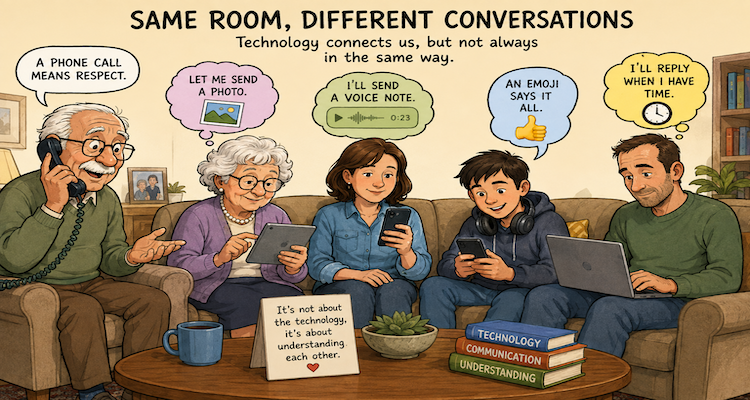
A family can sit in the same room and still inhabit very different communication worlds. One person may expect a phone call, another sends a voice note, a teenager replies with an emoji, and a grandparent may prefer a face-to-face conversation. The difference is not simply about screen time. It is increasingly about the rules, speed and expectations that technology has brought into everyday relationships.
Digital communication has expanded the number of ways families can stay connected, but it has also changed what people interpret as attention, politeness, availability and care. A missed call can feel different from an unread message. A short “OK” may be seen as efficient by one generation and dismissive by another. Family conversations now often require people to translate not only language and emotion, but communication habits shaped by different technologies.
Key Takeaways
- Technology has expanded family communication while creating different expectations about responsiveness and attention.
- Messaging, voice notes, video calls and social platforms can strengthen contact but may not provide the same depth as conversation.
- Generational tension often comes from differing communication norms rather than simple resistance to technology.
- Digital tools can exclude relatives when platforms change faster than people can comfortably adapt.
- Healthier family communication may depend on agreeing on expectations instead of assuming one generation’s habits are universally correct.
When a Message Means Something Different to Everyone
The modern family conversation no longer happens through one channel. A single family may use phone calls, SMS, WhatsApp-style messaging, video calls, social media, group chats and shared photos. That flexibility can be valuable, particularly when relatives live apart. But it also creates a less obvious problem: each generation may attach a different meaning to the same act of communication.
For one person, calling without warning is natural. For another, it can feel intrusive. A parent may interpret an unanswered call as a lack of concern, while an adult child may assume a message is enough. A younger relative may use a reaction emoji as acknowledgement; an older family member may see it as an inadequate response.
Research on communication technologies suggests these differences are not merely stereotypes about young and old people. Communication preferences, technology familiarity and the perceived quality of different media can shape how family members experience contact.
The important distinction is that more communication channels do not automatically produce better communication.
Technology Has Narrowed the Access Gap, but Not the Communication Gap
It would be misleading to describe older generations as simply “offline.” Technology adoption among older adults has increased substantially. Pew Research Center reported in 2026 that 78% of Americans aged 65 and older owned a smartphone, although ownership remained lower than among younger age groups.
That matters because the new generation gap is increasingly less about whether someone owns a device and more about how they use it.
A smartphone can support a traditional phone conversation, a quick text, a family group chat or a video call. Two relatives may therefore own essentially the same technology while using entirely different communication habits.
Research published in Technology in Society in 2025 examined long-distance relationships between younger adults and older family members. It found that different technologies were associated with different forms of perceived support. Among younger adults, video calls and SMS were associated with emotional and informational support, while social media use was associated with greater emotional support among older adults. The study also found that perceived support helped explain the relationship between technology use and family communication satisfaction.
The lesson is more nuanced than “texting is bad” or “video calls bring families closer.” The medium matters, but so does the way different family members experience that medium.
The New Source of Friction: Expectations
Technology has changed an important social question: What does it mean to be available?
A landline call once required two people to be present at the same time. A letter created an expectation of delay. Messaging changed that rhythm. A person can now see a message immediately but respond hours later. Read receipts, online indicators and typing notifications can make silence visible.
That creates opportunities for misunderstanding.
A delayed reply may result from work, sleep, distraction or a simple desire to answer later. Yet the technology can make the delay appear deliberate because the sender may know that the message was delivered or read.
The resulting tension is often described as a generation problem, but it can be better understood as a mismatch of communication expectations:
- Some people value immediacy.
- Some value uninterrupted time.
- Some prefer conversation before messaging.
- Some use messages mainly for practical coordination.
- Others use frequent short messages as a sign of emotional closeness.
Families can have disagreements even when everyone is comfortable using technology. The disagreement is often over the unwritten rules surrounding it.
Why More Advanced Technology Does Not Always Create Better Conversations
There is a common assumption that richer technology should produce richer communication. Video calls, for example, provide visual cues that text messages do not. Yet research suggests that the relationship is more complicated.
A 2022 study examining communication between grandparents and grandchildren found that face-to-face and telephone communication were reported most frequently, while more technologically advanced media did not automatically receive higher evaluations for communication quality. The researchers noted that a seemingly “lean” medium, such as a text message, can still create a meaningful experience, while richer technology does not automatically improve a relationship.
Another study in The Gerontologist found that technology-mediated communication did not simply replicate the effects of face-to-face family contact for older adults.
That does not mean digital communication is ineffective. It means that technology cannot be judged only by the number of features it offers.
A brief message sent at the right moment may feel deeply personal. A scheduled video call may feel formal or exhausting. A phone call can provide reassurance that a long chain of messages cannot. The quality of communication depends on context, relationship and personal preference.
Family Group Chats Have Created a New Shared Space
One of technology’s most significant changes to family life is the group chat.
Unlike the family phone call, the group chat is persistent. Conversations can continue throughout the day. Photos, announcements, jokes and practical updates accumulate in a shared digital space.
This can make geographically separated families feel more connected. But group chats also reveal another difference between generations: not everyone participates in the same way.
One family member may send ten messages a day. Another may read everything and rarely respond. A third may mute the conversation because of work. Silence in a group chat is therefore difficult to interpret.
The technology records participation, but it does not explain absence.
That distinction is important. Digital platforms can create the appearance that communication is measurable: who replied, who reacted, who viewed the photo. Yet these signals are imperfect measures of care, interest or emotional connection.
The Digital Divide Has Become More Complicated
The traditional digital divide focused on access: who had an internet connection, computer or smartphone.
That problem has not disappeared. Pew’s research continues to show differences in technology access and use by age and other demographic factors, even as adoption has grown.
But family communication now faces a second divide: confidence and comfort.
A person may own a smartphone without feeling comfortable changing privacy settings, joining a video call, recovering an account or adapting when an app changes its interface. Research using European data published in 2026 found that family support and intergenerational contact were associated with internet access and digital skills among older people, although the relationship between support and technology use was not simply linear.
This creates an overlooked role for younger relatives. They are often not merely communicating through technology; they may also become informal technology support for the family.
That support can strengthen connection, but it can also create frustration when help feels rushed, patronising or overly technical.
The most effective approach may be less about teaching every feature and more about helping someone use the tools that genuinely matter to them: making a video call, sharing a photograph, sending a voice message or staying connected with family.
Technology Is Also Giving Families More Ways to Bridge Distance
The story is not one of decline. Digital communication can solve a problem that earlier generations simply had to accept: physical separation.
A 2024 randomized controlled study involving older adults and family members found preliminary evidence that a technology-supported intervention could increase contact frequency among younger family members and encourage intergenerational technology use. The researchers also found that satisfaction with online phone calls was associated with greater use and perceived usefulness of communication technology.
The important word is preliminary. Technology alone does not guarantee stronger relationships.
But when people receive support in using tools and find those tools genuinely useful, technology can reduce some of the barriers created by distance.
This is especially relevant for families spread across cities and countries. A video call cannot replace physical presence, but it can allow grandparents to see a child grow up in ways that a traditional long-distance phone call could not.
The Real Challenge Is Translation Between Communication Cultures
The deepest generation gap may not be technological at all.
It is cultural.
Every communication technology develops its own etiquette. Younger people may understand the meaning of a reaction, disappearing message or short voice note instinctively because they have grown up with these formats. Older relatives may bring expectations developed around letters, landline calls and face-to-face conversations.
Neither approach is inherently superior.
The practical challenge is recognising that different habits can communicate the same intention. A young person who prefers texting may still care deeply. An older relative who repeatedly calls may be seeking connection rather than trying to interrupt.
Families can reduce unnecessary friction by making expectations explicit:
- Say whether a call is urgent before assuming an immediate answer.
- Recognise that a delayed reply is not automatically a sign of neglect.
- Use the communication method that works best for the situation.
- Avoid treating technological fluency as a measure of intelligence or relevance.
- Make room for both digital contact and uninterrupted, deeper conversation.
These are small adjustments, but they address a problem technology itself cannot solve: people often assume that others understand the meaning they attach to a message.
Conclusion
Technology has not silenced family conversations. In many cases, it has made them more frequent, more immediate and possible across greater distances than ever before.
The quieter change is that families now communicate through different systems of expectation. The same smartphone can represent convenience to one person, pressure to another, emotional connection to a third and an unfamiliar obligation to someone else.
That is why the generation gap should not be reduced to a simple story of older people resisting technology and younger people embracing it. The more important question is whether families can build shared rules around tools that each generation experiences differently.
The strongest family conversations may depend less on choosing between a phone call and a text message than on understanding what the other person expects when they reach out.
This content is published for informational or entertainment purposes. Facts, opinions, or references may evolve over time, and readers are encouraged to verify details from reliable sources.