










Karma Yoga Explained: How to Work Without Becoming Attached to Results
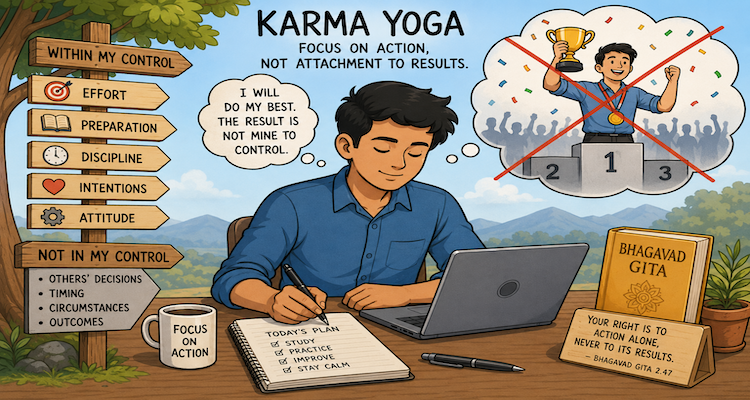
Most people understand work through results: the promotion, the profit, the examination score, the recognition, or the visible success that proves an effort was worthwhile. Karma Yoga, one of the central paths described in the Bhagavad Gita, challenges that instinct. It asks a difficult question: Can a person give full attention to the work itself without allowing the outcome to determine their inner peace?
This does not mean becoming indifferent, careless, or unambitious. The Gita’s idea is more demanding. It calls for disciplined action, ethical responsibility, and engagement with one’s duties while recognizing that results are influenced by factors beyond individual control.
That distinction makes Karma Yoga more practical than the popular phrase “do your duty without expecting anything in return” may suggest. The real challenge is not to stop caring about results. It is to stop becoming psychologically dependent on results that cannot be completely controlled.
Key Takeaways
- Karma Yoga emphasizes wholehearted action while reducing attachment to outcomes beyond one’s complete control.
- The Bhagavad Gita does not promote laziness or indifference; it repeatedly connects disciplined action with responsibility and self-mastery.
- Detachment from results can help separate effort from anxiety, because effort and outcome are not entirely the same thing.
- Karma Yoga asks people to examine motivation, including whether fear, ego, reward, or duty is driving their actions.
- Its modern relevance lies in focusing attention on the quality of present action rather than treating every result as a measure of personal worth.
What Karma Yoga Actually Asks of Us
The best-known statement associated with Karma Yoga appears in Chapter 2, Verse 47 of the Bhagavad Gita:
“Your right is for action alone, never for the results.”
The verse also adds an important qualification: one should not make the fruits of action the sole motive, nor become attached to inaction.
That final point is often overlooked.
Karma Yoga is not an instruction to withdraw from life because outcomes are uncertain. Nor is it an excuse for poor planning. The teaching is directed against a different problem: allowing one’s emotional stability, identity, or sense of purpose to become completely dependent on a particular result.
A student can prepare carefully and still face an unexpected examination. An employee can perform well and still lose an opportunity because of organizational decisions. A business owner can make sound decisions and still encounter market conditions beyond personal control.
Karma Yoga begins by distinguishing what belongs to the individual and what does not.
The individual can influence preparation, attention, effort, conduct, and the quality of a decision. But the final outcome may also depend on other people, circumstances, timing, and conditions that cannot be commanded.
The teaching does not deny the importance of results. It challenges the belief that results are fully ours to possess.
Detachment Is Not the Same as Indifference
One of the biggest misunderstandings surrounding Karma Yoga is the idea that detachment means not caring.
The Gita argues for the opposite of passive disengagement. In Chapter 3, action is repeatedly emphasized. Verse 3.19 instructs the individual to perform the action that ought to be done without attachment. The broader teaching of the chapter presents disciplined action not inactivity as the path under discussion.
This creates an important distinction:
| Attachment to results | Detachment from results |
|---|---|
| “I must get this result to be at peace.” | “I will work seriously, while accepting that the result is not entirely mine to control.” |
| Fear of failure can dominate the action. | Attention returns to preparation and responsible action. |
| Success may produce excessive ego; failure may produce excessive self-condemnation. | Results can be evaluated without making them the complete measure of personal worth. |
| The outcome becomes the only reason for acting. | Duty, values, responsibility, and the quality of action also matter. |
This is why Karma Yoga should not be confused with a lack of ambition.
A surgeon should still aim for the best possible outcome. An entrepreneur should still measure performance. A student should still want to succeed. A writer should still care whether the work reaches readers.
Karma Yoga does not remove standards. It changes the relationship with them.
You can pursue a goal intensely without allowing the goal to become a psychological condition for peace.
The Gita’s Deeper Shift: From Possession to Responsibility
The modern interpretation of success often encourages ownership of outcomes: I created this result; therefore, it defines me.
Karma Yoga introduces a more complicated view of action.
The emphasis is on responsibility for one’s conduct rather than ownership of every consequence. That distinction matters because action takes place within a larger network of causes and conditions.
This does not eliminate accountability. If a person acts carelessly, dishonestly, or incompetently, “detachment” cannot be used to avoid responsibility. Karma Yoga is not a philosophy of excuses.
Instead, it asks a more disciplined sequence of questions:
- What is my responsibility here?
- What action is actually within my control?
- Have I prepared properly?
- Is my conduct aligned with my values and duties?
- Have I become so obsessed with the reward that fear or desire is damaging the quality of my work?
These questions move attention from “How do I guarantee the outcome?” to “How do I perform this action as well as I can?”
That shift can be especially useful in situations where the outcome cannot be guaranteed.
Why Attachment Can Distort the Work Itself
Attachment to results does not always improve performance. Sometimes it can interfere with it.
Consider an interview. Preparation is useful. But once the mind becomes consumed with I must get this job, attention may shift away from listening, communicating clearly, and responding thoughtfully.
The same pattern can appear in creative work. A writer who thinks only about popularity may begin making every editorial decision around anticipated approval. A person focused entirely on recognition may gradually confuse visibility with the value of the work.
Karma Yoga offers a counterweight: bring ambition to the work, but do not let anticipated reward take control of the mind.
This is not a claim that detachment automatically produces success. The Gita does not offer Karma Yoga as a technique for guaranteeing promotions, profits, or victories.
Its promise is philosophical and spiritual rather than transactional. The practice concerns the way a person acts and relates to the consequences of action.
That difference is essential. Karma Yoga should not be reduced to a productivity strategy promising better results. It is a discipline for acting without becoming enslaved by the constant demand for results.
Work Without Attachment Does Not Mean Work Without Goals
Goals remain useful.
A person needs a destination to plan effectively. Organizations require measurable objectives. Athletes need performance targets. Researchers need hypotheses and methods.
The problem begins when a goal changes from a guide into an emotional absolute.
A practical reading of Karma Yoga may therefore look like this:
Set the goal
Know what you are trying to achieve. Define success clearly enough to guide your decisions.
Focus on the process
Identify the actions that are genuinely within your control: preparation, practice, discipline, communication, and ethical conduct.
Accept uncertainty
Recognize that even excellent effort cannot control every variable.
Learn from the result
Detachment does not mean ignoring feedback. If the result is poor, study why. Correct mistakes. Improve the next action.
Begin again without carrying excessive psychological baggage
Failure does not have to become permanent self-definition, and success does not have to become permanent self-importance.
This approach preserves the practical value of outcomes without allowing them to become the sole basis of identity.
Karma Yoga and the Question of Duty
Another important feature of the Gita’s teaching is the idea of kartavya, or action that ought to be performed.
Chapter 18 describes a form of renunciation in which a prescribed or necessary action is performed because it should be done, while attachment and desire for its reward are relinquished.
This adds an ethical dimension to Karma Yoga.
The question is not simply: What will benefit me?
It can also become: What is the responsible action in this situation?
That distinction is significant in professional and personal life. Many necessary actions offer no immediate reward. Caring for family, correcting a mistake, completing an unpopular responsibility, or doing honest work when recognition is unlikely may all involve action that is not driven purely by personal gain.
Karma Yoga gives such action a different foundation.
The value of the work does not disappear simply because applause does not arrive.
A Modern Practice: Separate Effort From Outcome
The philosophy can be difficult because human beings naturally prefer certainty. We want our effort to produce a predictable reward.
Karma Yoga does not offer that certainty. Instead, it asks for a different discipline: commit fully to the part that is yours and release the illusion that everything else can be controlled.
A simple way to apply this principle is to review any important task in two columns.
Within my control:
- Preparation
- Time and attention
- Skill development
- Honesty and effort
- The decisions I make
Not completely within my control:
- Other people’s choices
- Timing
- Competition
- Unexpected circumstances
- The final response to my work
The purpose is not to stop caring about the second list. It is to stop wasting all mental energy trying to possess it.
That may be the most practical insight Karma Yoga offers: detachment is not doing less. It is refusing to let anxiety over the uncontrollable weaken the quality of what can still be done.
Conclusion
Karma Yoga is sometimes reduced to a simple slogan: work without expecting results. The fuller teaching is more demanding.
It asks people to act, to fulfill responsibilities, to pursue excellence, and to avoid attachment to inactivity. At the same time, it asks them to recognize the limits of personal control and to loosen the emotional grip of success and failure.
The result is not passivity. It is a different form of commitment.
You still prepare. You still compete. You still build, study, create, and strive. But the outcome is no longer allowed to become the sole judge of whether your effort had value.
In that sense, Karma Yoga offers a difficult but enduring discipline: give your best to the action in front of you, learn from whatever follows, and do not surrender your peace of mind to results that were never entirely yours to control.
This content is published for informational or entertainment purposes. Facts, opinions, or references may evolve over time, and readers are encouraged to verify details from reliable sources.