










Why Historic Roots Still Matter in a World Built for the Future
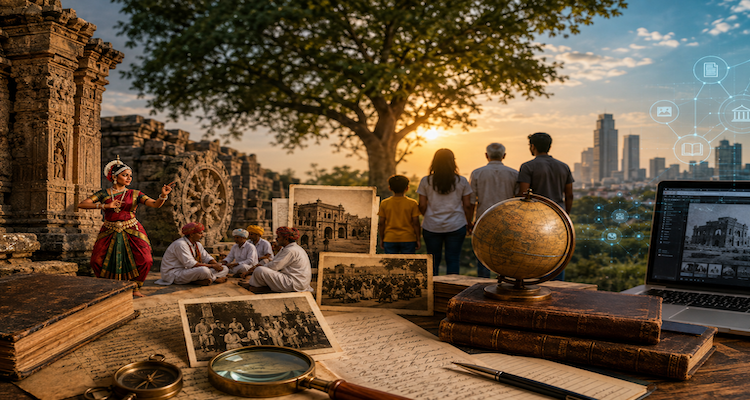
The most visible forces shaping modern life often appear new: digital platforms, artificial intelligence, global networks, automated systems and rapidly changing cultural habits. Yet many of the ideas behind them are much older. The institutions people trust, the traditions communities preserve, the records governments maintain and the knowledge societies pass between generations all carry traces of earlier choices.
That is why history is more than a record of what happened. It is part of the infrastructure through which societies understand identity, make decisions and adapt to change.
UNESCO describes heritage as a connection between past, present and future, while its Memory of the World programme treats documentary heritage as a foundation for collective memory, research and informed decision-making. The deeper lesson is straightforward: progress does not erase the past. It builds on it, reacts against it or sometimes repeats it.
Key Takeaways
- Historic knowledge helps societies understand how present institutions, traditions and ideas came to exist.
- Cultural heritage can strengthen identity while still adapting to changing social conditions.
- Historical records are evidence that can support rights, accountability and informed public decisions.
- Preserving the past is not simply about protecting old objects; it can preserve knowledge, memory and continuity.
- Primary sources help people distinguish historical evidence from later interpretation or simplified narratives.
- The lasting value of history lies in how intelligently societies use it to navigate change.
History Is More Than a Record of the Past
History is often reduced to dates, names and major events. That approach can make the past appear distant from everyday life.
In reality, much of modern life is built on inherited decisions.
Political institutions, legal systems, scientific traditions, languages, architecture, education systems and cultural practices did not emerge fully formed. They developed through layers of experimentation, conflict, adaptation and transmission.
The Library of Congress describes primary sources as the original documents and objects created during the period being studied. Examining such material can expose people to multiple perspectives and encourage them to question evidence, make inferences and develop reasoned explanations.
That distinction matters because historical understanding is not simply about remembering what someone says happened. It is also about asking what evidence exists, who created it, what perspective it represents and what may be missing.
History therefore becomes a form of critical thinking.
Cultural Roots Survive by Changing
One of the misconceptions about heritage is that preserving a tradition means keeping it exactly as it was.
Living cultures rarely work that way.
UNESCO defines intangible cultural heritage as practices, knowledge and expressions recognized by communities as part of their cultural identity. Such traditions are transmitted across generations but also adapt over time.
That flexibility helps explain why festivals, rituals, craftsmanship, oral traditions, music and other cultural practices can survive for centuries despite major social changes.
A tradition that cannot adapt may gradually lose practitioners. A tradition that remains meaningful can change its form while retaining its central identity.
UNESCO notes that social practices and rituals can reinforce a community’s sense of identity and continuity with the past, while also being affected by migration, formal education, globalization and other changes in modern society.
The important distinction is between preserving meaning and freezing appearance.
A community can use modern technology to document an old craft. A museum can digitize historical material. Younger generations can reinterpret traditional art through contemporary forms. None of these necessarily represents the disappearance of heritage. They can instead become mechanisms through which heritage survives.
Records Turn Memory Into Evidence
Memory is powerful, but memory alone is not enough.
Historical records provide something different: evidence that can be examined, compared and revisited.
The U.S. National Archives explains that records can document government actions, rights, identities and historical events. It also emphasizes their importance for accountability and democratic government.
This principle extends beyond government archives.
A family photograph can reveal how people lived. A letter can show how an event was understood at the time. A map can reveal how a landscape changed. A newspaper can capture the assumptions of a particular period. A business record can demonstrate how an organization operated.
The value of such material increases when it is preserved alongside context.
A document without provenance can be difficult to interpret. A photograph without a date or location may lose much of its historical usefulness. A digitized archive without reliable metadata can be difficult to search and verify.
Preservation, therefore, is not simply storage. It is the maintenance of evidence and context.
Why This Matters in the Digital Age
The digital era has created an extraordinary paradox.
More information can be produced, copied and distributed than ever before, yet digital abundance does not automatically guarantee historical understanding.
Web pages disappear. Digital formats become obsolete. Platforms change ownership or policies. Social-media posts can lose their original context. Images can circulate without dates or sources. Automated systems can reproduce information without making its origins clear.
UNESCO’s Memory of the World programme was created to help preserve documentary heritage and expand access to it. The programme’s international register had grown from 38 inscriptions in 1997 to 570 in 2025, illustrating the scale of the effort to identify and protect globally significant documentary heritage.
The challenge is no longer simply whether information exists.
It is whether future generations will be able to determine what the information was, where it came from and why it mattered.
That question becomes especially important as more of the contemporary historical record is born digitally.
Heritage Can Shape Resilience
The relationship between the past and the future becomes particularly visible when communities face disruption.
UNESCO research and programmes increasingly examine heritage not merely as something to protect but as a resource that can contribute to community resilience. One UNESCO-supported initiative, for example, describes “active memory” and intergenerational learning as ways collective memory can strengthen belonging and support communities dealing with disasters.
This does not mean heritage automatically makes communities resilient. Nor does it mean the past provides ready-made solutions to modern problems.
The more defensible insight is narrower: knowledge accumulated across generations can contain practices, relationships and forms of local understanding that remain useful when circumstances change.
That can include knowledge of landscapes, traditional craftsmanship, social organization, local environmental conditions or community responses to earlier disruptions.
The past can therefore function as a resource rather than simply a museum exhibit.
The Risk of Losing Context
Preservation itself is not enough.
History can be selectively remembered, simplified or presented without the voices of people who experienced it differently.
That makes context essential.
Museums and heritage sites can provide opportunities for people to encounter objects and stories from different perspectives. UNESCO has recently emphasized their potential as spaces for dialogue and intercultural understanding, particularly because collections can connect people with histories and identities across generations.
A responsible approach to heritage should therefore ask difficult questions.
Whose story is being preserved?
Who created the record?
Who was excluded from it?
What evidence contradicts the dominant interpretation?
How has the meaning of an object or tradition changed?
These questions do not weaken history. They make historical understanding more rigorous.
From Inheritance to Responsibility
Every generation receives an inheritance it did not create.
Some of that inheritance is visible: buildings, monuments, books, artworks, tools and archives.
Some is less tangible: languages, customs, knowledge, institutions, values and collective memories.
The responsibility of one generation is not necessarily to preserve everything unchanged. It is to understand what has been inherited, determine what remains valuable, recognize what should be questioned, and ensure that important evidence is not unnecessarily lost.
That requires both preservation and interpretation.
Digital technology can help enormously. Archives can be digitized. Fragile documents can be reproduced. Historical collections can become accessible to audiences far beyond their original locations. Researchers can compare materials across borders and disciplines.
But technology cannot decide what a society should remember or how a historical record should be interpreted.
Those remain human questions.
The Future Still Needs the Past
Modern societies often measure progress by what is new: faster systems, newer technologies, larger networks and more sophisticated tools.
But innovation does not happen in an empty space.
Scientific knowledge builds on earlier discoveries. Institutions evolve from earlier institutions. Languages carry older meanings into new environments. Cultural practices survive by adapting. And public decisions are often shaped, consciously or unconsciously, by memories of what happened before.
The most useful relationship with history is therefore neither blind nostalgia nor complete rejection.
It is informed continuity.
Understanding historic roots allows people to see why the present looks the way it does. Preserving evidence makes it possible to challenge inaccurate memories. Protecting living traditions can maintain connections between generations. And examining the past critically can help societies recognize patterns without assuming that history will repeat itself exactly.
The lasting impact of history is not simply that old things remain.
It is that the choices, knowledge, identities and evidence carried forward from earlier generations continue to influence what becomes possible next.
Conclusion
Historic roots matter because societies are cumulative. Every generation inherits structures, knowledge and memories, then modifies them before passing something forward.
The challenge is to make that inheritance conscious.
Preserving history should not mean living in the past. It should mean retaining enough evidence, knowledge and cultural memory to understand where present choices came from and to make better-informed choices about what comes next.
In that sense, the past is not merely behind us. It is part of the context through which the future is built.
This content is published for informational or entertainment purposes. Facts, opinions, or references may evolve over time, and readers are encouraged to verify details from reliable sources.