










Why Some Languages Survived Empires That Tried to Replace Them
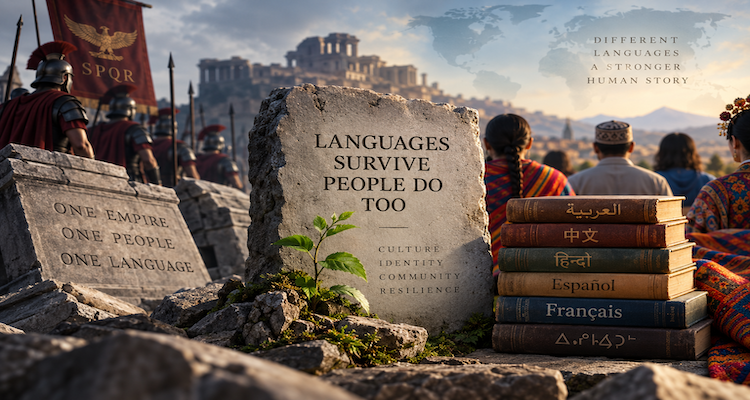
Political power can change borders, laws, schools and official institutions remarkably quickly. Language is harder to replace.
Across history, empires and centralized states have often elevated one language above others because a common administrative language can make government, education, commerce and political integration easier. In Wales, for example, the Tudor-era Laws in Wales Acts made English the language of law and restricted access to public office for people who did not use English. In the Andes, Spanish colonial rule created powerful pressures toward Castilianization. Under Francisco Franco, Basque language and cultural expression faced severe restrictions in Spain.
Yet Welsh, Basque and Quechua did not simply disappear.
That survival reveals something important about political power: a state can control the institutions where a language is used without necessarily controlling every family, community, religious tradition, cultural practice or social network through which the language is transmitted. Language survival is therefore less a story of vocabulary resisting vocabulary than of communities preserving the conditions under which children continue to learn and use a language.
Key Takeaways
- Political suppression can weaken a language dramatically without automatically ending intergenerational transmission.
- Families and local communities can preserve languages even when governments favor another language in public life.
- Written traditions, religious institutions, schools and cultural organizations can create durable language-supporting networks.
- Survival does not mean a language escaped decline; Welsh, for example, remains under pressure despite institutional revival.
- The strongest protection is not simply the number of speakers but the ability to use a language across generations and social domains.
Empires Could Control Institutions Without Controlling Every Conversation
Language shift usually happens when people increasingly need another language to participate in education, employment, administration, commerce or social advancement.
Sociolinguists therefore distinguish between knowing a language and maintaining it as a community language. A language can remain recognizable for generations while steadily losing the domains in which people use it.
UNESCO’s framework for assessing language vitality places particular emphasis on intergenerational transmission, alongside speaker numbers, domains of use, response to new media, and educational and literacy resources. In other words, counting speakers alone cannot tell the whole story.
This helps explain an apparent paradox.
A government can make one language compulsory in courts or schools, but a family may continue using another language at home. A religious community may preserve texts in that language. Neighbors may use it in markets. Local writers may produce books. Songs, ceremonies and place-names may reinforce it.
Over time, these separate practices can form what amounts to a social infrastructure for linguistic survival.
The reverse is also possible. If parents stop passing a language to their children because the dominant language offers greater economic or educational opportunities, political pressure no longer needs to be overt. Language shift can continue through ordinary decisions about work, school and family life. Research on language maintenance consistently identifies family transmission and the domains in which a language can be used as central factors.
Wales Shows How Suppression and Survival Can Coexist
Welsh offers one of the clearest examples.
Following the integration of Wales into the English legal and political system, the Laws in Wales Acts of 1535 and 1542 made English the language of law and required people holding public office to use English. The legal system consequently created powerful incentives for English.
But the language survived outside those institutions.
Welsh remained embedded in communities, families, religious life and local culture. One particularly important development was the availability of major religious texts in Welsh. A Welsh New Testament appeared in 1567, followed by William Morgan’s influential Welsh Bible translation in 1588. Cadw notes that the translation helped establish Welsh literacy and played an important role in the language’s survival.
That distinction matters.
The state could determine the language of a court proceeding. It could make English economically and administratively advantageous. But it could not instantly remove Welsh from every household or cultural setting.
The long-term result was neither complete survival nor complete replacement. Welsh declined substantially.
Official census data show that nearly a million people aged three and over could speak Welsh in 1921. The number eventually fell to about 503,500 in 1981 before rising again through 2001; in 2021, 538,300 people aged three and over reported that they could speak Welsh, equivalent to 17.8% of the population of Wales. The 2021 proportion was the lowest recorded in a census, illustrating how institutional revival does not automatically reverse demographic decline.
At the same time, Welsh has acquired stronger formal institutional protection. The Welsh Language Act 1993 established equality principles for Welsh and English in public business and justice, while the Welsh Language (Wales) Measure 2011 strengthened the language’s official status and created the Welsh Language Commissioner.
The lesson is not that Welsh “defeated” English.
It is that language survival can persist through periods of political disadvantage, followed later by institutional rebuilding.
Basque Survival Was Closely Tied to Community and Identity
Basque presents a different but related case.
Euskera survived on both sides of the Franco-Spanish border despite long periods in which Spanish or French possessed far greater institutional power. During Francisco Franco’s dictatorship, restrictions on Basque cultural expression were particularly severe. Research on Basque society documents restrictions on the public use of Euskera, including restrictions affecting advertising, branding and names.
Yet repression did not erase the language.
One reason was that Basque was not merely a language of formal administration. It remained connected to local communities and identity. During the Franco period, activists also developed informal and sometimes underground educational initiatives intended to maintain transmission and expand use.
After political conditions changed, another factor became important: institutional capacity.
Research on Basque language policy in the French Basque Country found that language activism, civil society, political institutions and cross-border connections helped create conditions for institutionalizing support for Euskera.
In the Spanish Basque Country, language normalization policies similarly sought to increase the domains in which Basque could be used rather than treating survival as simply a matter of encouraging people to “speak Basque more.”
That distinction is crucial.
A language becomes vulnerable when it is restricted to fewer and fewer situations. A child might understand it at home but need Spanish at school, work and public institutions. Eventually, the dominant language becomes the easier language for the next generation.
Revitalization therefore has to rebuild domains of use, not just vocabulary.
Quechua Survived Colonial Rule in a More Complicated Way
Quechua demonstrates why the relationship between empire and language is more complicated than a simple story of conqueror versus conquered.
Spanish colonial rule created strong pressures toward Castilianization, particularly through administration, economic institutions and religious policy. Historical research on colonial documents identifies the role of evangelization and Crown regulations in promoting Spanish.
But Spanish rule did not simply cause Quechua to disappear.
Indeed, colonial authorities and religious institutions sometimes used Quechua because communicating with Indigenous populations required it. A scholarly history of Colonial Quechua describes how the Peruvian church developed written forms of Quechua for pastoral purposes.
More recent scholarship complicates the story further. Research published by Oxford University Press in 2024 argues that colonial economic changes helped make cities, mines and haciendas important centers in the evolution and spread of Quechuan varieties, rather than producing a simple one-way replacement by Spanish.
This is one of the most revealing features of language history.
Empires sometimes weaken languages while simultaneously creating new circumstances in which those languages continue to be useful.
A language may be marginalized politically but remain indispensable locally. It can also change in response to contact, borrowing vocabulary and developing new varieties without ceasing to be the language of its community.
Survival, therefore, does not necessarily mean preservation in an untouched form.
Languages survive partly by changing.
The Hidden Battleground Is Often the Family
Political history tends to focus on decrees, schools and official languages. But language survival often comes down to a much smaller institution: the household.
If parents speak a minority language with their children, the language can cross the generational boundary.
If children understand their parents but answer in the dominant language, the process can begin moving in the opposite direction.
If neither happens, the language may survive mainly among older generations.
This is why UNESCO places intergenerational transmission at the center of its language-vitality framework. A language used by large numbers of adults can still be endangered if children are no longer acquiring it naturally.
The same principle helps explain why political repression alone does not predict linguistic extinction.
Two communities can face similar policies and experience very different outcomes.
One may have dense local networks, strong family transmission, religious or literary traditions, geographic concentration and institutions capable of rebuilding the language later.
Another may experience migration, urbanization, economic dependence on the dominant language and a rapid collapse in parent-to-child transmission.
The political pressure can be similar. The social structure is not.
Survival Does Not Mean the Empire Failed
There is a temptation to describe surviving languages as evidence that political power ultimately loses to cultural identity.
History is more complicated.
Many languages that survived imperial rule nevertheless lost enormous numbers of speakers, territories and functions. Welsh remains far smaller than it once was. Indigenous languages across the Americas experienced severe displacement and extinction under colonial systems. UNESCO has estimated that at least 40% of roughly 6,700 languages spoken today are endangered, while warning that the available data are incomplete.
Survival can therefore be partial.
A language may survive as:
- a household language but not an administrative language;
- a cultural language but not the main language of employment;
- a regional language alongside a national language;
- a second language learned through education rather than inherited at home;
- a literary language with fewer native speakers;
- or a revitalized language whose modern form differs substantially from its historical predecessor.
These are different kinds of survival, and treating them as equivalent can obscure what communities have actually lost or regained.
What Makes a Language Difficult to Replace?
The historical cases point toward several recurring factors.
Intergenerational transmission. Children must continue learning the language naturally, particularly within families and close communities.
Multiple domains of use. A language is more resilient when it can be used at home, in education, religion, culture, media, work and public life rather than being confined to one setting.
Written and cultural traditions. Books, religious texts, newspapers, literature and other records can preserve prestige and provide resources for teaching.
Community institutions. Schools, associations, religious organizations, cultural groups and political institutions can turn individual commitment into sustained collective action.
Identity and belonging. A language can become a visible marker of membership in a community, making its preservation meaningful beyond practical communication.
Institutional recovery. When political conditions change, communities with existing linguistic networks can sometimes convert cultural survival into formal language policy.
None of these guarantees survival. But together they help explain why political dominance does not automatically produce linguistic replacement.
The Deeper Lesson: Language Is a Social System
The history of Welsh, Basque and Quechua suggests that languages should not be treated as static objects that governments can simply switch on or off.
They are social systems.
A government can change the language of a court. A school system can change the language of instruction. An economy can reward fluency in one language. A media environment can make another language more visible.
But the final question is more intimate:
What language do people continue to use with the next generation, and where can that generation use it once they grow up?
That is why language survival is rarely explained by resistance alone. It depends on whether a community can reproduce its language socially and whether it can keep finding places where that language remains useful, meaningful and wanted.
Political empires have repeatedly demonstrated the power to marginalize languages. History also shows the limits of that power.
A language does not need to dominate government to survive. But it does need people, relationships, institutions and future generations willing and able to carry it forward.
And that may be the most important distinction of all: political power can determine which language is most useful for dealing with the state; communities determine, to a much greater extent, whether another language remains alive between generations.
Conclusion
The survival of minority languages is not a simple story of cultural resistance defeating political power. It is a story of uneven power.
Empires can reshape education, administration and economic incentives, often with profound consequences. But language can remain embedded in households, communities, religious traditions, literature and local institutions long after political structures have changed.
Welsh, Basque and Quechua each demonstrate different versions of that pattern. None escaped pressure untouched. Their histories instead show that linguistic survival depends on something deeper than official recognition: the continued ability of a community to transmit, use and adapt its language across generations.
That is also why survival should never be confused with security. A language can survive centuries of political pressure and still remain vulnerable today if children stop learning it or if it disappears from everyday domains.
The real measure of survival is therefore not whether a language has endured in history books.
It is whether the next generation still has a reason and an opportunity to speak it.
This content is published for informational or entertainment purposes. Facts, opinions, or references may evolve over time, and readers are encouraged to verify details from reliable sources.