









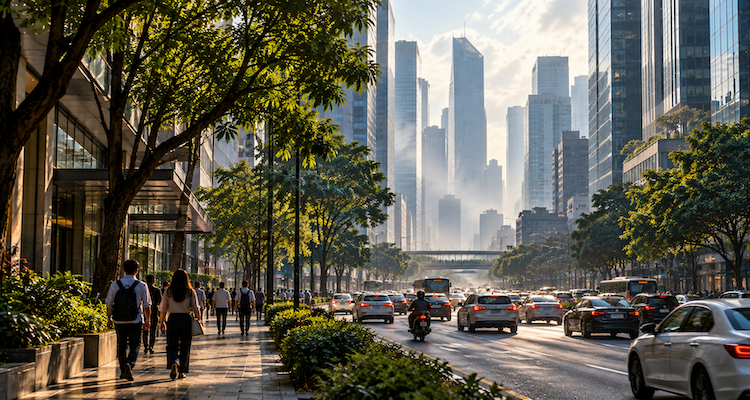
Why Travelers Are Looking Beyond Famous Capitals for Smaller Cities in 2026
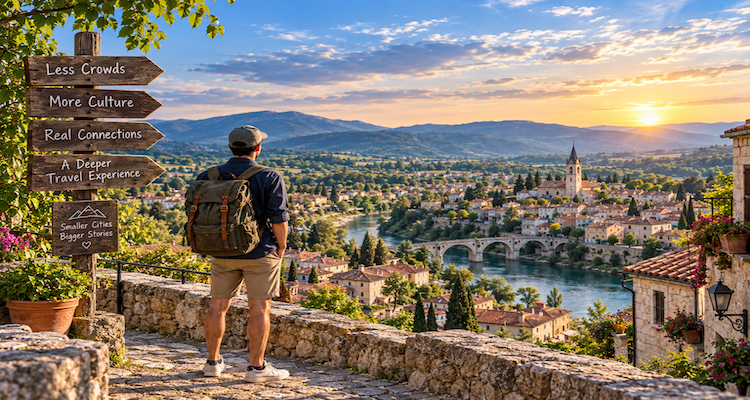
For decades, the classic international trip has followed a familiar formula: fly into a famous capital, visit its landmark attractions, take the obligatory photographs and move on to the next major city.
That pattern is beginning to loosen.
Travel data and industry research point toward a more distributed form of tourism, in which travelers are increasingly considering smaller cities, secondary destinations, regional centers and less crowded alternatives alongside the world’s best-known capitals. Skyscanner’s 2026 travel research, for example, identifies growing interest in destinations beyond major capitals, including places such as Tokushima in Japan and Hamilton in New Zealand.
The change is not simply about discovering “hidden gems.” It reflects a more practical reassessment of what travelers want from a trip: manageable crowds, better value, walkability, local culture, access to nature and enough infrastructure to make a destination comfortable without making it feel overwhelmed.
Key Takeaways
- Travelers are increasingly considering secondary cities when famous destinations feel crowded, expensive or overly familiar.
- Smaller destinations can provide cultural depth without requiring visitors to navigate the scale of a major capital.
- Overtourism is becoming a travel-planning factor, not merely a sustainability debate.
- Better air connections and digital discovery tools are making less-famous destinations easier to find.
- The shift does not mean capitals are becoming irrelevant; it means travelers have more choices within a destination region.
- Smaller cities can benefit economically, but unmanaged growth can simply move overtourism to a new location.
The appeal is shifting from “must-see” to “how do I want to travel?”
The traditional capital-city itinerary is built around concentration. A large city offers major museums, historic monuments, restaurants, transport networks and internationally recognized attractions within one destination.
But concentration can also become a disadvantage.
Crowding can change the experience of a place. Eurostat’s regional tourism data shows that tourism pressure is particularly high in many capital and major urban regions. In 2024, Brussels, Vienna, Prague and Berlin were among the EU regions with the highest tourism density relative to land area.
That matters because travelers do not experience tourism statistics as statistics. They experience them as queues, packed public transport, busy restaurants, difficulty finding accommodation and attractions that require advance planning.
The response is not necessarily to stop traveling to famous cities. Instead, some travelers are beginning to ask a different question: Is the most famous city actually the best base for the experience I want?
That question opens the door to smaller destinations.
A traveler interested in Japanese culture, for example, may still want to see Tokyo or Kyoto but may also consider destinations such as Tokushima or Nara depending on the purpose of the trip. A European traveler interested in food, architecture or regional culture may find that a secondary city offers a more focused experience than a capital overloaded with competing attractions.
The distinction is important. This is less about replacing famous cities than expanding the definition of a worthwhile destination.
Crowding has become part of the travel decision
Overtourism was once discussed mainly as a problem for destination managers and residents. Increasingly, it is also influencing travelers themselves.
Skyscanner’s 2026 research reports that 34% of travelers say they actively seek quieter destinations, while 32% say overcrowding has negatively affected a travel experience. It also found that 31% plan to visit popular destinations during shoulder seasons instead of peak periods.
Booking.com has reported a similar direction of travel. Its 2026 research on “destination dupes” found that 29% of travelers were interested in alternative destinations offering a similar experience to better-known places. Among travelers seeking less-crowded destinations, 44% said avoiding their contribution to overtourism was a motivation.
This creates a subtle but significant change in travel behavior.
Instead of asking only, “Where should I go?”, travelers are increasingly asking:
- How crowded will it be?
- Can I actually enjoy the main attractions?
- What will accommodation cost?
- Can I walk around comfortably?
- Is there a comparable destination nearby?
- Will my money reach local businesses?
- Can I experience something distinctive without spending most of the trip in queues?
Smaller cities often perform well against those criteria, although there are no universal guarantees.
Smaller does not necessarily mean obscure
One misconception about this trend is that travelers are suddenly abandoning cities for remote villages.
The evidence suggests something more nuanced.
Many emerging destinations are still established cities or recognizable regions. Skyscanner’s 2026 research highlights secondary cities and cultural hubs, while Expedia’s 2026 destination data shows rising search interest for places including Hobart, San Miguel de Allende, Savoie and Okinawa.
These places are not necessarily difficult to reach or lacking in tourism infrastructure. Their attraction is that they can offer a different scale of experience.
A smaller city may have:
- a concentrated historic center;
- strong regional food traditions;
- easier access to surrounding landscapes;
- fewer internationally famous attractions competing for attention;
- independent restaurants, markets and cultural venues;
- a stronger connection to its surrounding region.
That last point can be particularly valuable.
A major capital can sometimes become a destination unto itself. A smaller regional city may function instead as a gateway into the culture, landscape and food of a wider area.
Price is part of the equation, but not the whole explanation
Cost remains one of the most practical reasons travelers consider alternatives.
Expedia’s 2026 summer research found travelers splitting between major-event destinations and alternatives with lower accommodation prices. It identified several destinations where average daily hotel rates were substantially lower than comparable travel options during the period studied, including Fukuoka and Nara in Japan.
But the relationship between smaller cities and affordability should not be oversimplified.
A smaller destination is not automatically cheaper. Once a place becomes fashionable, accommodation prices can rise quickly. Limited hotel capacity can also make popular secondary destinations expensive during peak periods.
The more useful lesson is that travelers now have more opportunities to compare destinations before committing to one.
That changes the economics of trip planning.
Instead of accepting the price of a famous destination as a fixed cost of visiting a country, travelers can compare nearby cities, regional airports, alternative accommodation markets and different travel seasons.
Technology makes that comparison considerably easier.
Digital tools are helping travelers discover alternatives
The growth of secondary destinations is also connected to how people search for travel.
Travel discovery is no longer dependent entirely on guidebooks, travel agents or a small collection of famous landmarks. Search engines, mapping platforms, social media, booking platforms and AI-assisted travel tools can surface places that travelers might never have considered.
Booking.com’s 2025 research found that 67% of surveyed travelers hoped to use technology to find less crowded areas, while 41% expressed interest in using AI to curate trips.
That does not mean AI automatically produces better travel decisions. Recommendations can be repetitive, incomplete or based heavily on popularity signals.
But the broader development matters: the cost of discovering an alternative destination is falling.
A traveler who once searched for “best things to do in Paris” can now ask for a city with similar architecture, food culture, museums or walkability but fewer crowds. That changes the competitive landscape for destinations.
The local experience can become the main attraction
There is another reason smaller cities appeal to travelers: they can make ordinary local life more visible.
A famous capital often has a highly developed tourism economy built around major attractions. In a smaller city, the experience may be less centered on a checklist of globally recognized sights.
A market, neighborhood restaurant, local festival, regional craft tradition or everyday café can become a larger part of the trip.
That does not automatically make the experience more authentic “authenticity” is difficult to measure and can itself become a marketing label. But smaller destinations can offer a different relationship between visitor attractions and ordinary city life.
This aligns with a broader movement toward travel experiences built around culture and local connection rather than landmark collection.
Airbnb’s 2026 Asia-Pacific research, for example, reported that 83% of surveyed travelers look for experiences that connect them with local communities. The company also reported that 89% of surveyed APAC travelers had visited a non-urban destination in the preceding 12 months and 91% planned to do so in the following year.
That research concerns non-urban destinations rather than smaller cities specifically, so it should not be treated as direct proof that travelers everywhere are abandoning capitals. It does, however, reinforce the broader shift toward less conventional destinations and deeper local experiences.
There is a sustainability argument but it has limits
Dispersing tourism can potentially help destinations spread economic activity beyond the most congested areas.
The OECD has emphasized the importance of managing and spreading the benefits of tourism development, alongside inclusive tourism, climate action and stronger destination management.
The opportunity is significant. Smaller cities and intermediary cities can connect metropolitan areas with surrounding rural and regional economies. The OECD describes intermediary cities as important links between metropolitan, rural and remote areas, while noting that they often receive less policy attention than very large cities or rural regions.
But there is an important warning.
Sending more tourists to a smaller city does not automatically make tourism sustainable.
If visitor numbers rise faster than housing, transport, waste management, water infrastructure and local services can handle them, the destination can develop the same problems travelers were trying to avoid elsewhere.
The challenge, therefore, is not simply moving tourists away from capitals.
It is managing tourism at a scale that works for residents as well as visitors.
Why this matters for travelers planning their next trip
The practical implication is straightforward: travelers have more choices than the conventional capital-city itinerary suggests.
A useful strategy is to begin with the experience rather than the destination.
If the goal is food, identify regions famous for a particular cuisine and compare their major city with smaller culinary centers.
If the goal is history, look beyond the national capital toward historic regional cities.
If the goal is nature, consider whether a smaller city provides a better base for nearby landscapes.
If the goal is relaxation, examine walkability, accommodation density and seasonal crowd patterns rather than relying only on destination popularity.
And if the goal is affordability, compare the total trip not just hotel prices. A cheaper room can be offset by expensive transport, limited flights or long transfers.
The strongest alternative destination is therefore not necessarily the least famous one. It is the place where the geography, infrastructure, culture, cost and pace match the trip a traveler actually wants.
The risk of turning “hidden gems” into the next hotspots
There is an irony built into this trend.
The moment a destination becomes widely promoted as an alternative to an overcrowded place, it can begin attracting the same attention.
Expedia’s 2026 destination research illustrates this dynamic: several destinations positioned as alternatives to established hotspots recorded significant increases in search interest.
That is good news for local businesses and destination economies when growth is managed well. It can also create pressure if infrastructure does not keep pace.
Travelers therefore have a role to play.
Choosing a smaller destination responsibly can mean traveling outside peak periods, using locally owned businesses where practical, respecting residential areas, avoiding the unnecessary geotagging of fragile locations and checking whether local tourism organizations have guidance on visitor behavior.
The goal should not be to discover a place before everyone else does.
It should be to visit in a way that leaves the place capable of welcoming people after you.
Conclusion
The rise of smaller-city travel is not the end of the famous capital.
Paris, London, Rome, Tokyo and other global cities will continue to attract travelers because their cultural institutions, history, architecture and international significance cannot simply be replicated elsewhere.
What is changing is the assumption that the most famous city must automatically be the center of a trip.
Travelers now have better tools for comparing destinations, greater awareness of overcrowding and more interest in regional culture and slower experiences. Current travel research from companies including Expedia, Booking.com, Airbnb and Skyscanner points in the same broad direction: the travel map is becoming more distributed.
For travelers, that means a better question may no longer be, “Which famous city should I visit?”
It may be: “Which place will give me the experience I actually came for?”
That shift—from famous destination to meaningful destination could be one of the most important changes in how modern city travel is planned.
This content is published for informational or entertainment purposes. Facts, opinions, or references may evolve over time, and readers are encouraged to verify details from reliable sources.