








The Rise of Multi-Stop Living: Why Some Travelers Are Designing Trips Like Temporary Lives
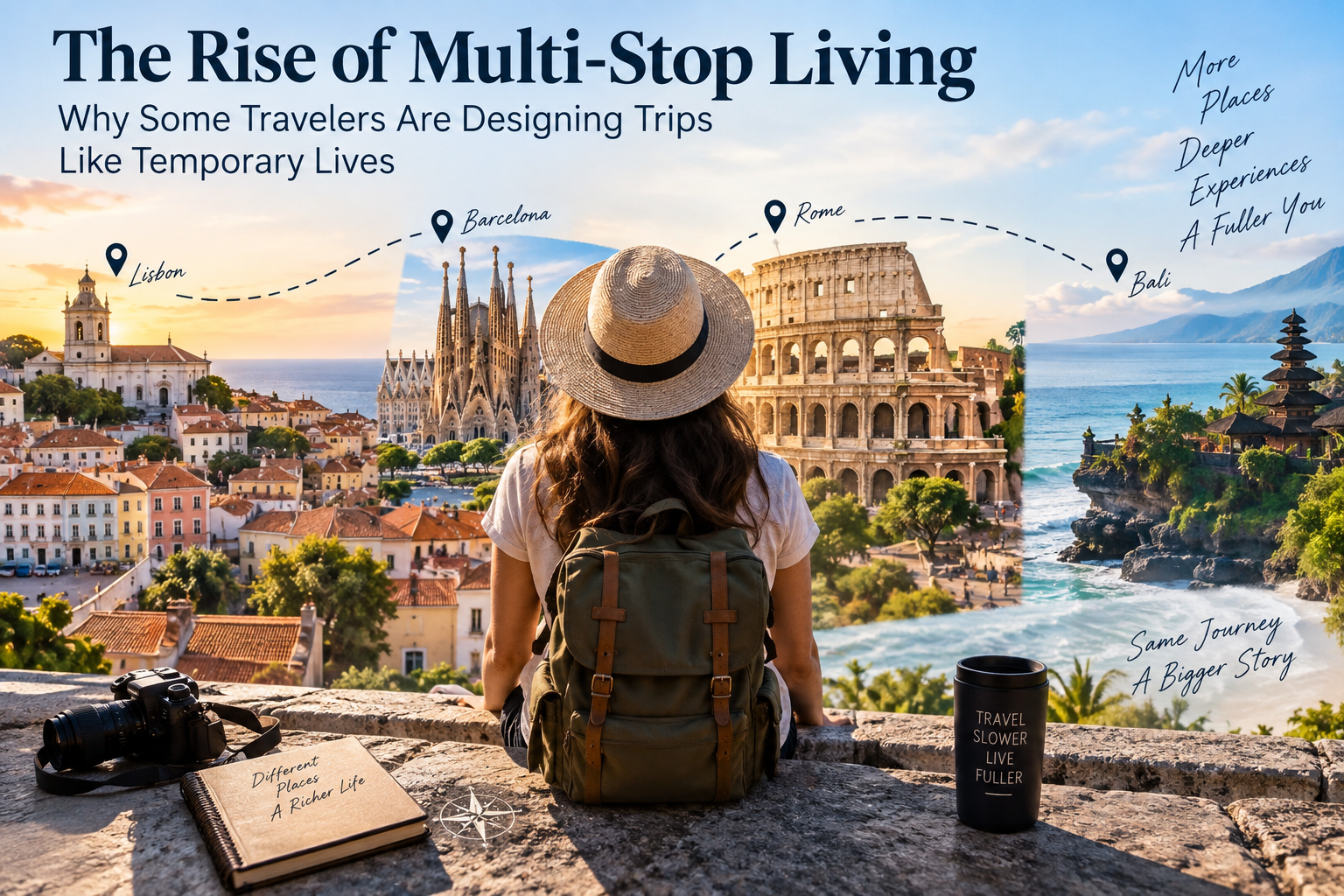
For some travelers, the traditional holiday itinerary is beginning to look oddly inefficient: fly somewhere, spend a few nights, photograph the highlights, and move on.
A different model is taking shape around longer stays and repeated bases. Instead of treating every destination as a brief stop, travelers are increasingly structuring journeys around temporary routines spending weeks or months in one place, working remotely where possible, then relocating to another base without necessarily returning home between stops.
The shift sits somewhere between tourism, relocation and everyday life. Researchers studying lifestyle mobility describe these patterns as increasingly blurred boundaries between travel, work and residence. Recent research also suggests that highly mobile people often discover that moving constantly is exhausting, leading some to slow down and develop a small number of recurring bases rather than continually chase new destinations.
This is the more interesting story behind the rise of “multi-stop living”: the traveler is no longer simply planning where to go next. They are planning where to temporarily live.
Key Takeaways
- Longer stays can turn a conventional itinerary into a sequence of temporary homes rather than a collection of short visits.
- Research suggests frequent movement can create fatigue, while slower mobility may provide greater continuity and routine.
- Remote work has made multi-location living more practical for some workers, but it remains constrained by visas, taxes and employment rules.
- Accommodation platforms are seeing a meaningful long-stay segment, although longer bookings remain a minority of overall stays.
- The model can benefit local economies while also creating housing, regulatory and affordability tensions in popular destinations.
- The strongest version of multi-stop living is less about constant movement and more about choosing a sustainable rhythm.
From “Trip” to Temporary Life
The distinction sounds subtle, but it changes how travel is planned.
A conventional multi-city trip might involve four cities in ten days. Multi-stop living reverses the logic: fewer destinations, longer stays and enough time in each place to establish ordinary routines.
That might mean spending six weeks in Lisbon, two months in another European city, several weeks somewhere warmer during winter, and returning periodically to a familiar base. The traveler may still be moving internationally, but each move is separated by a period of relative stability.
Academic research increasingly treats this kind of behavior as part of lifestyle mobility a broad category that includes forms of ongoing or semi-permanent movement such as digital nomadism, long-term travel and other arrangements that sit between tourism and permanent migration.
That distinction matters because the traveler is consuming a destination differently.
A visitor staying three nights is likely to prioritize attractions and efficient transportation. Someone staying two months has different needs: groceries, healthcare access, reliable internet, neighborhood services, laundry, exercise, social connections and a workable daily routine.
The destination becomes less of a backdrop and more of an operating environment.
Why Constant Movement Is Losing Some of Its Appeal
The image of the digital nomad often emphasizes freedom: a laptop, a new country every few weeks and the ability to work from almost anywhere.
Research paints a more complicated picture.
A 2025 qualitative study of 27 digital nomads in Bali found that many participants had initially embraced very high mobility but later regarded constant movement as demanding and difficult to sustain. Some wanted greater residential stability, including the possibility of rotating between several established bases rather than continuously moving to new places.
That finding is important because it challenges a common assumption: that people who enjoy geographic freedom necessarily want maximum geographic movement.
They may want the opposite.
A traveler can value flexibility while also wanting familiarity. The appeal of a recurring apartment, a known neighborhood café, a reliable coworking space or a familiar local community can become stronger once the novelty of constant relocation wears off.
In that sense, multi-stop living may represent a maturation of the digital-nomad idea rather than its disappearance.
The goal shifts from “How many places can I visit?” to “Where can I live well for a while?”
The Numbers Point Toward Longer Stays But Not a Mass Exodus From Short Trips
There is evidence that longer stays have become more important in accommodation markets, although the data should not be interpreted as proof that most travelers have abandoned conventional vacations.
A 2025 study using U.S. Airbnb reservation data from 2019 through 2024 found that the average number of nights per booking rose from 3.7 before the pandemic to roughly 4.1–4.4 after 2021. More significantly for the multi-stop-living question, the probability of a booking lasting at least 28 nights increased from 1.5% during the pre-pandemic period examined to 2.2% after the pandemic period, while long-stay bookings themselves remained relatively uncommon.
The significance is therefore not that everyone is suddenly living abroad for months.
It is that the long-stay tail of the accommodation market has become more substantial.
Airbnb has also reported increased demand for longer stays in individual markets. In Germany, the company said in March 2025 that demand for stays lasting one week to one month had risen by more than 200% compared with the previous year. Because this is company-reported platform data rather than a comprehensive measure of all German tourism, it should be read as an indicator of booking behavior on that platform, not as a measurement of the entire travel market.
Together, these signals point toward a more nuanced change: travel is not simply becoming “slower.” The market is becoming more capable of supporting different travel durations.
Remote Work Changed the Mathematics of Travel
The rise of remote and hybrid work is one of the structural developments behind this model.
For a conventional office worker, moving between cities usually means taking leave. For a genuinely location-independent worker, changing location can sometimes happen without interrupting employment.
That does not make the arrangement universally practical.
Employment contracts, company policies, immigration rules, tax residency, social-security obligations and data-security requirements can all restrict where someone can work. A person may be legally allowed to enter a country as a tourist but not legally allowed to perform employment there.
This is one reason multi-stop living should not be confused with simply buying a plane ticket and working from anywhere.
The lifestyle exists inside a complicated framework of national laws and employer policies.
Research on digital nomadism has increasingly examined these tensions, including the emergence of dedicated digital-nomad visa programs and the questions they raise around taxation, regulation and the relationship between temporary visitors and local communities.
A New Kind of Travel Planning
Multi-stop living also changes what makes a destination attractive.
For a short vacation, a destination’s famous landmarks may dominate the decision.
For a temporary resident, the priorities can be almost completely different.
A practical destination assessment might include:
- Reliable internet and mobile connectivity
- Walkability and everyday transportation
- Housing suitable for several weeks or months
- Access to groceries and ordinary services
- Safety and healthcare access
- Visa and permitted-work requirements
- Time-zone compatibility with work
- Seasonal weather
- Cost predictability
- Opportunities for social connection
- A reasonable distance from the next intended base
This creates an interesting reversal in tourism marketing.
The question is no longer only whether a destination is exciting.
It is whether it is livable for a temporary period.
That distinction helps explain why cities and regions that might not dominate traditional bucket lists can become attractive to longer-stay travelers. A place does not need to offer endless attractions if it provides a comfortable, affordable and interesting daily life.
The “Three Homes” Model May Be More Sustainable Than Constant Nomadism
One of the most revealing findings in recent research is that some highly mobile people eventually imagine their future not as permanent wandering, but as a rotation among several places.
That could mean maintaining a primary home while spending part of the year in two other locations. It could also mean returning repeatedly to the same destinations rather than constantly discovering new ones.
The distinction is important.
A traveler who returns to the same places can develop deeper relationships, understand local routines and reduce the cognitive cost of repeatedly starting from zero.
It also changes the meaning of familiarity.
A hotel room in a new city is accommodation.
A neighborhood where someone has returned five times can begin to feel like a second home.
This is perhaps the strongest conceptual shift behind multi-stop living: mobility does not necessarily require novelty.
The Local Impact Is More Complicated
The model has obvious attractions for travelers, but destinations do not experience it uniformly.
Longer-stay visitors can spend money beyond traditional tourist attractions, including supermarkets, cafés, local transportation, fitness services and other everyday businesses. Their spending can therefore resemble aspects of resident consumption.
But the same mobility can contribute to pressure in housing markets, particularly where short-term or medium-term accommodation competes with housing used by local residents.
Researchers studying lifestyle mobilities have increasingly emphasized these tensions, including gentrification, geoarbitrage and the unequal economic relationships that can develop between mobile visitors and host communities.
That makes “slow travel” an insufficiently simple label.
Staying longer does not automatically make travel more sustainable, equitable or beneficial to residents.
A traveler can stay in one place for three months and still consume the destination in a highly extractive way. Conversely, a longer stay can create stronger local connections and distribute spending more broadly.
The outcome depends on housing markets, regulation, traveler behavior, income differences and the relationship between visitors and residents.
The Hidden Cost: Building a Life Everywhere
The most overlooked challenge may be psychological rather than logistical.
Constant relocation requires repeated decisions: where to sleep, where to work, how to get around, where to shop, how to meet people and how to navigate unfamiliar systems.
A multi-stop lifestyle reduces some of that burden by slowing the pace. But it does not eliminate the difficulty of repeatedly rebuilding social and practical infrastructure.
The 2025 Bali study found that lack of deep social connections was among the challenges reported by highly mobile participants. This is significant because travel is often marketed as an accumulation of experiences, while a satisfying life also depends on continuity.
Multi-stop living therefore works best when movement is deliberately limited.
The traveler needs enough change to create variety, but enough repetition to create belonging.
That is a fundamentally different objective from maximizing the number of destinations visited.
What Multi-Stop Living Could Mean for the Future of Travel
The available evidence does not justify declaring multi-stop living the new standard for tourism. Most people still travel for conventional holidays, and long stays remain a relatively small portion of accommodation bookings.
But the model reveals a broader change in how travel can fit into people’s lives.
Tourism, remote work and temporary residence are becoming less neatly separated. Academic research increasingly treats these categories as overlapping forms of mobility rather than completely distinct behaviors.
For travelers with location flexibility, that opens a different way to design a year.
Instead of asking where to take a holiday, they can ask where to spend a season.
Instead of seeing accommodation as a place to sleep, they can evaluate it as temporary infrastructure for everyday life.
And instead of collecting destinations, they can build a small network of places they genuinely know.
Conclusion
The rise of multi-stop living is not really a story about people wanting to travel more.
It is a story about some people wanting travel and ordinary life to coexist differently.
The most sustainable version of the idea is not endless movement. It is intentional mobility: staying long enough to establish routines, choosing destinations for livability as well as attraction, understanding the legal and financial constraints, and returning to places rather than constantly replacing them.
For travelers who can make the model work, the result may look less like a never-ending holiday and more like a life with several temporary addresses.
That may be the more lasting evolution in travel: not seeing more places, but learning how to live well in more than one.
This content is published for informational or entertainment purposes. Facts, opinions, or references may evolve over time, and readers are encouraged to verify details from reliable sources.