









The Hidden Tourism Economy Created by People Who Work While Traveling
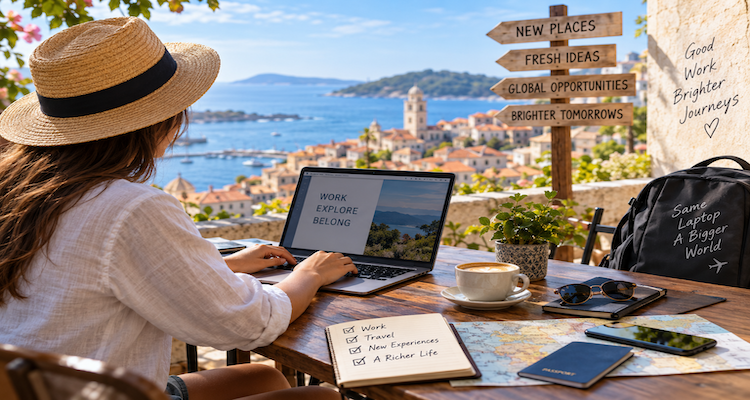
A growing class of travelers is spending money in destinations without behaving much like conventional tourists. They rent apartments for weeks or months, work from cafés and coworking spaces, buy groceries, use local transport, visit restaurants between meetings and sometimes hire local services all while earning their income somewhere else.
These are remote workers, workationers and digital nomads, and their economic importance is easy to miss because much of their activity sits between tourism and ordinary residential life. Research increasingly suggests that they should be understood not simply as tourists with laptops, but as a distinct part of the visitor economy.
That distinction matters. A conventional visitor may spend heavily on attractions, hotels and short-term experiences. A working traveler can distribute spending across accommodation, food, coworking, telecommunications, transport, household goods, fitness, healthcare, professional services and longer-term rentals. In some destinations, the economic footprint therefore extends well beyond the businesses normally associated with tourism.
Key Takeaways
- Working travelers can spread tourism spending across everyday services that conventional visitor statistics may not capture clearly.
- Longer stays can create steadier demand for accommodation, food, coworking spaces and local services.
- Chiang Mai research found digital nomads contributing through consumption, local hiring and knowledge-sharing activities.
- The economic benefits are not automatic and can coexist with housing pressure, inequality and social separation.
- Remote work is creating a visitor category that sits between tourism, temporary residence and employment.
- Destinations increasingly have to decide whether to attract these workers and how to do so without shifting costs onto residents.
Tourism Is No Longer Only About Time Away From Work
The traditional tourism model assumes a relatively clear separation: people travel to a destination, stop working, consume leisure services and eventually go home.
Remote work disrupts that model.
A person can now fly to another country while retaining the same employer, clients or business. Instead of staying for three nights, they might remain for several weeks. Their working hours may be spent in a coworking space, apartment or café, while evenings and weekends are used for restaurants, cultural activities and excursions.
Academic research increasingly treats this as a meaningful change in the visitor economy. A 2025 study in the Journal of Destination Marketing & Management describes workations as a combination of remote work and tourism and argues that they can create longer stays and help destinations address seasonal demand.
Another 2025 study in Tourism Management examined workations as a distinct form of travel arising from increased mobility among employed knowledge workers.
The important point is not that every remote worker is a tourist. Many are not. The useful distinction is between people who merely work remotely from home and those whose geographic mobility is part of how they live and travel.
That distinction creates an economic category that traditional tourism models can struggle to describe.
The Spending Happens in Places Tourists Often Ignore
Consider how a working traveler might spend money during a month in a destination.
Accommodation is obvious. But the spending does not necessarily stop there.
There may be:
- coworking or coliving fees
- supermarket purchases
- cafés used as informal offices
- mobile data and internet services
- taxis and public transportation
- laundry and cleaning
- gyms and fitness classes
- pharmacies and personal services
- restaurants and takeaway food
- local freelancers
- domestic travel
- cultural and recreational activities
This is where the “hidden” economy becomes interesting.
A conventional tourist’s expenditure is relatively easy to associate with tourism: hotel, restaurant, attraction, flight and excursion. A remote worker can behave more like a temporary resident while retaining tourist consumption patterns.
A detailed longitudinal case study of Chiang Mai, Thailand, found precisely this pattern. Researchers studying the city’s visitor economy reported that digital nomads contributed through accommodation, food, coworking and coliving services, while some also hired local freelancers. The researchers argued that their spending extended beyond conventional hospitality into everyday local businesses.
That does not mean every digital nomad spends more than every conventional tourist. The evidence does not support such a universal claim.
It means the composition of spending is different.
And that difference can matter to a local economy.
Why Longer Stays Change the Business Equation
Time is one of the most important variables.
A traveler staying two or three nights has limited opportunities to become a regular customer. Someone staying six weeks has a different relationship with the local economy.
They may find a favorite café and return repeatedly. They may establish a relationship with a barber, gym, coworking operator or food shop. They may rent an apartment rather than book a hotel room. They may return to the same restaurant several times instead of sampling a different establishment every night.
Research published in the Journal of Destination Marketing & Management identifies longer stays as one reason workations may be commercially attractive to destinations, including their potential to smooth seasonal tourism demand.
This changes the question for tourism businesses.
Instead of asking only, “How many visitors came?”
A destination may increasingly need to ask:
How long did they stay, what did they buy repeatedly, and which parts of the local economy received that spending?
Those are different measurements.
Chiang Mai Shows What the Hidden Economy Can Look Like
Chiang Mai provides one of the clearest research cases because digital nomads have been part of the city’s visitor landscape since the mid-2010s.
A longitudinal study published in the Information Systems Journal examined Chiang Mai from the perspective of local communities rather than focusing only on the nomads themselves. Researchers compared digital nomads with other visitor groups and found distinctive economic, technological and social effects.
Coworking and coliving spaces became part of the local infrastructure supporting this population.
But the more interesting finding was what happened around that infrastructure.
The researchers identified knowledge spillovers situations in which local people encountered digital technologies, online businesses and new ways of working through interactions with nomads. Digital nomads also organised learning and networking events, while some local people were inspired to pursue remote work or entrepreneurial activities themselves.
That is a different economic effect from simply selling another hotel room.
Tourism traditionally generates income by moving consumers toward a destination’s existing attractions and hospitality businesses. Remote-work tourism can also bring skills, professional networks and business knowledge into the local environment.
That does not automatically create lasting development. But it is an economic effect that conventional tourism discussions can overlook.
The Worker and the Tourist Become the Same Customer
The most useful way to understand this phenomenon may be to stop treating “tourist” and “worker” as mutually exclusive categories.
A digital nomad can be both.
The Chiang Mai research describes digital nomads as behaving according to the rhythms of working professionals while simultaneously consuming tourism-related goods and services.
That produces a hybrid economic footprint.
During the morning, the person might be buying coffee and paying for a coworking desk.
At lunchtime, they become a regular customer at a local restaurant.
In the afternoon, they are generating income for a company based elsewhere.
In the evening, they may pay for a local fitness class or cultural experience.
At the weekend, they become a conventional tourist, visiting nearby attractions or taking a short trip.
The same person therefore moves between several economic categories without necessarily changing location.
That is why the phenomenon is difficult to capture through traditional tourism statistics.
Technology Is the Infrastructure Behind the Shift
None of this works without a particular technological foundation.
Reliable broadband, cloud software, video conferencing, digital payments, online marketplaces and portable computing have reduced the importance of physical proximity for many knowledge-based jobs.
The labor market has changed alongside it.
MBO Partners’ 2025 research estimates that 18.5 million U.S. workers described themselves as digital nomads, about 2.2% more than the previous year. Its survey defines digital nomads as workers combining remote work with travel and location independence.
The same research found that digital nomads include both independent workers and people with traditional employment. That is important because the phenomenon is no longer limited to freelancers or entrepreneurs.
Some travelers have an employer.
Others have clients.
Some run businesses.
Some combine employment with independent work.
The common factor is not employment status. It is the ability to earn income without being permanently tied to one workplace.
The New Tourism Economy Also Has a Cost
The economic story becomes misleading if it focuses only on new spending.
The same characteristics that make destinations attractive to remote workers can create pressure for residents.
Research reviewing digital nomadism has identified tensions involving geo-arbitrage, gentrification, infrastructure and the relationship between mobile visitors and local communities.
The Chiang Mai case study also found concerns around privilege, social bubbles and inequality alongside the economic and knowledge benefits. Some local residents viewed nomads as relatively privileged outsiders benefiting from differences in living costs between countries.
This creates a difficult policy question.
If an internationally paid worker arrives in a lower-cost city and spends money locally, local businesses may benefit. But if large numbers of relatively high-income outsiders compete for housing, the same process can make accommodation less affordable for residents.
The two effects can happen simultaneously.
That is why “digital nomads are good for tourism” is too simplistic.
The more useful question is where the money goes, who captures it, and what costs are transferred to the local population.
A Different Kind of Destination Competition
For destinations, the competition is increasingly about more than beaches, monuments and hotel rooms.
Working travelers need infrastructure.
They care about reliable connectivity, accommodation suitable for longer stays, workspaces, transport, safety, community and the practical ability to combine professional obligations with everyday life.
A 2026 study of 435 foreign digital nomads living in Chiang Mai found that infrastructure, living costs, community layout and social environment significantly influenced decisions to reside there.
This suggests a broader change in destination strategy.
A city that wants to attract working travelers is effectively competing on livability, not just attractions.
That can produce benefits beyond tourism if investment improves broadband, public infrastructure, coworking facilities and services used by residents as well.
But it can also create a problem if infrastructure is designed primarily around outsiders while local residents face rising costs.
Why the Category Matters for Businesses
The emergence of working travelers creates opportunities for businesses that do not traditionally think of themselves as tourism businesses.
A café with dependable Wi-Fi and suitable seating can become part of the visitor economy.
A residential landlord becomes indirectly connected to tourism.
A gym can gain customers from a constantly changing international population.
A local freelancer can find clients through networks formed around coworking communities.
A software company can serve customers who are geographically mobile.
Even supermarkets and convenience stores can benefit from longer-term visitor demand.
This is why the economic footprint of work-based travel can be larger in breadth than its appearance suggests.
The visitor may not spend every day sightseeing.
But they are still spending.
The Measurement Problem
There is a major limitation in understanding the scale of this economy: digital nomadism does not fit neatly into conventional categories.
Tourism statistics generally depend on concepts such as trips, overnight stays, visitor expenditure and purpose of travel. A person who rents an apartment for two months, works remotely for an overseas employer and takes weekend trips does not fit comfortably into one category.
Academic research has increasingly highlighted this classification problem. A 2026 review of lifestyle mobilities and digital nomadism specifically examines the blurred boundaries between tourism, mobility, infrastructure, geopolitics and gentrification.
That means claims about the precise economic value of digital nomads should be treated carefully.
There is growing evidence of economic activity.
There is much less basis for applying one universal spending figure to every destination.
The economic impact depends on length of stay, income, housing arrangements, local ownership, taxation, consumption patterns and how much spending remains within the local economy.
What Destinations Should Pay Attention To
The most promising approach may not be to maximize the number of remote workers.
It may be to maximize the quality of the economic relationship between working visitors and residents.
That could mean encouraging:
- longer stays rather than rapid visitor turnover
- locally owned accommodation and businesses
- coworking facilities integrated with local communities
- professional events open to residents
- local hiring and freelance opportunities
- infrastructure that benefits residents as well as visitors
- transparent rules around taxation and immigration
- housing policies that protect local affordability
The Chiang Mai research is particularly useful here because it shows both sides of the equation: economic contribution and knowledge exchange on one side, and social separation and inequality concerns on the other.
The lesson is not that digital nomads should replace conventional tourists.
It is that they represent a different kind of visitor and destinations need to understand the difference before designing policy around them.
Conclusion
The hidden tourism economy of remote workers is not hidden because the money is insignificant. It is hidden because the spending often looks like ordinary everyday consumption.
A laptop worker renting an apartment, buying groceries, paying for internet, visiting a café and taking weekend excursions may not look like a tourist in the conventional sense. Yet that person can be contributing to accommodation, food, transport, leisure, coworking and local services for weeks or months.
The deeper shift is therefore not simply that people can work while traveling.
It is that work itself has become part of the tourism economy.
For destinations, that creates an opportunity but not a blank cheque. The places most likely to benefit sustainably will be those that understand where working visitors’ money goes, measure their longer-term effects and ensure that the economic gains do not come at the expense of the people who already live there.
The future of this segment may therefore be less about attracting more digital nomads and more about designing a visitor economy in which residents and mobile workers can both benefit.
This content is published for informational or entertainment purposes. Facts, opinions, or references may evolve over time, and readers are encouraged to verify details from reliable sources.