









How Climate Change Is Quietly Rewriting the Travel Calendar
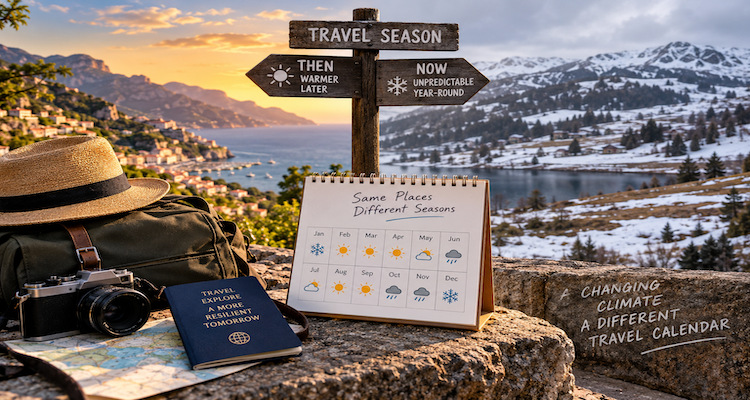
For decades, the travel calendar seemed remarkably predictable. Mediterranean beaches filled in July and August, ski resorts waited for winter, and northern destinations relied on summer visitors escaping colder climates. School holidays, traditions and airline schedules reinforced those patterns.
Climate change is beginning to loosen that calendar.
The change is not as simple as people abandoning hot destinations. Instead, the most important shift may be more subtle: the months considered comfortable, attractive or reliable for particular kinds of travel are changing. A beach holiday that once made sense in the middle of summer may increasingly make more sense in May, June, September or October. A northern European destination may become more attractive during the traditional summer peak. Mountain resorts are confronting a different problem as dependable snow becomes harder to guarantee.
Recent research and tourism data suggest that this is already becoming a planning issue rather than a distant scenario. Europe recorded its warmest year on record in 2024, while extreme heat, wildfires, flooding and changing precipitation are increasingly affecting tourism operations and visitor comfort.
The result is a travel calendar that is becoming less fixed by tradition and more influenced by climate conditions.
Key Takeaways
- Peak summer is becoming less universally attractive as extreme heat increasingly affects comfort, activities and destination choice.
- European tourism research projects demand shifting northward and from peak summer toward shoulder and winter seasons.
- The change creates opportunities for cooler destinations but can also transfer overcrowding, water pressure and infrastructure problems.
- Ski tourism faces a different calendar problem because warming threatens the reliability of natural snow at vulnerable elevations.
- Travellers may increasingly need to choose destinations by month rather than relying on traditional “best time to visit” advice.
- The transition will be uneven: climate, tourism type, infrastructure and traveller preferences will determine which places gain or lose demand.
The Summer Holiday Is No Longer a Fixed Concept
The traditional European tourism calendar remains highly seasonal. Eurostat reported that 31.1% of all nights spent in EU tourist accommodation in 2025 occurred in July and August. August alone accounted for about 501 million nights, compared with 139 million in January.
That concentration has never been caused by climate alone. School holidays, public holidays, work schedules, cultural traditions and business practices all influence when people travel.
But climate is an important part of the equation and it is becoming harder to treat it as a stable background condition.
The European Environment Agency notes that tourism depends heavily on weather and climate because many activities take place outdoors and rely on natural resources such as snow, water, forests and coastal environments. Rising temperatures, longer heatwaves, changing rainfall and wildfire risk can therefore affect both destination attractiveness and the ability of tourism businesses to operate normally.
That creates a new distinction for travellers: the conventional peak season is not necessarily the same thing as the most comfortable season.
Mediterranean Summer Is Becoming a More Complicated Proposition
The Mediterranean illustrates the tension particularly clearly.
Southern Europe remains one of the world’s major leisure destinations, but hotter summers can reduce the appeal of activities that traditionally define a trip: walking through historic city centres, hiking, cycling, sightseeing or spending long periods outdoors.
The OECD’s 2026 tourism analysis points to evidence that extreme heat can cause visitors to shorten outdoor activities, visit fewer attractions and, in extreme cases, postpone or cancel trips. It also identifies a growing interest in cooler destinations and travel periods.
This does not mean Mediterranean tourism is disappearing.
A more plausible interpretation is that the timing of demand can change before the destination itself becomes unattractive.
Spring and autumn can become relatively more appealing because they preserve many of the experiences travellers want while reducing exposure to the most intense summer heat.
That is important economically. If visitors move from July to May or October, a destination may still receive tourists—but hotels, restaurants, transport operators, seasonal workers and attractions have to operate successfully during those months.
Climate change therefore turns a weather problem into a scheduling problem.
Research Shows a North-South Shift in European Tourism Demand
One of the clearest pieces of evidence comes from research published in Environmental Research Letters in 2025.
Researchers analysed tourism and climate data across 1,315 European regions and modelled tourism demand under different levels of global warming. The study found a pronounced north-south pattern: northern areas could gain tourism demand while southern regions face larger losses, particularly under higher warming scenarios. Coastal areas and summer tourism were especially sensitive.
The study also projected a substantial seasonal redistribution.
Under its scenarios, European summer tourism demand declines while demand is reallocated toward milder seasons and regions. The researchers estimate that maintaining current annual tourism levels would require destinations to accommodate more demand during shoulder and winter periods.
That finding matters because it changes the question travellers and tourism businesses should be asking.
It is no longer simply:
“Where should I go?”
Increasingly, it becomes:
“Where should I go, and in which month?”
Cooler Destinations May Gain But That Does Not Mean They Get a Free Pass
Northern Europe and higher-altitude destinations could become more attractive during summer as travellers seek relief from extreme heat.
The OECD describes this emerging pattern as the rise of “coolcations”: trips chosen partly because a destination offers more comfortable temperatures during increasingly hot periods elsewhere. Its 2026 tourism report points to northern Europe, Canada and Alpine regions as potential beneficiaries of changing summer conditions.
Iceland provides an interesting example. The OECD cites Icelandic Tourist Board survey results indicating that climate conditions including cool temperatures and air quality had some to significant influence on the decision to visit for nearly half of foreign tourists surveyed about their previous year’s trip.
But shifting tourism north does not automatically solve the underlying problem.
A destination that suddenly becomes fashionable can experience its own pressure on accommodation, transport, water resources, ecosystems and local communities. The same tourism seasonality that has challenged Mediterranean destinations can be transferred to places that historically had less infrastructure for large summer visitor volumes.
In other words, climate change can redistribute tourism pressure without eliminating it.
The Shoulder Season Could Become the New Battleground
The biggest winner from a changing travel calendar may not be a particular country.
It may be May, June, September and October.
These shoulder months have traditionally offered destinations an opportunity to spread visitors beyond the peak season. Climate change could strengthen that opportunity in places where summer heat becomes less comfortable while spring and autumn remain attractive.
European research has specifically identified reductions in summer demand alongside increases in shoulder-season demand as a potential adaptation pathway.
For travellers, that could mean:
- More comfortable conditions for walking-heavy city trips.
- Greater appeal for Mediterranean beach destinations outside July and August.
- Potentially less pressure on attractions during traditional peak periods.
- More choice in accommodation and travel dates.
- A different definition of the destination’s “high season.”
But there is a catch.
Businesses cannot simply move the calendar on paper. Hotels need staff, restaurants need suppliers, attractions need to remain open and transport networks need sufficient demand to operate. Seasonal workers may also need more stable employment across a longer period.
The 2025 European tourism study explicitly identifies infrastructure, transport links, seasonal pricing and off-season attractions as parts of the adjustment required to redistribute demand.
Winter Tourism Has Its Own Calendar Problem
The climate-driven travel shift is not limited to summer.
Winter tourism faces a different challenge: snow reliability.
The European Environment Agency identifies winter tourism as a major climate risk, particularly for lower-altitude destinations in central and southern Europe. Reduced snow cover can shorten the period in which skiing and other snow-dependent activities are reliably available.
This creates pressure to adapt in several ways, including snowmaking, diversification into non-snow activities and changes in operating seasons.
But snowmaking itself cannot make every resort climate-proof. It requires suitable temperatures and water, and its feasibility varies by elevation and location.
The OECD’s 2026 tourism assessment notes that warming may extend summer tourism in some regions while simultaneously reducing the number of days suitable for skiing, skating and other winter activities.
The consequence is a calendar with two opposing movements:
Summer seasons may lengthen in some cooler destinations, while dependable winter seasons may contract in vulnerable mountain areas.
The Calendar Is Also Becoming a Risk Management Tool
Travel planning has traditionally focused on price, crowds and weather averages.
Climate change adds another consideration: reliability.
A destination can have an attractive average climate and still experience a disruptive wildfire, flood, heatwave or storm during a traveller’s chosen week.
The OECD reports that extreme weather is already disrupting tourism through airport and road closures, damaged infrastructure, closed attractions, event cancellations and changes in visitor perceptions.
This is why the phrase “best time to visit” is becoming less straightforward.
A month that was historically considered ideal may still be statistically attractive, but travellers may increasingly need to consider the probability of extreme heat, wildfire exposure, water stress, heavy rainfall or snow disruption alongside traditional seasonal advice.
That does not mean every trip requires a climate-risk assessment.
It does mean that weather averages alone are becoming an incomplete travel-planning tool.
Climate Change Will Not Affect Every Destination the Same Way
One of the easiest mistakes is to describe climate change as though every destination will simply become hotter and less pleasant.
The evidence is much more complicated.
The 2025 European tourism study found substantial differences between tourism types and regions. Coastal tourism showed particularly strong sensitivity to climate conditions, while urban, rural and snow-related tourism displayed different levels of sensitivity in the researchers’ modelling.
The European Commission’s Joint Research Centre similarly found that the effects vary dramatically across regions. Its modelling projected potential gains in northern Europe alongside significant losses in parts of southern Europe, with seasonal demand changing at the same time.
And the modelling is not a forecast of exactly what travellers will do.
Tourists adapt. Businesses adapt. Governments build infrastructure. Destinations change their marketing. Travellers may tolerate conditions differently from what a climate index predicts.
The 2026 research on beach-tourist comfort illustrates why this uncertainty matters: researchers are examining whether established tourism climate indices accurately capture how real visitors perceive weather under increasingly hot conditions.
That is an important limitation. Climate models can identify pressure points, but human travel behaviour remains part of the equation.
What This Means for Travellers
The practical lesson is not that people should stop travelling to warm countries.
It is that the old seasonal rules deserve a second look.
For a heat-sensitive trip particularly one involving extensive walking, sightseeing or outdoor activities travellers may increasingly benefit from considering shoulder seasons rather than automatically choosing the traditional summer peak.
For northern destinations, summer may become an increasingly attractive period, but travellers should also consider whether rising demand is producing its own crowding and infrastructure pressures.
For ski holidays, snow reliability and elevation may matter more than a resort’s historical reputation.
And for any destination exposed to wildfire, flooding or extreme heat, flexible booking policies and checking official weather or hazard information closer to departure can become more valuable.
The broader shift is from calendar-based travel planning to condition-based travel planning.
A New Geography of “Peak Season”
The travel industry has spent decades building around predictable seasonal demand.
Climate change introduces a different kind of uncertainty: the conditions that created those seasons are themselves changing.
The result will not be a single new global travel calendar. Instead, there will be many smaller calendars.
A Mediterranean beach destination may gradually depend more on spring and autumn. A northern European city could become more attractive during July. An Alpine resort may have to build a broader year-round business rather than relying overwhelmingly on winter snow. A destination once considered secondary could become more competitive simply because its summer climate is more comfortable.
The European Environment Agency already describes this as both a risk and an opportunity: some destinations may lose attractiveness during traditional periods while cooler areas can benefit from increased demand or longer favourable seasons.
That makes climate change a tourism-market issue as much as an environmental one.
The destination map may not change overnight.
The calendar can change first.
Conclusion
For travellers, climate change may become visible not through one dramatic transformation but through a series of small decisions: choosing September instead of August, looking north instead of south, checking snow reliability before booking a ski trip, or discovering that a destination once described as “shoulder season” now offers some of its best conditions.
For tourism businesses, the stakes are larger. Seasonal demand affects employment, infrastructure, investment and local economies. Moving visitors from one month to another requires more than changing a marketing campaign; it can require an entirely different operating model.
The most important shift is therefore conceptual.
The “best time to visit” is becoming less universal.
As climate conditions continue to change, the smartest travel calendar may increasingly be the one that follows the conditions of a place not simply the traditions of the past.
This content is published for informational or entertainment purposes. Facts, opinions, or references may evolve over time, and readers are encouraged to verify details from reliable sources.