









When AI Becomes the Middleman Between Humans and Institutions
A person once called a bank, emailed a doctor, visited a government office or spoke with a school administrator to navigate an institution. Increasingly, the first interaction is becoming a conversation with software.
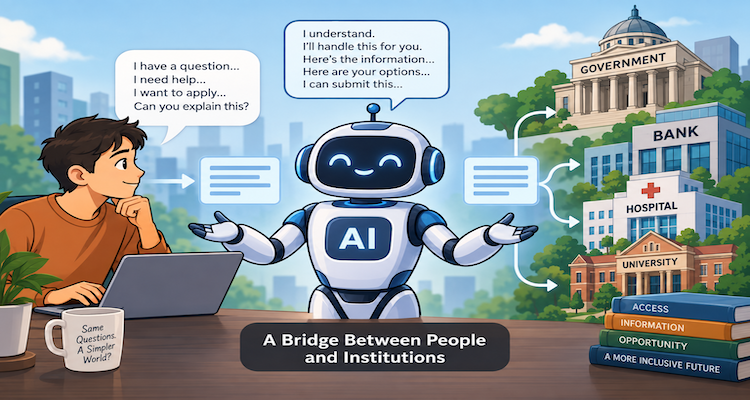
That shift is easy to describe as automation. But something more consequential is happening underneath it: AI is beginning to occupy the space between people and institutions, interpreting what people ask, translating institutional rules, retrieving information, recommending next steps and, increasingly, taking actions on a user’s behalf.
The change matters because an intermediary does more than pass information along. It can decide what information is surfaced, how a request is interpreted, which options are presented and when a human becomes involved.
The technology is moving in that direction at the same time that governments, banks, healthcare organizations and businesses are experimenting with increasingly capable AI systems. The OECD reported in 2025 that 67% of OECD countries were using AI in public-service design and delivery, while NIST has separately begun developing standards and security guidance specifically for AI agents capable of taking autonomous actions.
The important question is therefore no longer simply whether institutions will use AI. It is what happens to the relationship between a person and an institution when an AI system becomes the layer through which that relationship is increasingly conducted.
Key Takeaways
- AI is evolving from a customer-service tool into an interface that can interpret requests and act across institutional systems.
- The intermediary role gives AI influence over what people see, understand and do next.
- Banking and healthcare already demonstrate how useful and risky AI-mediated communication can become.
- Faster answers do not necessarily mean better access when complex cases still require human judgment.
- Human oversight matters most when AI influences decisions involving money, health, rights or access to essential services.
- The central challenge is preserving institutional accountability when AI increasingly handles the interaction.
AI Is Moving From Assistant to Interface
The first generation of institutional AI largely answered questions.
A bank chatbot might explain how to reset a password. A government website might use a virtual assistant to locate a form. A university might deploy a chatbot to answer questions about admissions. A healthcare system might use software to help draft replies to patient messages.
These systems generally operated at the edge of the institution.
AI agents represent a more consequential step. Instead of simply generating an answer, an agent can potentially plan a sequence of actions, interact with software and external systems, retrieve information and perform tasks on behalf of a user.
NIST’s 2026 AI Agent Standards Initiative describes agents as systems capable of autonomous actions and notes emerging applications including managing email and calendars, shopping and working with external systems and internal data. NIST also says these systems introduce security concerns that require adaptation of existing cybersecurity practices.
That creates a new relationship:
Person → AI → Institution
rather than:
Person → Institution
The distinction is subtle but important.
If someone asks an AI assistant to resolve a billing problem, for example, the AI may need to understand the person’s request, determine which institutional process applies, retrieve relevant information and potentially initiate an action.
The institution still owns the underlying account and policies. But the AI has become the interpreter between the two sides.
That makes the quality of the intermediary consequential.
The Middleman Controls More Than the Conversation
A traditional intermediary can filter information. An AI intermediary can potentially do much more.
It can summarize a policy instead of displaying the full policy. It can prioritize one option over another. It can decide that a request belongs to a particular category. It can ask follow-up questions. It can determine whether a problem is simple enough to handle automatically or complicated enough to escalate.
That means the AI layer can influence the user’s practical experience of the institution even when the institution’s formal rules have not changed.
This is one reason AI governance increasingly focuses on oversight rather than accuracy alone.
The European Union’s AI Act, for example, requires appropriate human oversight for high-risk AI systems. Its provisions emphasize that people responsible for oversight must understand the system’s capabilities and limitations, monitor its operation and be able to disregard, override or stop the system when necessary.
The principle is significant because an AI intermediary can be technically functional while still producing a poor institutional experience.
A chatbot that answers every question instantly may appear efficient. But if it cannot recognize a dispute, understand an unusual circumstance or provide a path to a human, the speed becomes less meaningful.
The U.S. Consumer Financial Protection Bureau identified precisely this problem in its examination of banking chatbots. It found that automated systems could struggle with complex problems, leave customers in repetitive loops and make it harder to obtain meaningful human assistance.
The lesson extends beyond banking:
An institution does not become more accessible simply because its interface becomes conversational.
Banking Shows the Difference Between Convenience and Access
Financial services offer one of the clearest examples because customer interactions can involve money, deadlines, disputes and legal rights.
The CFPB reported that all 10 of the largest commercial banks it reviewed had deployed chatbots as part of customer service. Its analysis also documented complaints involving inaccurate information, repetitive responses and difficulty obtaining human assistance.
There is an important distinction here.
For a simple request such as locating a transaction or understanding a basic product feature automation can be useful.
For a complicated dispute, the same architecture can become a barrier.
Consider two customers who type essentially the same sentence: “There is a charge on my account that I don’t recognize.”
One may need only basic information. Another may be reporting fraud, disputing a transaction or facing a larger account problem.
An AI system has to distinguish between those situations. If it cannot, the conversational interface can create an illusion of personalization while operating underneath as a rigid decision tree.
The CFPB has warned that institutions can face consumer-protection problems when automated systems fail to recognize disputes or prevent customers from obtaining appropriate assistance.
This illustrates a broader rule for institutional AI:
The harder the case is to categorize, the more important an escape route to human judgment becomes.
Healthcare Makes the Problem More Personal
Healthcare adds another dimension because communication is not merely administrative. It can affect decisions about symptoms, treatment and care.
AI is already being studied as a way to reduce the burden created by patient-portal messages. A 2025 study examining AI-generated responses found that clinicians saw potential reductions in cognitive workload, but it also found that errors in AI drafts were sometimes missed during review.
Another study analyzing 201 AI-generated replies to primary-care patient messages found a mixed picture. AI responses showed strengths in areas such as rapport-building and facilitating next steps, but limitations were also observed in information gathering, information delivery and responding to emotion.
That matters because a patient may not know whether a message was drafted by AI, substantially altered by a clinician or generated from an automated workflow.
The intermediary therefore becomes part of the relationship itself.
This is not necessarily an argument against AI-assisted healthcare communication. AI may reduce administrative burden and help clinicians handle large volumes of routine communication.
But the appropriate design is different from simply replacing a clinician with a conversational interface.
A useful system should make clear:
- what AI is doing;
- what a clinician has reviewed;
- when human judgment is required;
- what information the system can and cannot reliably interpret; and
- how a patient can obtain human assistance.
The emerging evidence suggests that efficiency and human oversight need to be designed together rather than treated as opposing goals.
Government Services Raise an Even Bigger Question
The AI intermediary becomes particularly significant when the institution is the government.
A private company can sometimes be replaced. A government agency may be responsible for a service that people have no practical alternative to.
The OECD’s 2025 review of AI in government examined 200 use cases across 11 core government areas. It found that AI was being used for activities including answering citizen questions, assisting with form filling and supporting public-service workers. At the same time, the OECD highlighted risks involving biased data, lack of transparency, overreliance and the possibility that errors could reduce public trust.
This changes the meaning of “customer service.”
When a retail chatbot gives a bad answer, a customer may choose another retailer.
When an AI system helps someone navigate a government benefit, permit, tax process or public service, the person’s relationship with the institution is fundamentally different.
The intermediary cannot become a black box through which citizens must pass simply because the underlying agency has automated its front door.
The OECD’s findings point toward an important principle: trustworthy government AI requires more than deploying useful models. It requires governance, accountability and mechanisms for dealing with errors.
The Hidden Power of Translation
Perhaps the most overlooked function of institutional AI will be translation not between languages, but between institutional language and human needs.
Institutions are usually organized around policies, forms, procedures, departments and eligibility rules.
People do not naturally speak in those categories.
A person may say:
“I lost my job and I’m struggling to pay my mortgage.”
The institution may need to determine whether that statement relates to hardship assistance, payment arrangements, insurance, eligibility requirements or another process.
An AI intermediary can translate the human description into institutional categories.
That can be enormously helpful.
It can also introduce a new point of failure.
If the system misunderstands the person’s situation, the individual may never reach the process that could have helped.
This is different from a conventional search-engine error. A poor search result can often be corrected by trying another query.
An institutional AI may instead create a chain:
misunderstood request → incorrect classification → incorrect information → incorrect action
The more autonomous the system becomes, the more consequential that chain can be.
The Risk Is Not Only Hallucination
Public discussion of AI reliability often focuses on hallucinations systems generating information that is incorrect or unsupported.
That is important, but it is not the only risk.
An AI intermediary can produce a technically plausible answer while still failing the user.
It might:
- answer the wrong interpretation of a question;
- omit an important exception;
- fail to recognize that a situation is urgent;
- recommend a valid but inappropriate process;
- make escalation difficult;
- expose information to the wrong system;
- or encourage the user to accept an automated decision without understanding how it was reached.
NIST’s generative-AI risk guidance notes that organizations may need additional human review, tracking, documentation and management oversight because the behavior and risks of generative AI can be less understood than those of conventional software.
For AI agents, the security problem becomes even more concrete because the system may have permission to act.
A flawed answer is one problem.
A flawed answer followed by an unauthorized action is another.
NIST’s 2026 work on AI-agent security specifically highlights risks created by combining model outputs with software functionality.
The Institutional AI Stack Is Becoming More Complicated
The future interaction may not involve one AI system.
A person’s request could pass through several layers:
User → personal AI assistant → institution’s AI agent → enterprise software → human employee
Each layer may have different permissions, data, policies and incentives.
This creates an important accountability question.
If a person’s AI assistant misunderstands an institution’s policy, who is responsible?
If the institution’s AI misunderstands the user’s request, who is responsible?
If both systems act correctly according to their own rules but the overall interaction produces a harmful outcome, where does responsibility sit?
There is no universal answer yet, and the answer will vary according to the sector, jurisdiction and system design.
But the architecture itself suggests that accountability cannot be treated as an afterthought.
The more systems interact autonomously, the more important it becomes to maintain logs, clear permissions, escalation paths and identifiable responsibility.
The EU AI Act already places obligations on deployers of high-risk systems concerning human oversight, monitoring and record-keeping.
What Good Institutional AI Should Look Like
The strongest institutional AI systems may not be the ones that eliminate humans most aggressively.
They may be the ones that know when not to act alone.
A practical model would give AI responsibility for tasks where automation offers clear benefits while preserving human control over consequential decisions.
That means designing for:
Easy escalation.
People should be able to reach an appropriate human when the system cannot resolve the problem.
Visible boundaries.
Users should understand what the AI can access, what it can change and what requires human approval.
Traceability.
Important actions should leave records showing what happened and which system or person initiated the action.
Human override.
People responsible for the system should have meaningful authority to stop or reverse automated actions where appropriate.
Context-sensitive automation.
A routine password question and a disputed financial transaction should not necessarily receive the same level of automation.
Clear disclosure.
People should not have to guess whether they are communicating with a machine or a human.
These principles align with the direction of major governance frameworks. The EU AI Act explicitly emphasizes human oversight and the ability to override or stop high-risk AI systems, while NIST’s work stresses governance, security, documentation and appropriate oversight.
The Real Competitive Advantage May Be Human Access
Businesses often frame AI customer service around speed and cost.
Those are measurable benefits.
But institutions also compete or are judged on something harder to quantify: whether people feel they can actually get their problem resolved.
The CFPB’s research illustrates why this matters. Automation that reduces access to human assistance may lower the institution’s immediate service costs while increasing frustration and weakening trust.
That creates an interesting possibility.
As AI becomes widespread, human access itself could become a differentiator.
A company that says, “Our AI will handle everything” may not necessarily offer the best experience.
Another might say, “Our AI handles routine requests quickly, and you can reach a qualified person when the situation requires judgment.”
The second model may prove more valuable precisely because AI has become ubiquitous.
The New Question Is Who Controls the Interface
The most important shift may not be that institutions are using AI.
It is that AI is increasingly becoming the interface through which institutions are experienced.
That gives the intermediary unusual power.
It can simplify bureaucracy or reproduce it in conversational form. It can make services more accessible or create a polished barrier. It can help professionals handle workloads or conceal errors behind automated language. It can empower people to act more efficiently or quietly narrow the choices they see.
AI therefore should not be evaluated only by asking whether it produces good answers.
The more useful questions are:
What decisions does it influence?
What information does it control access to?
What actions can it take?
Who can override it?
What happens when it is wrong?
And perhaps most importantly:
Can a person still reach the institution itself when the AI intermediary fails?
Conclusion
The rise of AI as an intermediary marks a deeper transition than the replacement of a customer-service chatbot with a more sophisticated one.
AI is beginning to sit between individuals and the organizations that shape their everyday lives banks, healthcare providers, governments, schools and businesses.
That can reduce friction. It can also redistribute power.
When AI only answers questions, a mistake may be inconvenient. When AI interprets requests, determines pathways and takes actions, its mistakes can influence access, money, care, rights and trust.
The goal should therefore not be to remove the human from every institutional interaction.
It should be to use AI where automation genuinely improves access while preserving human judgment, transparency and accountability where they matter most.
The institution may increasingly have an AI front door. But people should never lose the ability to find the people behind it.
This content is published for informational or entertainment purposes. Facts, opinions, or references may evolve over time, and readers are encouraged to verify details from reliable sources.