










Why AI Efficiency Could Increase the Amount of Work Instead of Reducing It
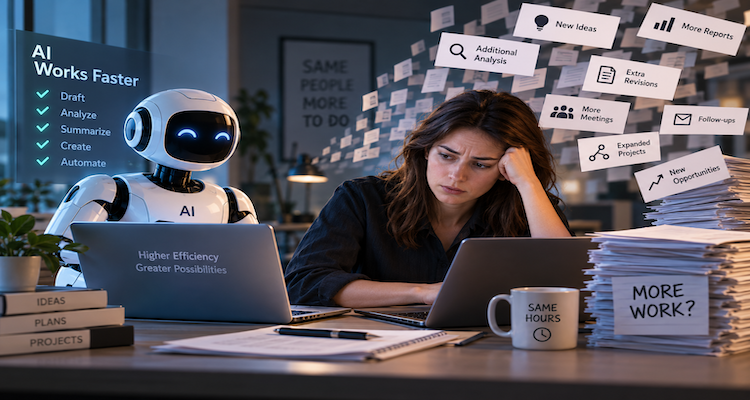
Artificial intelligence is getting better at one of the things businesses have always wanted from technology: completing tasks faster. Generative AI can draft emails, summarize documents, produce code, analyze information and help workers move through routine knowledge tasks more quickly. Controlled studies have found measurable productivity gains in customer support, software development and other forms of knowledge work.
But there is a less obvious consequence of becoming faster: when the cost of completing a task falls, organizations may respond by asking for more tasks to be completed.
That does not mean AI inevitably makes people work longer. Some research shows the opposite: workers can save time and reduce work outside normal hours. The more interesting question is what happens after those initial savings reach the organization. If a worker can produce twice as much analysis, content, code or correspondence in the same amount of time, does the organization accept the time saving or does the amount of expected output rise?
Emerging research suggests that productivity and workload are separate questions. AI can make individual tasks more efficient while changing the amount, pace and expectations of work around those tasks.
Key Takeaways
- AI can reduce the time required for individual tasks without automatically reducing the total amount of work assigned.
- Research shows productivity gains vary considerably by occupation, experience level and type of task.
- Time saved by AI can be absorbed by higher output expectations, additional tasks or more rounds of review.
- Some workplace experiments have found reduced email time and less work outside regular hours, showing that heavier workloads are not inevitable.
- The biggest organizational question may be who captures AI-generated time savings: workers, managers, customers or shareholders.
- AI productivity should therefore be measured by outcomes and workload, not simply by how quickly individual tasks are completed.
The Productivity Paradox Hiding Inside AI
The simplest way to think about AI productivity is:
Same work + less time = productivity gain.
But organizations rarely operate that simply.
Suppose an analyst previously needed four hours to prepare a market briefing. An AI assistant reduces the drafting and research process to two hours. The company now has several choices. The analyst could spend the remaining two hours on deeper analysis, leave work earlier, help colleagues, or take on another assignment.
Only some of those choices reduce the worker’s workload.
The others increase the organization’s productive capacity.
This distinction is important because productivity measures what can be produced from a given amount of input. Workload measures how much work is actually demanded. A technology can improve the first without reducing the second.
Research on AI already demonstrates this separation.
A large field experiment involving more than 7,000 knowledge workers across 66 firms found that workers given access to generative AI spent about two fewer hours per week on email among users of the tool during the latter part of the experiment. They also reduced time working outside regular hours. Yet researchers did not detect a corresponding change in the quantity or composition of workers’ tasks from individual-level AI access.
That is an important result because it complicates the popular idea that AI automatically converts saved minutes into more work.
In that experiment, at least, workers saved time without simply filling the saved time with a larger measured task load.
The organizational response can nevertheless be different.
When Faster Work Creates More Work
There are several mechanisms through which efficiency can translate into greater workload.
1. The output target moves
If a writer could previously produce five well-researched briefs in a week and AI makes the process substantially faster, management may eventually ask for seven.
The technology has not failed. It has done exactly what it was supposed to do.
But the worker’s free time has disappeared.
This is a familiar feature of productivity improvements. When the cost of producing something falls, organizations have an incentive to produce more of it.
AI potentially makes this especially powerful because it can reduce the cost of producing many forms of digital work: drafts, presentations, reports, software code, marketing variations, customer responses and internal documentation.
2. Higher quality becomes the new baseline
AI can also change expectations without anyone formally increasing a quota.
A manager who once accepted a basic report may now expect a report containing additional scenarios, more supporting evidence, clearer visualizations and several rounds of revision because AI has made those additions cheaper.
The amount of work expands through quality expectations rather than a larger numerical target.
This is particularly significant for knowledge work, where the boundary between “finished” and “could be improved” is often flexible.
3. Faster production creates more opportunities for iteration
AI makes experimentation cheaper.
A team can generate five marketing concepts instead of two. A developer can explore several implementation approaches. An analyst can model additional scenarios. A researcher can compare more possibilities.
Each individual step may take less time.
The overall workflow can nevertheless become larger.
This is one reason the phrase “AI saves time” can be misleading when treated as a complete description of productivity. Saving time on one step can make it economically rational to add more steps.
AI Can Increase Productivity Without Increasing Everyone’s Work
The evidence is important precisely because it does not support a simple “AI means longer hours” conclusion.
A 2023 NBER study of 5,179 customer-support agents found that access to a generative AI assistant increased issues resolved per hour by about 14% on average. The gains were much larger for novice and lower-skilled workers, while effects were considerably smaller for more experienced and highly skilled workers. The study also found improvements in customer sentiment and evidence consistent with worker learning.
More recent research on software developers similarly found productivity gains across three field experiments involving 4,867 developers. The combined estimate indicated a 26.08% increase in completed tasks, although the researchers emphasize uncertainty around the estimate and variation across experiments.
These findings establish something important: AI can genuinely make workers more productive.
They do not, however, establish what organizations will do with the additional capacity.
That is a separate economic and managerial decision.
The Missing Variable Is What Happens to the Saved Time
Imagine three companies adopting the same AI system.
Company A uses the productivity gain to reduce overtime and give employees more discretionary time.
Company B keeps working hours unchanged but reallocates employees to higher-value projects.
Company C increases output targets because the same workforce can now produce more.
All three companies could report an improvement in productivity.
Only the first necessarily produces a reduction in workload.
This is why employee experience can diverge sharply from an organization’s productivity statistics.
The OECD has identified increased work intensity as one of the workplace risks associated with AI, alongside concerns involving surveillance, data collection and inequality. At the same time, its survey evidence found that many workers reported improved performance and greater enjoyment of work after using AI.
Both things can be true.
AI can make work easier while making the pace of work faster.
The “Extended Workday” Question
One recent line of research makes the issue even more interesting.
A 2025 NBER working paper examining individual time-diary data from 2004 through 2023 reported that greater occupational exposure to AI was associated with longer workdays and less leisure time. The researchers argue that the relationship is consistent with AI complementing human labor and increasing the marginal productivity of workers rather than simply replacing them. They also report stronger effects where monitoring efficiency and competitive pressures are greater.
This is an association, not proof that AI caused every additional hour of work.
That distinction matters.
Workers in highly AI-exposed occupations may differ from other workers in many ways, and the study uses historical and observational data rather than a simple randomized experiment showing that AI directly caused longer hours.
Still, the finding illustrates a plausible economic mechanism: when technology makes a worker more productive, the economic value of another hour of that worker’s time can increase.
If the worker’s bargaining power is weak, more of that productivity may be captured through additional output rather than additional leisure.
AI May Also Create More Tasks Than It Removes
There is a broader economic explanation for why productivity improvements do not necessarily shrink the amount of human work.
Economists Daron Acemoglu and Pascual Restrepo have developed a task-based framework distinguishing between automation, which can replace labor in existing tasks, and the creation of new tasks, which can generate new demand for human labor. Their research emphasizes that technological change can simultaneously displace workers from some activities while creating new activities in which people remain productive.
AI makes this distinction particularly relevant.
Consider software development.
If AI can generate routine code faster, developers may spend less time writing boilerplate. But the organization may then devote more effort to testing, security, product experimentation, documentation, customization and new software projects.
Some old tasks become cheaper.
New tasks become economically worthwhile.
The result is not necessarily less work. It can be different work at a larger scale.
The International Labour Organization’s 2026 research on the “aggregation paradox” makes a related point from another direction: substantial productivity improvements observed at the task and individual-worker level have not yet translated into clear AI-driven productivity growth at the economy-wide level. The ILO points to uneven adoption, organizational changes, skills, diffusion and measurement as factors affecting whether local productivity gains become broader economic gains.
That gap between task-level efficiency and organization-level outcomes is central to understanding the AI productivity debate.
The Real Risk Is Not That AI Saves Too Much Time
The more important risk is that organizations misunderstand what productivity improvement actually means.
If AI cuts the time needed to complete a task by 30%, that does not automatically mean an employee has gained 30% more free capacity.
The organization might use that capacity for:
- more customers;
- more product experiments;
- faster response times;
- additional reporting;
- more frequent updates;
- more personalized services;
- more software releases;
- more documentation;
- additional analysis;
- or simply higher performance expectations.
In some cases, that is beneficial. More output can mean better services, lower prices, higher wages or economic growth.
The problem arises when the productivity gain is treated as an unlimited source of additional capacity.
AI systems can also introduce their own work. Outputs require checking, editing, fact verification, security review and contextual judgment. The exact balance depends heavily on the task. Research on knowledge workers has found that AI can improve performance on some tasks while producing weaker results on others, illustrating what researchers have described as a “jagged” technological frontier.
A faster first draft can therefore create a larger review pipeline.
What Businesses Should Measure Instead
Organizations evaluating AI should look beyond a simple question such as “How much faster did the employee complete the task?”
A better measurement framework would examine at least four dimensions:
Productivity: Did output or quality improve for the same resources?
Workload: Did the amount of work assigned to employees increase?
Work intensity: Did employees have to work at a faster pace or respond to more demands?
Worker benefit: Did the productivity gain translate into higher pay, shorter hours, greater autonomy, better work or simply more output?
These measurements can tell very different stories.
An organization might discover that AI reduced the time required to prepare reports by 40%, while the number of reports produced increased by 60%. In that situation, the company has achieved an impressive productivity improvement—but employees may not experience any reduction in workload.
That distinction should be part of AI adoption decisions from the beginning rather than discovered after burnout, turnover or resistance appears.
The Question of Who Captures the Productivity Gain
The deepest issue is therefore not whether AI is productive.
The evidence increasingly suggests that it can be.
The harder question is who receives the benefit of that productivity.
There are several possible destinations:
- employees through shorter working hours;
- employees through higher wages or greater autonomy;
- companies through higher margins;
- customers through lower prices;
- businesses through greater output;
- society through new products and services.
There is no technological law determining the answer.
Workplace rules, management practices, competition, labor-market conditions, worker bargaining power and organizational choices all influence how productivity gains are distributed. The ILO’s recent research similarly emphasizes that translating AI’s task-level gains into broader productivity depends on organizational transformation, skills, diffusion and institutional conditions.
That means the “AI will save us time” narrative is incomplete.
AI can create the capacity for more leisure.
It can also create the capacity for more work.
The technology determines what becomes possible. Organizations and institutions determine what becomes expected.
Conclusion
AI efficiency does not have a predetermined relationship with workload.
A faster worker can finish earlier, produce more, perform more sophisticated work or be given enough additional tasks to remain just as busy as before. Current research provides evidence for several of these outcomes rather than a single universal pattern. Controlled experiments demonstrate meaningful productivity gains, while other research raises the possibility that increased productivity can be associated with longer working hours or greater work intensity.
For businesses, the lesson is straightforward: AI productivity should not be measured only by how much time a technology saves. It should also be measured by what happens to the time after it is saved.
If the result is better work, greater autonomy and sustainable workloads, AI can make work genuinely better.
If every saved hour simply becomes another target, another report, another meeting, another customer or another deadline, then AI may reduce the time required for work without reducing the amount of work people have to do.
That is the productivity paradox worth watching not whether AI can make people faster, but whether becoming faster gives people more freedom or simply gives organizations the ability to ask for more.
This content is published for informational or entertainment purposes. Facts, opinions, or references may evolve over time, and readers are encouraged to verify details from reliable sources.