










The Shoulder-Season Shift: Why More Travelers Are Rethinking Peak-Month Holidays
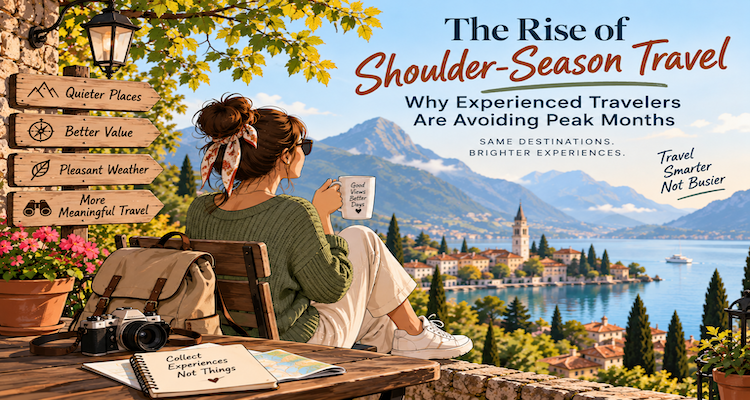
For decades, the conventional travel calendar has been easy to understand: summer for Mediterranean beaches, winter for ski resorts, and school holidays for family trips. But that calendar is becoming less attractive to a growing number of travelers.
The alternative is the shoulder season the periods just before and after a destination’s busiest months. Think April and May rather than June through August, or September and October rather than the height of summer.
The appeal is hardly mysterious. Shoulder-season travel can mean fewer crowds, more manageable temperatures, greater flexibility and, in some destinations, better value. But a more important change is taking place underneath those practical advantages: the traditional definition of the “best time to visit” is becoming less stable.
Tourism research has long documented the concentration of visitors into particular months and the economic, environmental and social pressures that result. More recently, European travel data has begun showing stronger demand outside the traditional summer peak, while climate research is making the reasons for reconsidering midsummer travel increasingly difficult to ignore.
Key Takeaways
- Shoulder-season travel can reduce exposure to peak crowds while offering many of the same destination experiences.
- European travel data shows stronger interest in quieter and less conventional destinations and periods.
- Rising summer heat is making timing a practical consideration, especially in southern Europe.
- Shoulder season is not automatically cheaper; demand, events and weather can still push prices higher.
- Travelers willing to move beyond July and August can sometimes gain more flexibility without changing the destination.
- Climate change could gradually extend some tourism seasons while making traditional peak periods less attractive.
Peak Season Was Built Around Constraints
The traditional tourism calendar did not emerge simply because July and August were universally the most pleasant months to travel.
School holidays, workplace schedules, weather patterns, transport availability and established tourism infrastructure all helped concentrate demand. Once hotels, airlines, attractions and local businesses organized themselves around those patterns, the calendar became self-reinforcing.
Tourism researchers have studied this phenomenon for decades. Seasonality is not limited to one annual high point: demand can vary by month, week and even day, producing substantial differences in visitor concentration. Academic research has linked this concentration to economic inefficiencies, pressure on infrastructure and social and ecological impacts at destinations.
For travelers, however, the problem is more immediate.
A famous city during its busiest weeks can mean crowded public transport, queues at major attractions, heavily booked restaurants and accommodation, and less room for spontaneous decisions. A beach destination can face similar pressure when a large proportion of its annual visitors arrive within a narrow window.
The shoulder season changes the equation by spreading travel across a wider portion of the year.
The Data Shows Interest in Quieter Travel
There are signs that this is more than an internet travel fad.
In its 2025 monitoring of intra-European travel, the European Travel Commission reported that 55% of surveyed Europeans were seeking less popular or off-the-beaten-path destinations for their next trip. The survey covered major European source markets and the June-November 2025 travel horizon.
That figure does not mean 55% of Europeans have switched to shoulder-season travel. It measures destination preferences, not a wholesale abandonment of peak periods. But it is consistent with a broader desire to avoid the most concentrated forms of tourism.
More recent European tourism data provides another clue.
The European Travel Commission’s Q4 2025 report found that travel demand remained strong into autumn and early winter. It also reported particularly strong growth in several Northern and Central/Eastern European destinations, including Finland, Norway, Poland, Slovakia and Hungary.
The same report observed that demand had begun moving more toward shoulder periods in parts of Europe, with some destinations recording stronger autumn performance than summer.
That is an important distinction.
The story is not that travelers have suddenly stopped wanting summer holidays. Summer remains enormously important to European tourism. Rather, the travel year is becoming more flexible at its edges.
Climate Is Changing the Calculation
One of the strongest reasons to reconsider peak-season travel has little to do with hotels or airfare.
It is temperature.
The European Environment Agency notes that tourism is highly dependent on weather and climate. Its assessment warns that increasing heat, wildfires, water scarcity and other climate hazards can affect destinations and tourism infrastructure. It specifically identifies heat stress as a factor that can reduce the attractiveness of southern Europe during summer.
That matters because the traditional peak season can coincide with precisely the period when some destinations are experiencing their most difficult conditions.
The issue is not simply whether a traveler can tolerate a hot afternoon. Extreme heat can change how a holiday works.
A visitor walking through a historic city may need to rearrange sightseeing around cooler hours. Hiking can become less comfortable or riskier. Outdoor attractions may lose some of their appeal. Air conditioning becomes more important. Wildfires, drought and extreme weather can create additional disruptions.
Europe’s summer 2025 illustrated the problem. Copernicus reported that it was the continent’s fourth-warmest summer on record, with substantial heat stress across central and southern Europe. Parts of the Iberian Peninsula, Balkans, Greece and Türkiye experienced at least one day of extreme heat stress under the report’s methodology.
This does not mean every summer destination has become unpleasant, nor does it prove that climate change is directly causing every traveler’s decision to move their holiday.
It does mean that weather is becoming a more consequential variable in travel planning.
The Shoulder Season Can Change the Experience, Not Just the Price
Price is often presented as the main reason to travel outside peak season. That is too simplistic.
Shoulder-season travel can be valuable even when the savings are modest.
Consider a destination where the main attractions remain open in September or October but visitor numbers are lower. The practical benefit may be more important than a discounted hotel room.
A traveler may spend less time waiting and more time actually experiencing the destination.
That can matter particularly in cities where the attractions themselves are the reason for visiting.
Museums, archaeological sites, historic districts, restaurants, markets and walking routes do not necessarily become less interesting because the calendar has moved beyond August. In some cases, the experience can improve simply because there are fewer simultaneous demands on the same physical space.
Tourism research supports the broader idea that seasonality affects how resources and visitor flows are managed. Studies have examined how tourism demand varies across months and weeks and how destinations can use counter-seasonal strategies to spread demand more effectively.
For travelers, that translates into a straightforward principle:
The best travel month is not necessarily the month with the highest number of visitors.
But Shoulder Season Is Not a Universal Bargain
There is an important myth to avoid.
Shoulder season does not automatically mean cheap.
Prices are determined by many factors besides visitor volume. A major festival, sporting event, school holiday, convention or unusually strong demand can push accommodation prices upward even outside the traditional peak.
Airline schedules can also change. Some seasonal routes may operate less frequently or disappear altogether. Certain hotels and restaurants may close temporarily. Mountain destinations can have limited facilities before or after their main season.
Weather is another trade-off.
September in one destination may deliver excellent conditions. October somewhere else may bring frequent rain. April can be ideal for city travel but too cool for a beach holiday. A shoulder-season trip therefore requires more research than simply choosing the month with fewer tourists.
This is where experienced planning matters more than the label itself.
The goal should not be “travel off-season at all costs.”
It should be “find the period when the destination works best for the experience you actually want.”
The Geography of Tourism May Be Changing
The most interesting implication goes beyond individual holidays.
If travelers increasingly adjust the timing of trips because of heat, crowds, prices or flexibility, tourism itself can become less concentrated geographically and seasonally.
European climate research has already explored this possibility. Climate-ADAPT notes that Mediterranean beach destinations could face losses in summer overnight stays under climate-change scenarios, while beach tourism in other parts of Europe could benefit from changing conditions. Research summarized by the European Environment Agency also indicates that warmer regions may experience a shift toward shoulder seasons, while cooler destinations could become more attractive during traditional peak periods.
This should not be interpreted as a precise forecast of where travelers will go in 2035 or 2050. Tourism depends on far more than temperature: transport, infrastructure, prices, marketing, safety, accommodation and cultural attractions all matter.
But the direction is significant.
A travel industry designed around a narrow definition of “high season” may increasingly need to operate across a broader calendar.
What This Means for Travelers
The practical lesson is surprisingly simple: stop asking only when a destination is busiest, and start asking when it is most suitable for you.
Before booking, consider five questions:
- What is the primary purpose of the trip? Beach, hiking, museums, food, wildlife and city exploration have different ideal periods.
- How sensitive are you to heat? This is becoming increasingly relevant for southern European destinations.
- What actually closes outside peak season? Check attractions, restaurants, transport links and seasonal businesses.
- What happens to prices during your exact dates? Never assume “shoulder season” equals cheap.
- Can you shift by a week or two? Small changes can sometimes produce a very different balance between crowds, weather and availability.
For travelers with flexible schedules, this last question may be the most useful.
You do not necessarily have to replace August with January. Moving a trip from late July to early September, or from August to October where conditions permit, can be enough to change the character of a destination.
The New Luxury May Be Flexibility
Travel has traditionally treated availability as a limitation: go when work allows, when schools close, when flights operate and when everyone else is going.
The growing shoulder-season movement suggests another model.
Flexibility itself becomes part of the travel experience.
Instead of asking, “When does everyone go?”, flexible travelers can ask, “When does this place make the most sense?”
That question incorporates weather, crowd levels, opening schedules, transportation, cost and the type of experience being sought. It also reflects a broader reality in European tourism: travel demand is strong, but the pattern of that demand is not necessarily fixed.
The evidence does not support declaring the death of peak season. Summer will remain central to global tourism, particularly for families and beach holidays.
But the old assumption that the busiest month is automatically the best month is becoming harder to defend.
Conclusion
Shoulder-season travel is not a secret trick for getting cheap holidays, and it is not a universal replacement for peak season.
Its real significance is more practical.
Travelers now have more reasons to question the traditional calendar: concentrated crowds, changing weather conditions, destination capacity, pricing and a growing appetite for quieter places. European tourism data already shows stronger interest in less-popular destinations and resilient demand outside the core summer period, while climate assessments suggest that some destinations may become increasingly uncomfortable during traditional peak months.
For the traveler, that creates an opportunity.
The smartest holiday may not be the one scheduled when everyone else is going. It may be the one scheduled when the destination, the weather and the experience finally line up.
This content is published for informational or entertainment purposes. Facts, opinions, or references may evolve over time, and readers are encouraged to verify details from reliable sources.