










Why Historical Mistakes Sometimes Become Traditions
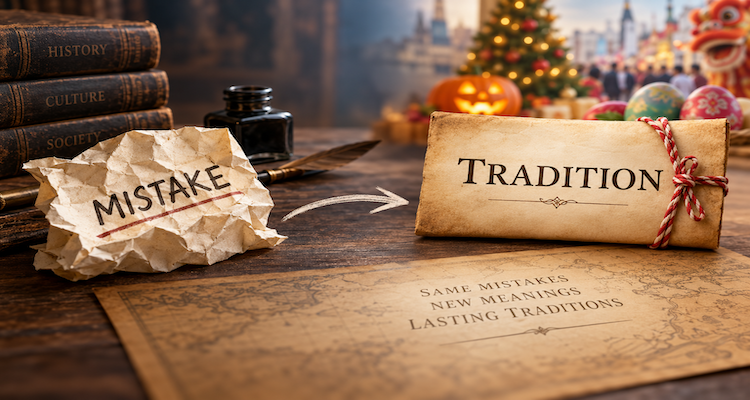
A surprising number of things that feel permanent in everyday life began as temporary solutions, accidental choices, misunderstandings, or circumstances nobody intended to preserve.
The modern keyboard is one example. The word apron contains the residue of a medieval change in how speakers divided a phrase. The clockwise movement of a clock is not dictated by physics but inherited from an older way of representing time. Even the Thanksgiving meal many people regard as an ancient American tradition took its familiar form gradually, rather than arriving fully formed at a single historic feast.
These examples point to a larger principle in cultural history: once enough people repeat a choice, the original reason for making it can become less important than the cost of changing it.
Researchers describe related processes through ideas such as path dependence, reanalysis, and cultural evolution. A historical accident does not automatically become a tradition. It becomes durable when repetition, imitation, coordination, institutions, technology, or social meaning reinforce it.
Key Takeaways
- Traditions can preserve old solutions long after the original problem has disappeared.
- Repetition can turn an arbitrary historical choice into something that feels natural or inevitable.
- QWERTY shows how skills, compatibility, and network effects can lock in a technological convention.
- Language can preserve ancient misunderstandings by turning misheard word boundaries into accepted vocabulary.
- Some traditions are not ancient survivals at all but later constructions that gradually acquired historical authority.
- A tradition’s age does not prove that its original form was optimal, deliberate, or historically accurate.
When an Accident Stops Looking Like an Accident
History rarely moves according to a clean plan.
People make decisions with limited information. Technologies are built around existing tools. Children learn what previous generations already use. Businesses invest in compatible systems. Governments formalize practices that are already widespread. Communities repeat rituals because they recognize them.
Each individual step can be quite ordinary.
The interesting part is what happens afterward.
Once a choice becomes widespread, abandoning it may become more difficult than continuing it. People learn the established system. Others design products around it. Institutions build procedures around it. New generations encounter the convention as a fact of life rather than as a decision somebody once made.
This is the basic logic behind path dependence: earlier choices can influence which options remain practical later.
Research on cultural evolution similarly emphasizes that historical development can be shaped by chance, error, limited foresight and selective retention. Cultural systems do not necessarily preserve only what was originally intended or objectively optimal.
That helps explain why asking, “Who decided this should be the tradition?” can sometimes produce an unsatisfying answer.
Nobody necessarily did.
The tradition may have emerged from thousands of small acts of repetition.
QWERTY: A Useful Example of Historical Lock-In
The computer keyboard is one of the most familiar examples of historical path dependence.
The QWERTY arrangement was developed for mechanical typewriters in the 19th century. Its history became the subject of a famous economic argument by Stanford economic historian Paul A. David, who used the keyboard to illustrate how a technology can become locked into a standard through historical circumstances, compatibility and accumulated investment.
It is tempting to tell the story simply: typewriter manufacturers deliberately made keyboards inefficient to slow typists down, and the inferior layout somehow survived.
That version is too neat.
Later scholarship has challenged several popular stories about QWERTY’s origin and argued that the historical development was more complicated. Research from the University of Strathclyde, for example, found evidence supporting the broader idea of path dependence while also questioning simplistic explanations of why particular key arrangements emerged.
What is much less controversial is the mechanism that helped QWERTY persist.
Once large numbers of typists learned one layout, employers could hire people who already knew it. Training programs could teach it. Manufacturers could build compatible machines. Typists accumulated skills that were costly to abandon.
The keyboard therefore acquired something more powerful than a technical advantage: an ecosystem.
A different layout might have been attractive in some circumstances, but switching would require users, teachers, manufacturers and businesses to coordinate.
That is why calling QWERTY simply a “mistake” misses the deeper lesson.
A historical choice can become difficult to reverse even without being objectively the best possible choice.
Language Is Full of Mistakes That Became Normal
Perhaps the clearest examples come from language.
Words are not always transmitted perfectly from one generation to another. Speakers hear sounds differently, word boundaries can become unclear, and unfamiliar expressions can be interpreted through patterns people already understand.
Linguists call one such process reanalysis.
A classic English example is apron. The word ultimately developed from the earlier form a napron. Over time, the boundary between the article and the noun was reinterpreted: what had been understood as “a napron” became “an apron.” Cambridge linguistic scholarship uses this example to illustrate morphological rebracketing.
The same kind of process affected nickname. The earlier word was ekename, meaning an additional name. The phrase “an ekename” was reinterpreted so that the initial n became attached to the noun, producing the form that eventually became nickname.
From one perspective, the change began with a misunderstanding.
From another, calling it an error is misleading.
Once enough speakers adopt the new form, the new form becomes the language.
There is no central authority capable of announcing that millions of speakers must return to the old pronunciation. The community itself becomes the mechanism of standardization.
What began as variation can become grammar.
What began as misdivision can become vocabulary.
And what began as an unintended change can eventually become so familiar that the original form sounds wrong.
Why Clock Hands Move Clockwise
Look at an analog clock and the direction seems almost inevitable.
It is not.
There is no law of physics requiring a clock hand to travel clockwise. A mechanical clock can be constructed to move in the opposite direction.
The familiar convention is connected to earlier systems of timekeeping. NASA’s educational material on sundials explains that, in the Northern Hemisphere, the shadow cast by a simple vertical sundial moves clockwise around the dial during the day. The historical explanation commonly given for clock hands is that mechanical timekeeping inherited this familiar directional pattern.
That does not mean somebody made a mistake when designing the first clocks.
It demonstrates something subtler: geography can become convention.
Early European clockmaking developed in the Northern Hemisphere, where this particular sundial pattern was familiar. Once clock faces, numbering and hand movements became established, changing direction offered little practical benefit.
The convention spread with the technology.
Eventually, people everywhere learned to interpret clockwise movement as normal even in places where the original astronomical circumstances were different.
The important point is not that clockwise is “wrong.”
It is that the alternative was perfectly possible.
History made one possibility familiar and the other strange.
Traditions Can Also Be Created After the Event
Sometimes the historical mistake is not in the original event but in the story later generations tell about it.
Thanksgiving provides a useful example.
The popular image of the first Thanksgiving often presents a recognizable meal of turkey, pumpkin pie and other foods that have become associated with the holiday. But the surviving historical evidence does not provide a complete menu matching the modern version.
The Smithsonian’s National Museum of American History notes that there is no historical record confirming turkey, pumpkin pie or football as elements of the 1621 celebration in the way the modern popular image suggests. The museum also explains that Thanksgiving became a national holiday much later, in 1863.
Turkey did eventually become central to the holiday’s public image, but that association developed over time. Smithsonian research notes that wild fowl was present at the 1621 feast, while the specific turkey-centered image became increasingly established during the 19th century. Sarah Josepha Hale played an important role in promoting Thanksgiving as a national holiday and in popularizing the turkey-centered version of the celebration.
This is important because traditions do not have to be invented all at once.
They can be assembled retrospectively.
A real event occurs.
Later generations select certain details.
Those details are repeated in stories, books, schools, advertisements, ceremonies and family practices.
Eventually the reconstructed version becomes more culturally familiar than the incomplete historical record.
The tradition is real even when the popular explanation for its origin is not entirely accurate.
Why People Preserve Things They No Longer Need
Historical persistence becomes easier to understand when the cost of changing a convention is considered.
Imagine a practice used by one person.
Changing it is easy.
Now imagine a practice shared by a family.
Changing it requires agreement.
Make it a community practice, and coordination becomes harder.
Make it an institutional standard, and changing it can require new training, equipment, laws, software, documentation and habits.
At that point, the question is no longer simply:
“Is there a better way?”
It becomes:
“Is the better way worth the cost of changing everything connected to the old one?”
This is why historical systems can survive after the circumstances that created them disappear.
The old arrangement may have accumulated what economists and social scientists describe as increasing returns or network effects: the more people use a standard, the more useful it becomes because other people are using it too.
Language works similarly.
So do technological standards.
So do social rituals.
So do institutional procedures.
A convention can therefore become self-reinforcing without anyone believing that it is perfect.
Tradition Gives Old Choices a New Meaning
There is another reason historical accidents survive: people eventually stop experiencing them as accidents.
They become symbols.
A particular food becomes associated with a holiday.
A particular gesture becomes associated with respect.
A particular route becomes part of a ceremony.
A particular design becomes recognizable as traditional.
At that stage, removing the practice is no longer a technical decision. It can feel like removing part of a community’s identity.
This helps explain why traditions can survive even when people know their original purpose has disappeared.
The meaning has changed.
The tradition no longer needs to perform the function that originally produced it.
It now performs a social function: connecting people to one another and to a shared sense of continuity.
That distinction matters.
A practice can be historically accidental and culturally meaningful at the same time.
The Danger of Calling Every Old Practice a Mistake
There is a temptation to look backward and divide traditions into two categories: sensible practices and stupid historical errors.
History is rarely that simple.
QWERTY, for example, should not be reduced to the claim that somebody intentionally designed a “bad” keyboard. The evidence surrounding its development is more complicated, and researchers have disputed parts of the conventional story.
Likewise, clockwise clocks are not a technological failure. They are a perfectly functional convention whose particular direction was shaped by historical circumstances.
And linguistic changes such as a napron becoming an apron are not mistakes in modern English. They are examples of how languages naturally evolve.
The more useful concept is historical contingency.
Something could have developed differently.
But once one version becomes established, later generations inherit the consequences.
That is a more powerful idea than simply saying that history preserves mistakes.
What This Means for Modern Life
The lesson extends beyond amusing historical trivia.
Whenever a society inherits a system, it is worth asking three questions:
- What problem was this originally designed to solve?
- Does that problem still exist?
- What would have to change if we replaced the system today?
Those questions are especially relevant to technology, business and public institutions.
An old procedure may survive because it is useful. But it may also survive because employees are trained around it, software depends on it, customers expect it, regulations reference it, or nobody wants to bear the cost of changing it.
The same logic applies to personal habits.
People often continue doing something because “that’s how it has always been done.”
Sometimes that is a good reason.
Sometimes it is merely evidence that the practice has successfully reproduced itself.
The distinction is worth making.
Tradition can be accumulated wisdom but it can also be accumulated inertia.
Often, it is a mixture of both.
Conclusion
History does not preserve only the best ideas.
It preserves what gets repeated.
A temporary solution can become a standard. A misheard word can become ordinary vocabulary. A geographic circumstance can become a worldwide convention. A later interpretation of an event can become a tradition that feels older and more certain than the evidence allows.
That does not make every tradition foolish or every old practice obsolete.
It simply means that familiarity is not proof of necessity.
The most revealing question to ask about an inherited custom, technology or institution may therefore be surprisingly simple:
Was this designed to be this way or did history merely leave it this way?
That question does not require us to abandon tradition. It gives us a better way to understand what tradition actually is: the accumulated result of choices, accidents, adaptations and meanings that survived long enough to feel inevitable.
This content is published for informational or entertainment purposes. Facts, opinions, or references may evolve over time, and readers are encouraged to verify details from reliable sources.