










Why Being Reachable Is Becoming a Lifestyle Choice People Are Rethinking
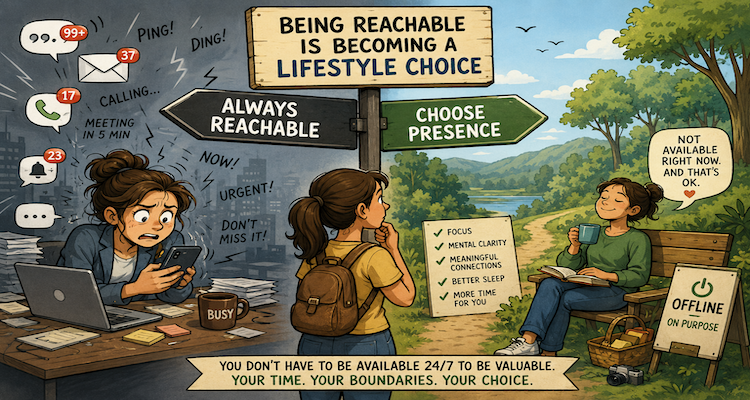
For years, being easy to reach was treated as a modern advantage. A phone in your pocket meant family could find you, colleagues could contact you, customers could get an answer and friends could expect a quick reply. The disappearance of distance made communication easier and gradually made constant availability feel normal.
That assumption is beginning to look less universal.
People are not abandoning digital communication. Instead, they are becoming more selective about when communication deserves their attention. Turning off notifications, deleting social-media apps, setting screen-time limits and creating firmer boundaries around work are increasingly recognizable forms of digital self-management. Deloitte’s 2025 Digital Consumer Trends research, for example, found that half of UK consumers had turned off all notifications for one or more apps, while 18% had set screen-time limits.
The important shift is therefore not from “connected” to “disconnected.” It is from permanent availability toward intentional availability.
Key Takeaways
- Constant connectivity has made accessibility easier, but it has also made attention harder to protect.
- Notification controls are becoming practical tools for managing digital attention rather than signs of rejecting technology.
- Workplace communication shows why being reachable can become a structural expectation rather than a personal choice.
- The emerging right-to-disconnect debate reflects growing concern about the boundary between work and personal life.
- Being unreachable for periods of time can be a deliberate lifestyle decision without requiring a complete digital detox.
The expectation of an immediate reply has changed communication
A message used to imply that someone would respond when they had the opportunity. Smartphones changed that expectation.
The technology itself did not create a universal rule that every message must receive an immediate response. But read receipts, typing indicators, push notifications, group chats and mobile email made the recipient’s availability more visible.
The result is a subtle change in social expectations: if someone can technically see a message, people may assume they can respond to it.
That distinction matters.
Communication technology gives people more flexibility, but flexibility can become obligation when availability is assumed rather than negotiated. The American Psychological Association has documented this tension for years. Its research on work-related communication found that technology could increase productivity and flexibility while also making it harder for some workers to stop thinking about work or take breaks.
The problem, then, is not simply the number of messages.
It is the disappearance of a clear boundary between receiving information and being responsible for responding to it.
The smartphone has turned availability into a background condition
The scale of digital connectivity helps explain why this issue feels different from earlier forms of communication.
Pew Research Center reported in 2024 that 41% of U.S. adults said they used the internet almost constantly. Among adults aged 18 to 29, that figure rose to 62%.
Those numbers do not mean that all of these people are constantly answering messages. Being online is not the same as being socially or professionally available.
But it illustrates how thoroughly internet access has moved into everyday life.
The smartphone is simultaneously a communication device, navigation tool, entertainment system, workplace terminal, banking interface, camera, news source and social connection. Disconnecting from one function can therefore feel like disconnecting from several others.
That is one reason why the emerging response is often selective rather than absolute.
Someone may want calls from family while blocking social-media notifications. A worker may remain available for genuine emergencies while ignoring routine messages outside working hours. A traveler may use a phone for maps and translation while keeping social applications closed.
The new question is less “Should I disconnect?” and more “What exactly am I willing to be reachable for?”
Notification fatigue is changing the meaning of convenience
Notifications were designed to make digital services more useful by bringing information to the user.
Over time, however, the same mechanism can turn the phone into an attention-management problem.
Deloitte’s 2025 Digital Consumer Trends research found that 50% of UK consumers had turned off all notifications for at least one app, while one in five consumers had deleted a social-media application during the previous year. Among Gen Z respondents, the share deleting a social-media app was higher.
This does not prove that society is rejecting social media or smartphones. People frequently reinstall applications, move between platforms and use different services for different purposes.
What it does show is that control over digital interruptions has become a consumer behavior in its own right.
That is a significant distinction.
The mature digital user may no longer judge an application only by what it can do. They may also judge it by how often it asks for attention.
That changes the product question from “Is this useful?” to “Is this useful enough to interrupt me?”
Work is where being reachable becomes more complicated
The lifestyle debate becomes more serious when availability is connected to employment.
Email, workplace messaging and collaboration software can make hybrid and remote work possible. They can also extend the working day psychologically even when an employee is not formally working.
A 2024 European Commission study on telework and the right to disconnect noted that information and communication technologies can support flexible working arrangements while also creating risks involving working conditions, health and safety, and work-life balance.
The issue is particularly relevant because modern workplaces can generate communication continuously.
Microsoft’s 2025 Work Trend Index, based on aggregated and anonymized Microsoft 365 activity, reported that employees in its analyzed population experienced an interruption from a meeting, email or chat roughly every two minutes during core working hours. Microsoft calculated this as 275 interruptions over a workday for its high-volume group of users. The company also notes that the telemetry excluded education and European Union tenants, so the figure should not be treated as a universal measure of all workers.
The precise number is less important than the underlying problem: digital work can create a steady stream of requests that compete for attention.
Being reachable therefore becomes a management issue, not merely a personal habit.
If an organization expects employees to respond quickly to everything, individual attempts to “use their phone less” cannot fully solve the problem. The boundary has to be supported by workplace norms.
The “right to disconnect” reflects a deeper cultural change
This is why the debate over disconnecting from work has moved beyond personal productivity advice.
European policymakers have increasingly examined whether workers need stronger protections around digital availability. A 2024 European Commission study reviewed the social, economic and legal context surrounding telework and the right to disconnect, noting both the benefits of digital flexibility and the risks created when work and non-work boundaries become blurred.
The idea is not necessarily that workers should become unreachable.
Rather, it recognizes a distinction between being able to communicate and being required to remain available.
That distinction could become increasingly important as workplaces adopt more collaboration software and AI-assisted systems. Faster communication does not automatically mean better work. If every efficiency improvement produces another stream of alerts, the time saved by automation can be partially consumed by additional coordination.
The challenge is therefore not simply technological.
It is organizational.
Being unreachable can become a form of personal autonomy
There is also a cultural dimension to this shift.
For many people, declining to answer immediately can feel like a social statement: I am busy, I am resting, I am with someone, or I simply do not want to respond right now.
That is different from ignoring people altogether.
A healthier digital boundary can be remarkably ordinary:
- checking messages at specific times instead of continuously;
- disabling non-essential notifications;
- separating work and personal communication accounts;
- using “do not disturb” settings during sleep or focused activities;
- telling colleagues or friends when a response should be expected;
- allowing low-priority messages to wait.
These approaches preserve the usefulness of connectivity without treating every incoming signal as an obligation.
The American Psychological Association’s earlier research also cautions against assuming that complete digital disconnection is automatically better. In its survey of employed Americans, many respondents said communication technology gave them greater flexibility and productivity, even as others reported difficulty taking breaks or mentally switching off from work.
That is an important counterpoint to the digital-detox narrative.
The goal does not have to be less technology. It can be better boundaries.
The next status symbol may be control over attention
For much of the smartphone era, technological sophistication meant being connected everywhere.
The opposite may now carry its own appeal.
A person who can spend an evening without responding to every notification is demonstrating something different: not a lack of access, but control over access.
This is especially relevant as devices and software become better at competing for attention. AI assistants, workplace agents, recommendation systems and increasingly personalized notifications may make digital services more useful while simultaneously increasing the number of things competing for a person’s attention.
That creates a paradox.
Technology can reduce the effort required to communicate while increasing the amount of communication people feel expected to manage.
The practical response may be a more deliberate definition of availability.
Instead of asking whether someone is online, organizations, families and individuals may increasingly need to ask: available for what, during which hours, and with what expectation of response?
Being connected does not have to mean being constantly available
There is no single ideal level of connectivity.
Some people genuinely benefit from immediate access to work, friends, family or online communities. Others find that continuous interruptions make their days feel fragmented. Many people will fall somewhere between those extremes.
The more useful lifestyle change is therefore not a collective retreat from technology.
It is the normalization of choice.
A phone can remain on without demanding that every notification deserves attention. A worker can be reachable during agreed hours without treating every evening message as urgent. A person can participate in digital culture without allowing every platform to occupy their attention throughout the day.
The emerging lesson is simple: availability is a resource, not an obligation.
As digital communication becomes more capable of reaching people at any moment, deciding when not to respond may become just as important as deciding how to stay connected.
Conclusion
Being reachable once represented freedom: anyone could contact you, wherever you were.
Increasingly, people are discovering the other side of that freedom. If everyone can reach you at any moment, your attention can become permanently open to interruption.
The response does not have to be a dramatic digital detox. It can be something much more practical a notification turned off, an evening protected from work messages, a delayed reply, or a clear agreement about when someone is available.
The deeper cultural shift is toward treating attention and availability as things people are allowed to manage deliberately.
Connectivity remains valuable. Constant accessibility does not have to be.
This content is published for informational or entertainment purposes. Facts, opinions, or references may evolve over time, and readers are encouraged to verify details from reliable sources.