










Why Educational Confidence Can Become a Trap
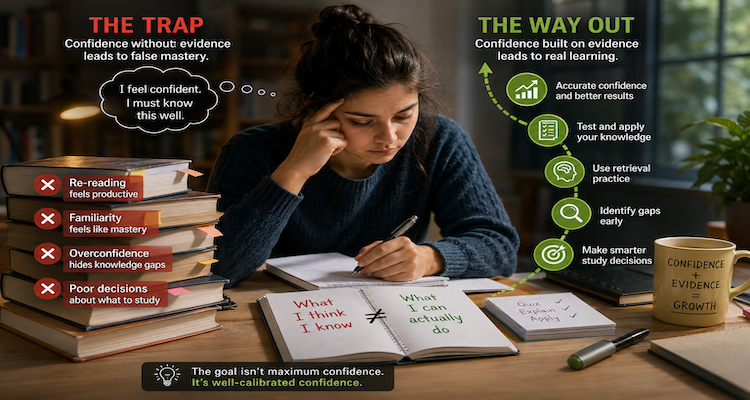
Confidence is usually treated as an educational advantage. A student who believes they can understand difficult material is more likely to attempt challenging work, persist after setbacks, and keep studying. Research on academic self-efficacy broadly supports that positive relationship: students’ beliefs about their capability are associated with academic performance, motivation and learning-related behaviors. But the evidence also points to an important qualification. Confidence is useful only when it remains connected to evidence about what a learner can actually do.
That distinction creates a less comfortable problem for education. A student can feel increasingly confident while becoming no more capable of recalling, explaining or applying the material. Familiar notes, repeated explanations and easy recognition can make knowledge feel accessible even when it cannot be produced independently. Researchers studying metacognition call this kind of mismatch a judgment-of-learning error or, more broadly, an illusion of competence.
The problem, then, is not confidence itself. It is confidence that stops being tested against reality.
Key Takeaways
- Confidence can support persistence, but it does not by itself demonstrate that learning has occurred.
- Familiarity with notes or explanations can make students overestimate how well they understand material.
- Retrieval practice gives learners better evidence about what they can actually remember.
- Accurate self-assessment matters because students use confidence to decide what, when and how much to study.
- Strong educational environments should build both self-belief and the ability to recognize knowledge gaps.
- The healthiest goal is not maximum confidence, but confidence that is appropriately calibrated to performance.
When Confidence Helps Learning
Educational confidence is not inherently misleading.
Academic self-efficacy refers to a person’s belief that they can organize and carry out the actions required to achieve a particular performance. It is different from simply feeling good about oneself. A student who believes they can solve a particular class of mathematics problems, for example, is making a task-related judgment about capability.
A systematic review of university research found a moderate positive relationship between academic self-efficacy and academic performance. The review also identified factors such as effort regulation, deep-processing strategies and goal orientations that can influence the relationship. Importantly, the authors cautioned that the available evidence did not establish a simple causal pathway in which confidence automatically produces better performance.
That matters because confidence can affect behavior.
A learner who expects to be capable may be more willing to attempt difficult work, persist when the first attempt fails, or engage with challenging goals. Conversely, a learner who assumes they cannot succeed may stop before giving themselves an opportunity to improve.
The educational objective should therefore not be to make students less confident. It should be to make their confidence informative.
The Dangerous Moment: When Familiarity Feels Like Mastery
One of the most important distinctions in learning is the difference between recognizing information and being able to retrieve or use it.
Consider a student preparing for an examination. They read a chapter, underline important passages and review their notes several times. On the third reading, the material feels easy. Definitions look familiar. The structure of the argument makes sense. Nothing appears particularly difficult.
That feeling can be genuine but it does not necessarily mean the student could reproduce the information without assistance.
Research on judgments of learning has repeatedly examined the cues people use to estimate whether they have learned something. One influential line of work shows that perceptual and processing fluency can influence these judgments. Information that feels easier to process can contribute to higher confidence even when that ease is not a reliable indicator of later performance.
A 2024 study comparing repeated reading with reading different texts found a particularly relevant pattern: participants who repeatedly reread the same material became increasingly confident in their knowledge and were overconfident about it, particularly when tested after a delay.
This is why confidence can become a trap.
The learner does not necessarily become irrational. The evidence available to the learner has simply become misleading. The material is familiar, visually recognizable and easy to process. The brain can mistake those signals for evidence of durable knowledge.
Confidence Changes Study Decisions
The consequences extend beyond a student’s feelings.
Students use judgments about their own learning to decide whether to continue studying, which topics deserve attention and which strategies to use. If confidence is inaccurate, those decisions can also become inaccurate.
Research involving 177 college students found that most students reported repeatedly reading their notes or textbooks, while relatively few reported using self-testing or retrieval practice. The researchers connected this behavior with the possibility that learners experience illusions of competence that influence how they monitor and regulate their studying.
That creates a feedback loop:
Familiarity → confidence → reduced perceived need to study → insufficient testing → unnoticed knowledge gaps.
The danger is not simply that a student gets one question wrong. The deeper problem is that the student’s internal monitoring system may tell them that further work is unnecessary.
By the time an examination exposes the gap, the opportunity to correct it may be much smaller.
Retrieval Practice Turns Confidence Into Evidence
One practical way to make confidence more useful is to force it to compete with observable performance.
Instead of asking, “Does this chapter look familiar?” a learner can close the book and ask:
“Can I explain the main idea without looking?”
Instead of rereading a definition, they can attempt to reproduce it.
Instead of watching another explanation of a concept, they can solve a new problem using it.
This is the logic behind retrieval practice.
Research with secondary-school students found that retrieval practice improved both later performance and the accuracy of students’ confidence judgments compared with a control condition. Students who practiced retrieving information were better able to align their confidence with their later performance.
Other research similarly suggests that judgments made after retrieval can correspond more closely with subsequent performance than judgments made after simply restudying material. Retrieval provides additional diagnostic information: the learner has actually attempted to produce the knowledge rather than merely encountered it again.
This changes the meaning of confidence.
A student who says, “I am 90 percent confident because I just answered nine of ten questions correctly without looking at my notes,” has a very different basis for confidence from a student who says, “I am 90 percent confident because the chapter felt easy when I reread it.”
Both are confident.
Only one has recently subjected that confidence to a meaningful test.
The Role of Metacognition
This is where metacognition becomes important.
Metacognition broadly concerns people’s awareness and regulation of their own thinking and learning. In education, it includes the ability to judge what one knows, recognize what remains uncertain and adjust learning strategies accordingly.
Research conducted in a real classroom setting with 129 psychology undergraduates found that students with stronger metacognitive skills showed better preparation practices, performance and monitoring processes. The study also found that the relationship between performance and confidence accuracy varied according to the type of test.
That finding carries an important implication: confidence should not be evaluated in isolation from the task used to generate it.
A student might perform well on recognition-based questions while struggling to produce an explanation from memory. They might understand a familiar example but fail when the same principle appears in an unfamiliar situation.
A 2019 study involving pharmacy students also found that learners often anchored confidence judgments on prior knowledge, particularly early in a course. The researchers concluded that students may need help recognizing when prior knowledge is not sufficient evidence for judging current learning.
In other words, good learners need more than confidence. They need calibration.
Why “Feeling Less Certain” Can Sometimes Be Educationally Useful
This creates an apparent paradox.
An educational experience can sometimes make a student feel less confident while actually giving them better information.
A difficult retrieval question may reveal a gap that rereading concealed. A practice examination may expose weaknesses that a student did not notice while studying. Asking someone to explain a concept in their own words can reveal that their understanding is less complete than it felt during reading.
That temporary reduction in confidence is not necessarily a failure of education.
It can be a correction.
Research on metacognitive training and repeated testing has found evidence that students’ monitoring accuracy and performance can improve when they receive opportunities to make judgments and compare them with actual results. In one quasi-experimental study, metacognitive training was associated with improvements in monitoring accuracy and performance, including reductions in overconfidence for some participants.
The objective is therefore not to eliminate uncertainty.
It is to make uncertainty informative.
A student who discovers, “I thought I knew this, but I cannot explain it without my notes,” has gained valuable information. That realization tells the student what to study next.
The Dunning-Kruger Effect Is Not the Whole Story
Discussions of educational overconfidence often invoke the Dunning-Kruger effect the idea that people with low skill can have difficulty recognizing their own shortcomings.
The original 1999 study proposed that limitations in the skills required to perform a task can also impair people’s ability to recognize those limitations. Later research has questioned how broadly the effect should be interpreted and has highlighted statistical and methodological explanations for some patterns associated with it.
For education, the more useful lesson is narrower.
Students do not need to be categorized as “overconfident people” or “underconfident people.” Their accuracy can vary by subject, task, familiarity and the quality of feedback they receive.
Someone may be highly accurate when judging their ability to solve routine problems but poorly calibrated when predicting performance on unfamiliar ones.
That is why blanket advice such as “be more confident” or “be less confident” misses the real issue.
The better question is:
What evidence is this confidence based on?
What Schools and Learners Can Do Differently
A healthier learning culture does not treat confidence as the final outcome. It treats confidence as a hypothesis that can be tested.
For students, several habits can make that distinction practical:
- Retrieve before reviewing. Try to recall an explanation before opening the notes.
- Use practice questions diagnostically. Wrong answers are information about what needs work.
- Separate familiarity from recall. Ask whether you could reproduce the idea without seeing it.
- Change the context. Apply a principle to a new problem rather than only repeating the original example.
- Delay some self-assessments. Immediate feelings of fluency can be less informative than judgments made after a delay.
- Track predictions against results. If you predict an 80 percent score and repeatedly receive 60 percent, the gap is useful evidence about calibration.
Educators can reinforce the same principle by designing assessments that require explanation, retrieval, application and feedback rather than relying exclusively on recognition.
The aim is not to make every learner anxious about what they do not know. It is to give them reliable ways to discover what they know and what they still need to learn.
Confidence Should Follow Evidence, Not Replace It
Educational confidence has an important place in learning. Students need enough belief in their capacity to attempt difficult work and persist through setbacks. The research does not support treating confidence as inherently harmful; academic self-efficacy is consistently associated with positive educational outcomes, although the relationship is complex and should not be mistaken for simple causation.
The problem begins when confidence becomes detached from performance.
A familiar page can feel understood. A polished explanation can feel mastered. A correct answer remembered with a cue can feel like knowledge that will remain available without the cue. Each feeling contains information, but none should be mistaken for definitive evidence of learning.
The strongest educational confidence is therefore not the loudest or highest confidence.
It is calibrated confidence: the ability to believe in one’s capacity while remaining willing to test that belief against recall, application, feedback and results.
That is a more demanding form of confidence but also a more useful one.
For learners, the practical shift is simple: don’t ask only, “How confident do I feel?”
Ask, “What have I done that gives me reason to be confident?”
That question turns confidence from a comforting feeling into a tool for learning.
The information presented in this article is based on publicly available sources, reports, and factual material available at the time of publication. While efforts are made to ensure accuracy, details may change as new information emerges. The content is provided for general informational purposes only, and readers are advised to verify facts independently where necessary.