










Silence as a Spiritual Practice: What Happens When We Stop Filling Every Moment With Noise?
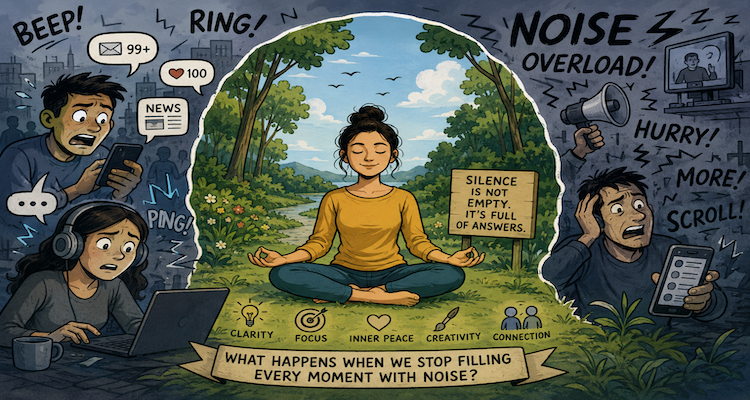
Silence is often treated as an empty space waiting to be filled. A pause in conversation invites a response. A quiet commute becomes an opportunity for a podcast. A few minutes without work can trigger a glance at a phone. Even relaxation is frequently accompanied by music, television or a stream of notifications.
Yet silence has long occupied a different role in religious and contemplative traditions. Buddhist meditation, Christian monastic practice, Hindu traditions and other spiritual disciplines have used quiet not simply as the absence of sound, but as a condition for attention, reflection and self-observation.
Modern research does not prove every spiritual claim associated with silence. It does, however, offer a useful corrective to the assumption that more stimulation is always harmless and that quiet is merely empty time. Environmental noise is now recognized as a public-health concern, while psychological and physiological research suggests that solitude, meditation and different forms of silence can affect attention, stress and emotional experience in complex ways.
The deeper question may therefore be less mystical than it first appears: what becomes available to us when we stop automatically filling every unoccupied moment?
Key Takeaways
- Silence is not one uniform experience; its effects depend on context, familiarity and whether quiet is voluntary or imposed.
- Research on environmental noise shows that excessive unwanted sound can affect sleep, well-being and other aspects of health.
- Solitude can provide opportunities for reflection and emotional regulation, but being alone is not automatically beneficial.
- Meditation research suggests links with changes in attention and brain-network activity, though silence itself should not be treated as a universal cure.
- A practical spiritual use of silence may begin with attention rather than isolation: noticing what arises before immediately seeking distraction.
Silence Is More Than the Absence of Sound
The modern discussion of silence can become confused because several different experiences are placed under the same label.
There is physical quiet: fewer external sounds from traffic, machines, media or conversation.
There is solitude: being temporarily apart from other people, which may occur in either a quiet or noisy environment.
And there is what contemplative traditions often seek as inner silence: a reduction in compulsive mental activity or a more stable relationship with thoughts and emotions.
These are related, but they are not identical.
A person can sit alone in a silent room while mentally replaying an argument, worrying about work or planning the next day. Another person can be surrounded by ordinary environmental sound yet experience a degree of mental steadiness during meditation.
This distinction matters because the evidence does not support a simplistic claim that silence automatically relaxes everyone. A 2023 systematic review examining silence and the autonomic nervous system found that responses can differ depending on whether silence is experienced internally or externally, as well as on familiarity, context and other factors. The review also emphasized the limits and complexity of the available evidence.
That nuance is useful spiritually as well. Silence is not necessarily a pleasant escape from oneself. Sometimes it removes the distractions that were preventing certain thoughts or feelings from becoming noticeable.
What Noise Does to Human Life
There is an important difference between choosing silence as a spiritual practice and simply escaping unpleasant noise. But the two discussions meet at a basic point: the human environment is not neutral.
The World Health Organization’s environmental noise guidelines describe noise as an important public-health issue and review evidence relating environmental noise exposure to outcomes including sleep disturbance, annoyance, cardiovascular and metabolic effects, cognitive impairment and well-being. The guidelines are based on systematic reviews of the evidence.
WHO’s more recent environmental-noise material notes that an estimated one in five people in the European Union are exposed to unhealthy levels of road traffic noise.
This evidence should not be stretched into the claim that every quiet room is therefore therapeutic. It does show something more basic: constant unwanted sound is not merely an aesthetic inconvenience.
The spiritual value of silence may partly begin where public-health research ends. Reducing harmful noise protects against a measurable environmental burden. Choosing periods without unnecessary stimulation may also create something harder to measure but immediately recognizable: room to notice.
The First Thing Silence Often Reveals Is Not Peace
Popular images of silence usually depict instant calm: a mountain, a monastery, a candle, a person sitting peacefully with closed eyes.
Actual silence can be less comfortable.
Without conversation, entertainment or a continuous flow of information, attention may turn toward unfinished thoughts. Boredom may appear. So may anxiety, irritation or loneliness.
That does not mean silence has failed.
Psychologists distinguish solitude from loneliness. Being physically alone does not necessarily mean feeling lonely, and solitude can provide opportunities for rest and reflection. At the same time, researchers caution against treating time alone as automatically beneficial for everyone or in every circumstance. Context, choice and the quality of the experience matter.
This distinction gives silence an overlooked spiritual function. Its purpose need not be to manufacture a pleasant emotional state. It can instead become a way of encountering experience before immediately trying to alter it.
If every uncomfortable moment is filled instantly with scrolling, conversation, music, video or work we may become highly practiced at distraction without becoming particularly skilled at attention.
Silence interrupts that automatic sequence.
Attention May Be the Real Practice
The spiritual traditions that value silence generally do not treat quiet as a magical substance. Silence is valuable because of what a person does within it.
One can spend twenty minutes in a quiet room rehearsing resentments. Another person can spend the same twenty minutes observing breathing, bodily sensations, sounds and thoughts without trying to chase each one.
Research on meditation offers some evidence that contemplative training is associated with differences in brain activity and connectivity, including in networks involved in self-referential processing and attention. A 2011 study comparing experienced meditators with meditation-naive participants examined activity in the brain’s default mode network during several forms of meditation.
A later systematic review of meditation and the default mode network found evidence that meditative interventions can affect its operation and functional connectivity, while also concluding that more research is needed before stronger claims can be made about meditation as an intervention for well-being.
These findings should not be reduced to the fashionable phrase that meditation “turns off” the mind. That is not what the research establishes.
A more useful interpretation is that contemplative practice may change how attention is directed and how habitual patterns of mental activity are engaged. Silence can provide the conditions for such practice, but silence alone is not the practice.
Why Silence Is Becoming Harder to Find
The difficulty of silence is no longer only physical.
A person may have access to a quiet room while carrying an environment of permanent interruption in their pocket. Digital devices have made it possible to fill small gaps in the day that previously might have contained waiting, daydreaming or reflection.
This does not mean technology is inherently opposed to contemplation. Music, recorded lectures, guided meditations and digital communities can all be valuable. The issue is habitual rather than technological: when does stimulation become the default response to any unoccupied moment?
That question has a cultural consequence.
A society that treats every pause as wasted time may gradually lose some of the spaces in which thought develops without immediate external input. Creativity, reflection and spiritual inquiry are different activities, but all can require periods in which attention is not constantly being redirected.
Silence, from this perspective, is not a rejection of information. It is a refusal to assume that every available second must be occupied by it.
Quiet Is Not Always Better Than Sound
The spiritual ideal of absolute silence also deserves scrutiny.
A 2024 systematic review and meta-analysis comparing natural sounds with quiet environments found that natural sounds were, overall, more beneficial for some physiological measures of stress reduction, although the evidence was not uniformly consistent and there were no significant differences for every outcome examined.
The finding points to an important distinction: the opposite of harmful noise is not necessarily total acoustic emptiness.
Birdsong, rainfall, wind and other natural sounds can create a different kind of attentional environment from traffic, alerts or amplified entertainment. Many spiritual traditions have understood this intuitively by placing contemplation in gardens, forests, mountains and other natural settings.
The lesson is not that everyone should seek complete silence. It is that the quality of what surrounds attention matters.
A Simple Way to Practice Silence Without Escaping Life
Silence does not require a retreat, special equipment or an attempt to eliminate all sound.
A practical experiment might involve ten minutes in which the goal is simply to stop adding stimulation.
That could mean:
- taking a walk without headphones;
- sitting without opening a phone when waiting for an appointment;
- beginning the morning before checking messages;
- eating one meal without media;
- spending a few minutes observing thoughts without trying to solve every problem immediately.
The important distinction is between silence as performance and silence as attention.
There is little value in turning quiet into another productivity task with a promise that every session must produce insight. Some days, silence may feel restful. On others, it may feel dull or uncomfortable.
The practice can still be useful because it changes the immediate habit of reaction.
Instead of asking, “What should I consume next?” silence creates an opportunity to ask, “What is already happening?”
The Spiritual Value of Not Filling the Gap
Perhaps the most significant thing silence offers is not peace but proportion.
It reminds us that not every thought requires a response. Not every pause needs content. Not every uncomfortable feeling must be covered with stimulation. And not every period without visible productivity is empty.
That insight connects an ancient spiritual practice with a modern behavioral problem. The issue is not that sound, technology or entertainment are inherently harmful. The problem begins when the ability to be without them starts to disappear.
Silence cannot solve every form of stress, and it should not be marketed as a substitute for medical or psychological care. The scientific evidence on quiet, solitude and meditation is varied and depends heavily on context.
But silence remains a useful practice precisely because it makes few promises.
It does not guarantee enlightenment. It does not ensure happiness. It does not make difficult thoughts vanish.
What it can do is remove, for a moment, the reflex to immediately cover experience with something else.
In that gap, small though it may be, attention has a chance to return.
Conclusion
The case for silence does not depend on romanticizing monasteries or declaring war on technology. The stronger argument is more practical: a life filled continuously with external input leaves fewer opportunities to notice what is happening internally.
Science supports concern about harmful environmental noise and offers evidence that solitude and contemplative practices can influence human experience, while also showing that silence is not universally calming and that context matters.
As a spiritual practice, silence may therefore be best understood not as emptiness but as a deliberate suspension of addition.
For a few minutes, nothing needs to be played, answered, solved or consumed.
The world does not disappear.
We simply become quiet enough to hear what remains.
This content is published for informational or entertainment purposes. Facts, opinions, or references may evolve over time, and readers are encouraged to verify details from reliable sources.
Related News
- Why Mark Zuckerberg Visited Kainchi Dham: The Neem Karoli Baba Connection Behind a Silicon Valley Story
- Kainchi Dham: How a Himalayan Ashram Became a Global Spiritual Landmark
- How Religious Architecture Continues to Shape Human Emotions Long After Belief Fades
- The New Search for Silence and Why It Is Becoming a Spiritual Movement