









Can We Really Clean the Oceans? The Science and Limits of Fighting Plastic Pollution
The idea of “cleaning the oceans” is appealing because it suggests a problem with a visible solution: build better machines, collect the floating debris and restore the sea. The science is more complicated. Large plastic waste can sometimes be intercepted or removed, particularly where currents, rivers and coastlines concentrate it. But plastic pollution is not a single floating island waiting to be vacuumed up. It is a distributed, continuously replenished problem stretching from streets and drainage systems to rivers, beaches, shipping routes, the ocean surface, the water column and the seafloor.
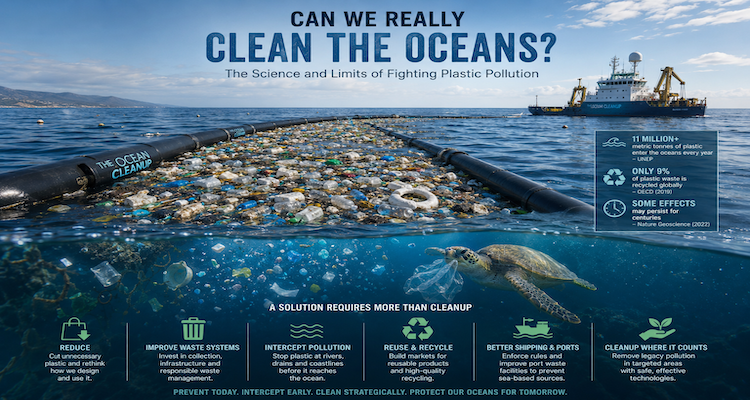
The scale explains why cleanup alone cannot solve it. UNEP estimates that more than 11 million metric tonnes of plastic enter the oceans each year. Meanwhile, plastics already in the environment continue to fragment into progressively smaller pieces, making detection and removal increasingly difficult.
The most important shift in understanding, then, is this: ocean cleanup and plastic prevention are not competing ideas, but they do not have equal leverage. Removing existing pollution can reduce immediate harm and deal with legacy waste. Preventing new leakage, however, determines whether the cleanup problem eventually becomes manageable or keeps expanding faster than technology can remove it.
Key Takeaways
- Ocean cleanup technologies can remove some concentrated floating debris, but they cannot realistically capture all plastic dispersed through the marine environment.
- Microplastics and sinking plastics present a fundamentally harder cleanup challenge than large, buoyant objects.
- The strongest evidence supports tackling plastic pollution across its entire lifecycle, not relying on downstream collection alone.
- Rivers, coastlines, ports and waste systems can offer more practical intervention points than the open ocean.
- Cleanup remains valuable for legacy pollution, but prevention determines whether the overall problem shrinks.
Cleaning the Ocean Is a Different Problem From Stopping Pollution
The phrase “ocean cleanup” can obscure a crucial distinction: removing plastic already in the sea and preventing additional plastic from entering it are separate engineering problems.
A floating bottle, abandoned fishing gear or large plastic fragment can potentially be detected, concentrated and collected. That makes cleanup technology useful in specific environments. Ocean currents can also concentrate floating debris into convergence zones, creating targets that are more practical to address than the ocean as a whole.
But much of the plastic problem is not concentrated this way.
Plastic can sink after becoming colonized by organisms, circulate at different depths, become buried in sediment or fragment into microplastics and smaller particles. The smaller and more dispersed the particles become, the harder it is to remove them without also disturbing marine organisms and other material in the water.
Research on the North Pacific Garbage Patch illustrates the fragmentation problem. A 2025 Scientific Reports study examining the environmental implications of cleanup noted that cleanup systems target floating plastic debris and do not target microplastics, while larger legacy plastic can continue breaking down into smaller particles even if new emissions are eliminated.
That means success cannot be measured simply by asking, “How much plastic can a machine collect?”
The more important question is: Can the rate of removal exceed or at least meaningfully reduce the combined flow of new pollution and the continuing fragmentation of old pollution?
That is a much harder test.
What Cleanup Technology Can Actually Do
Cleanup systems work best when the physical environment does some of the concentrating for them.
Floating debris in accumulation zones
The Great Pacific Garbage Patch is often presented in popular culture as though it were a solid island of trash. It is not. It is a dispersed accumulation of debris in a vast oceanic region. Nevertheless, areas of higher concentration can make targeted removal possible.
The Ocean Cleanup, the nonprofit behind large-scale offshore collection systems, has argued that the Great Pacific Garbage Patch could be substantially removed through sustained operations. Its estimates and cost projections are organizational claims rather than an independent guarantee, but the broader scientific point is sound: concentrated floating macroplastic is more technically recoverable than dispersed pollution.
The technology also has environmental trade-offs that require monitoring. Cleanup devices operate in ecosystems that contain marine life at or near the surface. The 2025 Scientific Reports assessment describes environmental impact assessments and mitigation measures associated with offshore cleanup systems, underlining an important principle: removing plastic is not automatically environmentally neutral simply because plastic itself is harmful.
A successful cleanup technology must therefore be judged on more than collection volume. Questions include:
- What size and types of plastic does it capture?
- What happens to marine organisms encountered by the system?
- How much energy and material does the operation require?
- What happens to the collected plastic afterward?
- Can the system operate economically at a meaningful scale?
The answers may differ sharply between open-ocean systems, river interception devices, beach cleanups and port-based waste collection.
Why Microplastics Change the Equation
The limits of ocean cleanup become much clearer when plastic becomes small.
Microplastics can originate from the breakdown of larger objects or from direct sources such as tyre wear, synthetic textile fibres and industrial plastic pellets. OECD analysis projects that, without stronger policy action, microplastic leakage will continue increasing even as the composition of plastic pollution changes.
Removing microscopic particles from a living ocean is not equivalent to skimming leaves from a swimming pool.
Marine water contains plankton, organic material, minerals and countless other particles. Some plastics float, while others remain suspended or sink. A system capable of filtering enormous volumes of seawater finely enough to capture tiny plastic particles would face major technical and ecological challenges.
This is why the “cleanup the ocean” metaphor eventually breaks down. There is no single contaminated layer that can simply be filtered.
The problem also has a time dimension. A modelling study published in Nature Geoscience examined a hypothetical scenario in which microplastic pollution stopped and accumulated microplastics were instantly removed. It found that some modeled regional effects could still persist for centuries. The study does not mean every consequence of plastic pollution is permanently irreversible, but it illustrates the long environmental commitment created by persistent pollutants.
The practical implication is straightforward: the longer plastic remains in the environment, the more difficult the problem can become.
The Most Effective Cleanup May Happen Before Plastic Reaches the Ocean
This is where the debate shifts from ocean engineering to infrastructure, policy and product design.
OECD analysis found that focusing only on downstream waste management is insufficient. In its 2024 policy scenarios, the OECD estimated that comprehensive action across the plastics lifecycle could reduce environmental plastic leakage by 96% by 2040 compared with business as usual. By contrast, a strategy focused on waste management without reducing production and demand achieved substantially less reduction in the model.
These are modelled scenarios, not guarantees. But they point to an important systems-level conclusion: plastic pollution is created upstream long before it becomes an ocean-cleanup problem.
A more effective strategy combines several layers of intervention:
Reduce unnecessary and problematic plastic
The less short-lived plastic entering the economy, the less waste must eventually be collected, recycled or contained.
UNEP’s Turning off the Tap report argues for reducing problematic and unnecessary plastic uses alongside broader changes in reuse, recycling and alternative product systems. Its scenario analysis estimated that deep policy and market changes using existing technologies could reduce plastic pollution by 80% by 2040.
Improve collection and waste management
Plastic that is never collected is far more likely to leak into rivers, coastlines and ecosystems. Waste infrastructure is therefore part of ocean protection, even when it is located far from the sea.
The OECD reported that 22% of global plastic waste in 2019 was either disposed of in uncontrolled sites, openly burned or leaked into the environment. Only 9% was ultimately recycled after accounting for recycling losses.
Intercept pollution closer to its source
Rivers, drainage systems and coastlines can provide more accessible intervention points than the open ocean. Interception does not eliminate the need for waste reduction, but preventing a plastic object from reaching the sea is generally easier than locating it after currents have dispersed it.
Address sea-based sources
Marine plastic pollution does not come only from land. Fishing, shipping and other maritime activities also contribute.
International Maritime Organization rules under MARPOL Annex V generally prohibit the discharge of plastics from ships into the sea, while implementation depends partly on practical systems such as adequate port reception facilities.
The policy challenge, therefore, is not simply writing rules. It is ensuring that ships, ports and waste systems can realistically comply with them.
The IMO’s continuing work on marine litter including its 2025 action plan and projects aimed at improving port waste management shows how prevention often depends on less visible infrastructure rather than spectacular cleanup machines.
The Business and Technology Challenge: Scale Matters More Than Spectacle
Ocean cleanup technology attracts attention because it is visible. A large collection system at sea offers a compelling image of innovation.
But the economics and engineering become more difficult when scaled.
A device may successfully collect tonnes of plastic while still representing only a small fraction of total annual leakage. Conversely, a comparatively mundane improvement to waste collection or reusable packaging can prevent pollution before it requires expensive recovery.
This does not mean cleanup technology lacks value. It means its role should be evaluated honestly.
Cleanup is most defensible where it targets pollution that is already concentrated, accessible and causing ongoing harm. Prevention is most powerful where it reduces the future flow.
These approaches also reinforce one another. If upstream policies reduce new leakage, the existing stock of recoverable pollution becomes a more finite problem. If new leakage continues unchecked, cleanup systems must operate indefinitely against a moving target.
The same logic applies to technology investment. The goal should not be to identify one machine capable of “solving” plastic pollution. It should be to build a portfolio of solutions suited to different parts of the problem:
| Intervention | Where it works best | Main limitation |
|---|---|---|
| Open-ocean cleanup | Concentrated floating macroplastic | Cannot capture all dispersed or microscopic pollution |
| River interception | Major waterways and concentrated flows | Does not stop pollution generated upstream |
| Beach and coastal cleanup | Accessible accumulation zones | Requires repeated effort if new waste continues arriving |
| Recycling systems | Recoverable and economically viable waste streams | Not all plastics are practically recyclable |
| Reuse and reduction | Products and packaging designed for repeated use or lower material demand | Requires infrastructure, consumer adoption and business changes |
| Waste collection and containment | Communities with leakage risks | Requires long-term investment and governance |
The table reveals an underappreciated point: there is no universal plastic solution because plastic leakage occurs through multiple pathways.
Can We Ever Remove All the Plastic Already in the Ocean?
Probably not in any literal sense.
The ocean is too large, plastics exist at too many sizes and depths, and some particles are already mixed into ecosystems and sediments. Claims that humanity can simply “clean the oceans” should therefore be treated with caution unless they clearly define what is being cleaned, from where and to what measurable standard.
A more scientifically defensible goal is to reduce plastic pollution progressively:
- Stop the fastest-growing sources of new leakage.
- Improve collection and containment before waste reaches waterways.
- Reduce unnecessary short-lived plastic demand.
- Design products for reuse, recovery or safer end-of-life management.
- Intercept pollution in rivers and coastal zones.
- Remove legacy debris where cleanup is technically feasible and environmentally justified.
- Monitor ecological effects and improve methods as evidence develops.
This approach may sound less dramatic than a promise to vacuum the ocean. It is also closer to what the evidence supports.
Conclusion
Yes, parts of the ocean can be cleaned. Floating debris can be removed from accumulation zones. Rivers and coastlines can be intercepted. Beaches can be restored. Ports and ships can improve waste handling. These efforts matter, especially for legacy pollution that will otherwise continue harming ecosystems and breaking into smaller fragments.
But cleaning is not the same as solving.
The central scientific and policy lesson is that ocean plastic pollution behaves like a system. It begins with production and product design, moves through consumption and waste management, travels through infrastructure and waterways, and only then becomes an ocean problem. By that stage, cleanup is often at its most difficult and expensive.
The most realistic path is therefore not to choose between prevention and cleanup. It is to assign each the role it can genuinely perform: prevent as much plastic as possible from escaping in the first place, and use cleanup strategically to reduce the legacy pollution already there.
The future of ocean cleanup may depend less on building a machine powerful enough to clean an entire ocean than on making sure the ocean eventually has less new plastic to clean.
This content is published for informational or entertainment purposes. Facts, opinions, or references may evolve over time, and readers are encouraged to verify details from reliable sources.