








The Historical Power of People Who Kept Records Nobody Thought Were Important
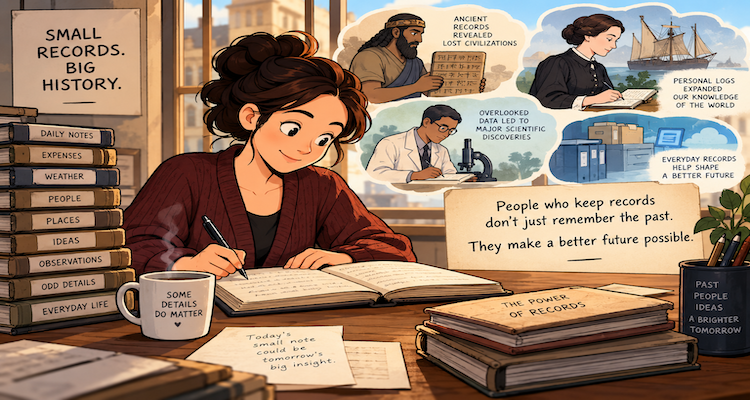
History is often associated with grand documents: treaties, royal decrees, military orders, constitutions and the writings of famous people. But some of the most revealing evidence about the past was never created with history in mind.
A shopping list. A business letter. A request for leave. A marriage contract. A child’s exercise book. A personal letter asking someone to attend a birthday party.
These records can appear insignificant when they are created. Centuries later, they can become evidence of how people actually lived.
The importance of such records is visible in collections ranging from the Roman writing tablets found at Vindolanda in Britain to the enormous Cairo Genizah collection and the life histories gathered by America’s Federal Writers’ Project. Together, they reveal something historians repeatedly encounter: official records can explain what institutions did, while ordinary records can help explain what life felt like beneath those institutions.
Key Takeaways
- Ordinary documents can reveal aspects of daily life that official histories rarely record.
- The survival of mundane records is often accidental, shaped by climate, storage practices and preservation decisions.
- Personal correspondence can expose economic networks, family relationships, work and social expectations.
- Archives do not simply preserve history; they influence which parts of the past remain visible.
- Everyday records are valuable evidence, but they must still be interpreted for bias, omissions and context.
When the Unimportant Becomes Historical Evidence
The first surprise about historical records is that their importance can change completely over time.
A document’s original purpose may have been intensely practical. Someone needed to order supplies, settle a debt, arrange a marriage, record an absence or communicate with a friend. There was no expectation that a historian thousands of years later would care.
The people who produced such records were usually solving immediate problems.
That is precisely what makes them valuable.
The U.S. National Archives describes records as evidence that can help future generations understand events and circumstances. Its explanation deliberately includes familiar objects such as letters, photographs, recordings and family documents alongside major national records.
The distinction matters because governments and institutions tend to document what governments and institutions consider important.
Ordinary people document something else: what they need.
That difference can create an entirely different view of the past.
A Birthday Invitation From Roman Britain
One of the clearest examples comes from Vindolanda, a Roman fort near Hadrian’s Wall in present-day Northumberland.
More than 1,700 writing tablets from the site are held by the British Museum, with additional discoveries continuing at Vindolanda. Many date from around the late first and early second centuries AD. They contain military reports and administrative documents, but also personal correspondence and details of everyday life.
Among the best-known is a birthday invitation written by Claudia Severa to Sulpicia Lepidina.
At first glance, a birthday invitation seems almost aggressively ordinary. It is not a declaration of war or a government order. It does not announce the rise or fall of an empire.
Yet the document provides evidence about relationships, literacy, social interaction and the lives of women associated with the Roman military community.
The British Museum identifies it as the earliest known example of a woman’s handwriting from anywhere in the Roman Empire.
Other tablets are even more mundane.
They include requests for leave, military reports, business correspondence and messages concerning supplies. One surviving letter concerns a shortage of beer. Another is a business letter from an entrepreneur supplying goods to the Roman army.
That is historically powerful because an empire is easier to understand when it stops looking like a collection of emperors and battles.
The tablets show an institution populated by people who needed food, clothing, leave, money, correspondence and social relationships.
The mundane details do not replace political history. They make political history more human and more concrete.
The Documents People Were Supposed to Throw Away
The Cairo Genizah offers an even more striking example.
For centuries, Jewish communities in Fustat, Old Cairo, placed old writings in a synagogue storeroom known as a genizah. Because texts containing the name of God were not simply discarded, documents that might ordinarily have disappeared were preserved instead.
The result was extraordinary.
The Taylor-Schechter Genizah Collection at Cambridge University Library contains roughly 193,000 manuscript fragments. The material includes religious texts, but also shopping lists, marriage contracts, divorce documents, medical writings, business letters, accounts and personal correspondence.
This changes what historians can ask.
Instead of simply asking what medieval religious authorities taught, researchers can investigate how people conducted business, organized families, traveled, dealt with illness and communicated across communities.
A discarded scrap can therefore become economic evidence.
A contract can become evidence about family structures.
A letter can reveal trade routes.
A child’s writing can offer evidence about education.
The University of Cambridge describes the collection as an unusually comprehensive window into medieval Jewish life precisely because it preserved not only texts people deliberately regarded as important, but also everyday material.
The irony is striking: some records survived because people did not consider ordinary disposal appropriate, while others survived precisely because nobody considered them historically valuable.
The Power of Records Created by Ordinary People
The same principle appears much later in American history.
Between 1936 and 1940, the Federal Writers’ Project produced approximately 2,900 life-history documents involving writers working across 24 states. These records describe the experiences of people who lived through the late nineteenth and early twentieth centuries, including factory workers, immigrants, rural residents and people who experienced the Great Depression.
The collection is valuable partly because it captures details that conventional political records were unlikely to prioritize.
People’s occupations.
Their education.
Their family circumstances.
Their income.
Their memories.
Their local customs.
Their experiences of work and migration.
The project also produced the much larger collection of interviews with formerly enslaved people that became known as the WPA Slave Narratives. The Library of Congress holds more than 2,300 first-person accounts collected in the 1930s, alongside hundreds of photographs.
These sources have enormous historical value, but they also demonstrate why preservation is not the same thing as perfect truth.
The interviews were conducted decades after slavery ended. Interviewers shaped the conversations. Transcriptions and editing affected the surviving texts. The Library of Congress notes that interviewers were instructed to reproduce aspects of spoken language, and the collection has to be understood within the circumstances in which it was created.
A record can therefore be invaluable without being neutral.
That distinction is fundamental to historical research.
The Archive Has Its Own Bias
There is another lesson hidden inside these collections: history is shaped not only by what people recorded, but by what survived.
Paper burns.
Ink fades.
Wood rots.
Buildings collapse.
Families throw away letters.
Governments destroy records.
Wars scatter archives.
Climate can either preserve material or accelerate its disappearance.
The Vindolanda tablets survived in unusually waterlogged, oxygen-poor conditions that slowed the biological processes that normally destroy organic material. Their survival was therefore partly an accident of environment.
The Cairo Genizah survived because of a very different mechanism: cultural and religious practices encouraged the retention of written material.
Neither archive represents everything people wrote.
They represent what happened to survive.
This creates what historians must constantly confront as a problem of selection.
If wealthy families preserved more documents than poor families, the surviving archive can overrepresent wealth.
If governments preserved administrative records but ordinary workers left few written traces, historians may know far more about institutions than about laborers.
If certain communities had stronger traditions of writing or preservation, their experiences may appear disproportionately visible.
The absence of a record is therefore not automatically evidence that an event, practice or experience did not exist.
Sometimes it means only that the evidence did not survive.
Why Small Records Can Change Big Historical Questions
The real value of mundane records is not that they make history more colorful.
It is that they can change the questions historians are able to ask.
A military archive can tell us how an army was organized.
A personal letter can show how soldiers and families experienced that organization.
A government census can count people.
A household document can reveal relationships within a family.
A trade record can show that goods moved between places.
A merchant’s letter can reveal the practical difficulties, timing and personal decisions behind that movement.
Cambridge’s Genizah research provides an especially useful example. Recent work on individual fragments has shown how apparently personal correspondence can provide evidence about medieval Indian Ocean trade and travel logistics.
This is why historians often care about fragments.
A fragment does not have to describe a major event to illuminate a major system.
Sometimes the system is visible only when thousands of small human decisions are placed together.
The People Who Recorded Their Lives Did Not Know They Were Building an Archive
There is a broader human lesson here.
Most people record their lives selectively.
We save receipts because we might need them.
We write messages because somebody needs information.
We keep photographs because we want to remember a moment.
We store contracts because they establish an agreement.
We save letters because throwing them away feels wrong.
The historical significance comes later.
The National Archives makes a similar point when it describes personal collections as forms of family archives. Everyday documents can preserve evidence of events and relationships even when nobody originally intended them to become historical sources.
Digital life has expanded this phenomenon enormously.
Emails, photographs, text messages, social-media posts, cloud documents, transaction histories and digital calendars are all potential records of contemporary life. But their existence does not guarantee their future preservation.
Digital information can be deleted instantly, locked behind obsolete formats, separated from its metadata or made inaccessible when a service disappears.
The historical problem has therefore changed.
Earlier generations often struggled because too little survived.
The digital generation may eventually face the opposite problem: enormous quantities of fragmented information without sufficient context.
The challenge will not simply be saving everything.
It will be determining what can still be understood.
What Future Historians May Find in Today’s Ordinary Records
A century from now, historians may care about documents that their creators currently consider disposable.
A delivery receipt could help reconstruct consumption patterns.
A workplace message could illuminate changing ideas about employment.
A personal calendar could reveal how people organized time.
A photograph of an ordinary street could document a neighborhood before redevelopment.
A discarded instruction manual could show how people interacted with technology.
None of these records needs to be famous.
Their value may emerge from scale and context.
One message tells little.
Thousands of messages can reveal a pattern.
One receipt is trivial.
Millions can reveal how an economy worked.
One photograph is a memory.
A collection can become evidence of social change.
That does not mean every digital trace should be preserved indefinitely. Privacy, consent, ownership and context create serious ethical questions. Historical value does not automatically override an individual’s right to privacy.
But the underlying principle remains.
The future will inherit a picture of our time from the records we leave behind and from the records that institutions, companies, families and individuals choose to preserve.
The Historical Record Is More Human Than the Textbooks Suggest
The most important lesson from these archives may be surprisingly simple.
History does not survive only in monuments.
It survives in paperwork.
It survives in letters written quickly, lists made for practical reasons, contracts created to settle disputes, messages sent to friends and accounts maintained because somebody needed to know what was owed.
The Vindolanda tablets allow modern readers to encounter Roman Britain through correspondence about military administration, supplies and personal relationships. The Cairo Genizah exposes the texture of medieval life through documents that include business records and shopping lists. The Federal Writers’ Project preserved voices and experiences that would otherwise have been much harder to recover.
None of these records gives us the whole past.
They are incomplete, selective and shaped by the circumstances of their creation and survival.
But that is precisely why they matter.
The people who wrote them were usually not trying to make history.
They were simply trying to get through their day.
Centuries later, those ordinary acts of recording can become some of the strongest evidence we have that those days were lived, negotiated, loved, argued over and remembered by real people.
The historical record is often at its most revealing when nobody thought they were making history.
This content is published for informational or entertainment purposes. Facts, opinions, or references may evolve over time, and readers are encouraged to verify details from reliable sources.