








The New Meaning of Convenience: When Saving Time Starts Changing How We Live
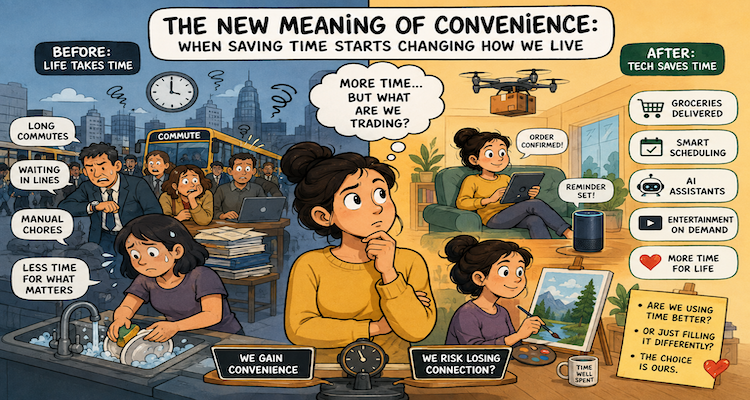
Convenience used to mean doing the same thing with less effort. A dishwasher reduced the work of washing dishes. A microwave shortened meal preparation. Online banking removed a trip to the branch.
Today, convenience reaches much further. A delivery app can eliminate a shopping trip. Streaming removes the need to wait for a scheduled broadcast. Digital payments compress a transaction into seconds. Generative AI can draft an email, summarize a document, or help write code before a person would have finished the first version.
The important question is no longer simply how much time technology saves. It is what people do with the time, expectations, and attention that convenience creates.
Research increasingly suggests that the answer is complicated. Time-saving technologies can genuinely reduce the time required for individual tasks, but the recovered time may be redirected into additional activities, higher expectations, more consumption, or greater availability for work. At the same time, newer evidence challenges the popular assumption that technology has inevitably made everyday life faster.
That tension gives convenience a new meaning: it is becoming less about having more free time and more about having fewer obstacles between intention and action.
Key Takeaways
- Convenience can remove friction without necessarily reducing the number of things people choose to do.
- Research shows time-saving technologies can change how households redistribute their time.
- Digital tools can make work more flexible while also making people more reachable outside working hours.
- Generative AI is already producing measurable time savings, but saved time does not automatically become leisure.
- New research challenges the idea that everyday life is universally getting faster.
- The real value of convenience depends on whether saved time becomes freedom, additional work, or additional consumption.
Convenience Has Changed From Saving Minutes to Removing Friction
The traditional idea of convenience was relatively straightforward: less effort for the same outcome.
A washing machine reduced the physical work involved in cleaning clothes. A dishwasher reduced the labor of washing dishes. A telephone eliminated the need to communicate in person. These technologies did not merely make individual tasks quicker; they changed the practical organization of household life.
Historical time-use research illustrates this transformation. An analysis of 85 years of U.S. time-use data found that women’s core housework, including cooking and cleaning, declined over time, while some of the available time was redirected toward childcare and shopping. The researchers linked part of this broader shift to behavioral changes associated with the spread of labor-saving domestic technology.
That distinction matters.
If a technology saves 30 minutes of housework, society does not necessarily receive 30 minutes of additional leisure. The person may use those 30 minutes to work, shop, care for someone, exercise, consume entertainment or simply perform another task that previously would not have seemed worth the effort.
Convenience therefore changes the economics of what feels worth doing.
When an activity becomes cheaper in time and effort, people can do more of it.
The Convenience Paradox: When Saving Time Creates More Activity
Researchers have studied this phenomenon under concepts including the time-use rebound effect.
The basic idea is simple. A technology saves time, but the time that becomes available can be reallocated to other activities. Those activities may themselves consume resources.
A 2024 study in Ecological Economics provides an unusually concrete example. Researchers randomly distributed automatic vacuum cleaners to households in Japan and examined subsequent changes in time use and electricity consumption. They found evidence that the technology changed household behavior and generated a time-use rebound effect. The associated increase in electricity consumption was relatively small estimated at 1.83% of household electricity consumption but the experiment demonstrates the underlying behavioral mechanism.
Earlier research using Canadian household data reached a related conclusion: adoption of time-saving appliances can change how people allocate time between household production and leisure, with some of the additional activity potentially increasing energy use.
The lesson is not that time-saving technology is counterproductive.
It is that saving time and reducing activity are two different things.
A faster dishwasher does not necessarily mean fewer dishes. A faster checkout does not necessarily mean less shopping. A faster way to produce a document does not necessarily mean fewer documents.
The technology changes the cost of the activity. People then decide what becomes possible at that new cost.
Digital Convenience Has Made Waiting Feel Different
The smartphone era introduced another layer: convenience is increasingly about removing waiting.
Shopping no longer needs to fit store hours. Entertainment no longer needs to fit television schedules. Messages do not require both people to be available simultaneously. A payment can happen while standing in line. A document can be edited from a phone while traveling.
Research on digital acceleration describes this as a shift toward asynchronous activity: email, messaging, e-commerce and streaming allow people to perform activities at times that would previously have been unavailable to them.
That creates an important psychological change.
When something takes less time, people often stop treating the saved time as a resource that must be protected. Instead, the activity becomes easier to fit into the day.
A five-minute task feels almost free.
Then another five-minute task arrives.
Then another.
Convenience can therefore reduce the friction per activity while increasing the number of activities that fit comfortably into a day.
This helps explain why a person can have access to extraordinary time-saving tools and still feel that the day is crowded.
The Workday Shows the Contradiction Clearly
Work provides perhaps the clearest example of convenience becoming a double-edged resource.
Digital communication has reduced the need for commuting, enabled remote work, accelerated information exchange and made many administrative tasks easier. But those same capabilities can blur the boundary between work and personal life.
The International Labour Organization and Eurofound found that digital technologies used for work can provide greater autonomy and reduce commuting time while also contributing to longer working hours, higher work intensity and interference between work and home life.
This creates a peculiar bargain:
The easier work becomes to perform anywhere, the easier it can become to perform everywhere.
Convenience removes geographical and temporal barriers. That can be liberating when a worker gains control over their schedule. It can become burdensome when the absence of barriers means there is no obvious stopping point.
The distinction is not technological but organizational.
A tool that saves an hour can produce an hour of freedom if the organization allows the worker to stop. It can produce an additional hour of work if the organization treats the saved time as new capacity.
Generative AI Makes the Question More Immediate
Generative AI adds a new dimension because it can reduce the time required for tasks involving language, information processing and software development.
The evidence is already more concrete than much of the surrounding speculation.
A randomized field experiment involving thousands of knowledge workers found that access to a generative AI tool changed work patterns. In the study reported by the National Bureau of Economic Research, workers who used the tool spent about two fewer hours per week on email during the later part of the experiment and reduced time spent working outside regular hours. The researchers did not find significant changes in the quantity or composition of workers’ tasks from individual-level AI access.
Another large study of 5,172 customer-support agents found that AI assistance increased productivity by 15% on average, measured by issues resolved per hour. The effect was considerably larger among less experienced workers, while gains were much smaller among the most experienced workers.
Software development provides another example. A 2026 Management Science publication based on randomized trials involving 4,867 developers reported a 26.08% increase in completed tasks associated with AI coding assistance across three experiments.
These findings demonstrate something important but limited.
They show that AI can reduce time or increase output in particular settings. They do not demonstrate that society as a whole will automatically receive more leisure.
That depends on what happens next.
If an organization keeps output expectations unchanged, saved time can become breathing room. If expectations rise because production is now faster, the same technology can create a higher baseline of expected performance.
Convenience can therefore become a new productivity floor.
When Faster Becomes the New Normal
This is perhaps the most overlooked consequence of convenience.
Once people become accustomed to a faster service, the old waiting time can start to feel like a problem.
A response that once took a day may eventually feel slow if it normally takes an hour. A physical appointment may feel inconvenient when a digital alternative is available. Preparing a document manually may seem unnecessarily laborious when an AI assistant can produce a first draft quickly.
The technology does not necessarily force people to move faster.
Instead, it changes what people consider an acceptable amount of time.
Research into self-service technologies illustrates this more precisely. Studies have found that convenience and perceived time pressure influence how consumers evaluate self-service systems and their perceived efficiency.
This is why convenience can become self-reinforcing.
The faster option becomes normal.
The normal option becomes the expected option.
And the expected option becomes the minimum acceptable option.
What began as a time-saving feature can eventually become a new standard.
But the “Everything Is Getting Faster” Story Is Too Simple
There is an important counterargument to the idea that technology has simply accelerated everyday life.
A 2026 study published in Humanities and Social Sciences Communications examined U.S. time-use data from 2003 to 2019 and found evidence of deceleration rather than acceleration across several measures of daily pace. The study reported decreases in activity variety and location switching, alongside increased sleep duration. It also found that people with internet access showed patterns associated with a slower pace of daily life rather than a faster one.
This does not mean technology makes life slower.
Nor does it prove that people are less stressed today.
The study covers a specific period and uses particular measures of pace rather than attempting to measure every aspect of modern life. But it does challenge an assumption that is often treated as obvious: technological acceleration does not necessarily translate into an accelerated personal day.
That distinction is crucial.
A computer can process information faster without making a person walk faster.
A delivery network can move products faster without requiring the customer to spend more time shopping.
An AI assistant can produce a draft faster without requiring the worker to spend the saved time working.
Technology can accelerate systems while individuals use the resulting efficiency to consolidate, simplify or even slow parts of their lives.
Time Poverty Changes the Value of Convenience
Convenience is also not equally valuable to everyone.
For someone with abundant free time, saving ten minutes may be pleasant.
For someone juggling paid work, caregiving, household responsibilities and unpredictable schedules, ten minutes may determine whether another obligation is manageable.
A 2026 study in the British Journal of Psychology examined how perceived time scarcity affects consumer decisions. Across four studies involving 831 participants, the researchers found that experimentally induced time poverty increased preferences for access-based consumption and that this relationship operated partly through stronger convenience orientation and reduced risk perception.
That finding adds an important dimension to the convenience debate.
Convenience is not merely a luxury.
For time-poor people, it can function as a coping mechanism.
But the same research suggests a potential trade-off: when people feel short of time, the desire to eliminate friction may become strong enough that careful evaluation of risks receives less attention.
In other words, the less time someone feels they have, the more expensive inconvenience becomes and the more attractive shortcuts may appear.
What Should We Actually Do With Saved Time?
The most useful question is not whether convenience is good or bad.
It is what kind of time we are trying to create.
A time-saving tool can serve at least four very different purposes:
- Recovery: more sleep, rest or unstructured time.
- Relationships: more time with family, friends or community.
- Meaningful work: more time for difficult tasks that require judgment and creativity.
- More activity: additional shopping, communication, entertainment, work or administration.
Only the first three necessarily feel like an improvement in life quality.
The fourth may simply turn a shorter task into a longer list.
This is where individuals and organizations face different choices.
For individuals, the practical challenge is to avoid automatically filling every efficiency gain. If an AI tool saves 30 minutes, that does not mean the next 30 minutes must immediately be assigned to another task.
For employers, the question is more consequential. If technology increases productivity, organizations have a choice about whether the benefit becomes higher output, reduced workload, shorter hours, greater flexibility or some combination.
Technology creates the possibility of those choices.
It does not make them automatically.
The New Meaning of Convenience
The old definition of convenience was less work.
The newer definition is closer to less friction.
That difference explains why convenience has become so powerful. Digital systems can remove small barriers throughout the day: finding information, making payments, ordering products, communicating, producing documents, navigating services and completing routine work.
Individually, each improvement may be tiny.
Collectively, they change the structure of daily life.
But the evidence does not support a simple story in which every saved minute disappears into a faster, more stressful existence. Historical household research shows that technology can genuinely reduce time spent on some forms of domestic work. Recent research shows that time-saving technologies can also produce behavioral rebound. Workplace studies show both greater flexibility and greater work intensity. And new time-use research suggests that everyday life itself may not be universally accelerating.
The deeper issue is therefore not whether technology saves time.
It does.
The harder question is who gets to decide what that saved time becomes.
Conclusion
Convenience becomes valuable when saved time remains under human control.
A faster transaction can be useful. A shorter commute can be liberating. An AI assistant that removes repetitive work can create room for more valuable work or simply make more work possible.
The technology cannot decide which outcome occurs.
That is a social, organizational and personal choice.
As convenience becomes increasingly embedded in everyday life, the measure of progress may need to shift from how quickly we can complete something to what becomes possible when we no longer have to spend so much time completing it.
The real dividend of convenience is not speed.
It is choice.
This content is published for informational or entertainment purposes. Facts, opinions, or references may evolve over time, and readers are encouraged to verify details from reliable sources.