









When AI Starts Making Decisions for You, Who Is Responsible for the Result?
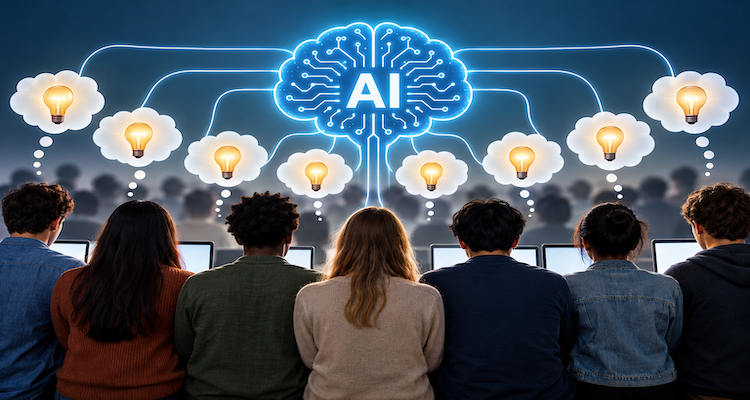
Artificial intelligence is moving from being a tool that answers questions to a system that increasingly influences decisions. Algorithms now help determine what content people see, which applications receive attention, how companies manage operations, how financial institutions assess risk, and how organizations prioritize resources.
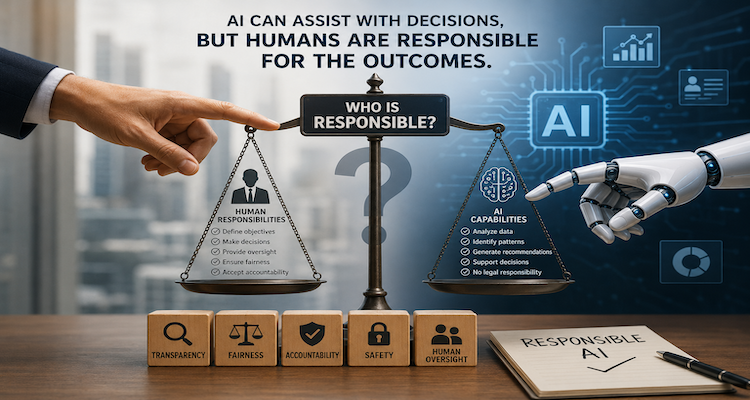
The difficult question is no longer whether AI can make decisions. The harder question is: when an AI-supported decision causes harm, who is responsible the developer who built the system, the organization that deployed it, the employee who relied on it, or the person who accepted its recommendation?
The answer is becoming one of the defining governance challenges of the AI era. While AI systems can process information at a scale humans cannot match, they do not carry legal responsibility, ethical judgment, or accountability. Those remain human responsibilities. Governments, standards organizations, and businesses are increasingly focusing on how to assign responsibility across the entire AI lifecycle rather than treating AI as an independent decision-maker.
Key Takeaways
- AI systems can influence decisions, but they cannot independently carry legal or ethical responsibility.
- Accountability depends on the roles of developers, deployers, operators, and decision-makers.
- Human oversight remains essential when AI affects people’s rights, safety, or opportunities.
- AI governance frameworks emphasize documentation, transparency, testing, and risk management.
- Businesses must treat AI accountability as an operational responsibility, not only a technology issue.
AI Does Not Make Decisions in Isolation
The phrase “AI made the decision” often hides a more complicated reality.
Most AI systems operate inside a larger chain of human choices. Someone selects the objective, collects or approves training data, defines success criteria, chooses where the system will be used, and decides how much authority the AI receives.
Consider an AI system used for hiring. The model may rank candidates, but humans decided:
- what qualities the system should prioritize,
- which historical hiring data should influence the model,
- how recommendations should be interpreted,
- whether a human must review the result.
The final outcome is therefore not created by the algorithm alone. It emerges from a combination of technology, organizational processes, human judgment, and institutional decisions.
This distinction matters because blaming “the AI” can allow organizations to avoid examining the choices made before and after deployment.
The Accountability Gap in Artificial Intelligence
Traditional technologies usually have clear responsibility structures. If a machine fails because of a manufacturing defect, responsibility may involve the manufacturer, operator, or maintenance provider.
AI systems introduce additional complexity because their behavior can depend on data, model design, updates, usage conditions, and human interpretation.
The same AI model can produce different outcomes depending on:
- the quality and limitations of its data,
- the environment where it is deployed,
- the instructions given to it,
- the people using its recommendations.
The National Institute of Standards and Technology AI Risk Management Framework emphasizes that organizations designing, developing, deploying, or using AI systems need approaches to identify and manage risks throughout the AI lifecycle.
This shifts the conversation away from asking “Who owns the AI?” toward a more practical question:
Who had the ability and responsibility to prevent, detect, or correct the harmful outcome?
Responsibility Is Shared, But Not Equal
AI accountability does not mean every participant carries the same responsibility.
Different actors influence different stages of an AI system.
Developers
Developers are responsible for technical decisions, including:
- system architecture,
- testing procedures,
- security protections,
- known limitations,
- documentation.
A developer cannot predict every possible future use of an AI system, but responsible development requires identifying foreseeable risks.
Companies Deploying AI
Organizations using AI often have the greatest responsibility because they decide how the system affects real people.
A company deploying an AI hiring tool, credit assessment system, or customer service model must understand:
- what the system can and cannot do,
- when human review is required,
- whether outcomes are reliable,
- whether affected individuals have ways to challenge decisions.
Human Operators and Managers
Human involvement does not disappear simply because AI is involved.
An employee who accepts an AI recommendation without review may share responsibility, especially when the decision affects individuals significantly.
Human oversight is not merely a technical feature. It is an organizational practice.
Why Transparency Matters
One of the biggest challenges with AI accountability is understanding why a system produced a particular result.
Many AI models, especially complex machine-learning systems, can be difficult to interpret. This creates problems when someone needs to explain or challenge an outcome.
The OECD AI Principles emphasize transparency, explainability, and accountability, including the importance of enabling people affected by AI systems to understand outputs and challenge decisions where appropriate.
Transparency does not always mean revealing every technical detail of a model. In practice, it can involve:
- documenting how a system is used,
- recording important decisions,
- monitoring performance,
- explaining limitations,
- maintaining audit trails.
Without these practices, organizations may know that an AI system produced a result but be unable to explain why.
The Business Impact: AI Accountability Becomes Risk Management
For companies, AI responsibility is becoming more than an ethical question. It is becoming a business requirement.
Poorly managed AI risks can affect:
- customer trust,
- regulatory compliance,
- reputation,
- operational reliability,
- legal exposure.
Organizations increasingly need AI governance processes similar to cybersecurity, financial controls, or quality management systems.
The NIST AI Risk Management Framework organizes AI risk management around four core functions: govern, map, measure, and manage. The framework is designed to help organizations incorporate trustworthiness considerations into AI design, development, use, and evaluation.
This approach recognizes an important reality: AI responsibility cannot be added after deployment. It must be built into the system from the beginning.
The Difference Between Responsibility and Liability
A critical distinction in the AI debate is the difference between being responsible and being legally liable.
A company may be responsible for ensuring an AI system is properly tested and monitored. Whether it is legally liable for a specific harm depends on laws, contracts, circumstances, and jurisdiction.
The OECD notes that accountability, responsibility, and liability are related but distinct concepts. Accountability involves the expectation that AI actors can explain decisions and ensure proper functioning, while liability generally concerns legal consequences.
This distinction matters because technology often develops faster than legal systems.
The challenge for policymakers is creating rules that encourage innovation while ensuring people affected by AI systems have meaningful protection.
What Responsible AI Decision-Making Looks Like
Organizations using AI responsibly generally need several safeguards:
- Clear ownership: Someone must be accountable for AI outcomes.
- Human review: Important decisions should have appropriate oversight.
- Testing and monitoring: Systems should be evaluated before and after deployment.
- Documentation: Organizations should record how systems work and where they are used.
- Risk assessment: Potential harms should be considered before problems occur.
- Feedback mechanisms: People affected by AI decisions need ways to question outcomes.
These practices do not eliminate every risk, but they make accountability possible.
The Future Question Is Not Whether AI Will Decide
AI will continue influencing decisions because its ability to analyze information can provide significant benefits. The question facing businesses, governments, and society is not whether AI should be involved, but how much authority it should receive and under what conditions.
A future where AI supports decisions does not require removing humans from the process. It requires humans to become better managers of systems they create.
The most important principle may be simple: AI can assist with decisions, but humans remain responsible for deciding how those systems are built, used, and trusted.
Conclusion
The rise of AI decision-making is creating a new responsibility challenge. Machines can recommend, predict, classify, and generate outputs, but they cannot accept accountability for the consequences.
The organizations and individuals behind AI systems must answer the questions that algorithms cannot: Was the system appropriate for the situation? Was it tested properly? Were people protected? Was there a way to correct mistakes?
As AI becomes more deeply embedded in business and society, responsibility will not belong to a single person or company in every case. It will depend on a chain of decisions across the AI lifecycle. The future of trustworthy AI will be determined not only by what machines can do, but by how carefully humans choose to use them.
This content is published for informational or entertainment purposes. Facts, opinions, or references may evolve over time, and readers are encouraged to verify details from reliable sources.