










The Internet Is Becoming Machine-First: What Happens When AI Agents Become Major Web Visitors?
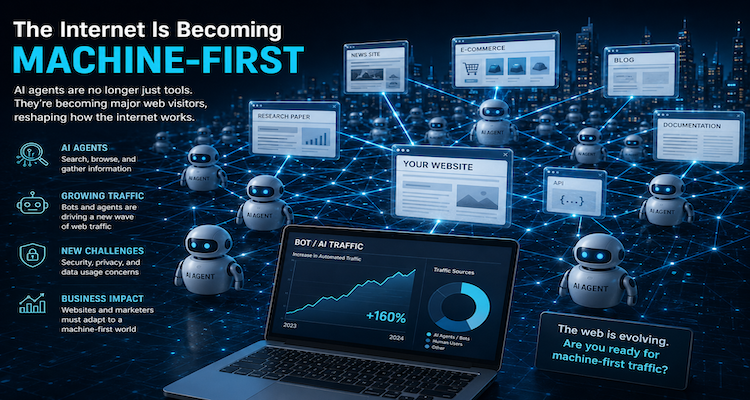
The web was built around a simple assumption: a person opens a browser, follows links, reads a page and decides what to do next. That assumption is becoming less reliable.
AI systems are increasingly doing parts of that work themselves. Search systems retrieve pages to construct answers. AI assistants browse websites to research questions. Browser agents can inspect pages, click buttons, fill forms and complete tasks on a user’s behalf. OpenAI’s browser-based Operator, for example, was designed to interact with websites through the same kinds of interfaces people use, while Google’s current guidance explicitly discusses browser agents that can inspect a site’s DOM, visual rendering and accessibility tree.
The change is bigger than the arrival of another class of web crawlers. A crawler primarily reads. An AI agent can increasingly interpret, compare, decide and act.
That distinction could reshape what a website is designed for, how publishers measure an audience, how businesses expose information, and even what it means to have a “visitor.”
Cloudflare’s 2025 data already showed AI bots accounting for an average 4.2% of HTML requests in its customer network, while Googlebot alone accounted for 4.5%. By 2026, Cloudflare reported that more than half of Internet traffic in its measurement was non-human, although that broader figure includes many kinds of automated traffic and should not be interpreted as a universal measure of AI-agent usage.
The important question is therefore no longer simply whether machines visit the web. It is what happens when machines become an important audience for the web and begin acting on what they find.
Key Takeaways
- AI visitors increasingly range from training crawlers to search systems and agents that perform actions on users’ behalf.
- Machine traffic can create server load and data value without producing a conventional pageview or referral.
- Websites may need to become easier for both humans and software agents to understand, navigate and verify.
- The economic problem is shifting from traffic volume toward attribution, access, licensing and measurable value.
- Publishers still need human-first content because AI systems depend heavily on accessible, useful and trustworthy information.
- The emerging agentic web could make websites function more like services and data interfaces than destinations alone.
From Crawlers to Agents
Not every machine visiting a website is an AI agent.
That distinction matters.
A traditional search crawler discovers and indexes pages. An AI training crawler may collect content for model development. A search-oriented AI crawler may retrieve information to answer a user’s question. A user-action system may fetch a page because an individual has asked an AI system to investigate something.
Cloudflare’s analysis separates AI crawling into training, search and “user action” purposes. In its 2025 data, user-action crawling grew dramatically during the year, although it remained only one component of overall AI crawler activity.
An agent adds another layer.
Instead of merely asking, “What does this page say?”, an agent can be asked to accomplish something:
- Compare several products.
- Find an available appointment.
- Research competing services.
- Complete an online form.
- Navigate a booking process.
- Check information across multiple websites.
- Decide which option best matches a set of instructions.
OpenAI’s Operator research preview demonstrated this direction by giving an AI system a browser through which it could type, click and scroll on websites. OpenAI subsequently integrated the capability into ChatGPT agent, which it describes as capable of researching public websites and performing online tasks.
Google’s 2026 guidance similarly describes browser agents as systems that may gather information from a website by analyzing its visual rendering, DOM structure and accessibility tree.
That changes the relationship between a website and its visitor.
A human visitor might spend five minutes comparing three pages. An agent could potentially perform the comparison in seconds and return only the conclusion to its user.
The website may still have been visited. The human simply may never have seen it.
The Pageview Is Losing Some of Its Meaning
For decades, digital publishing has relied heavily on a basic chain:
Impression → click → pageview → engagement → conversion.
AI introduces another path:
User request → AI agent → multiple websites → synthesized answer → user action.
The middle of that chain can happen without the user opening any of the underlying pages.
This creates a measurement problem.
Suppose an AI system reads an article from a publisher and uses information from it to answer a question. The publisher may receive a machine request but no conventional referral. The article influenced the user’s decision, but conventional analytics may not capture that influence.
Cloudflare has documented this “crawl-to-click” imbalance. Its 2025 analysis found that AI crawling could be substantial while referrals back to publishers were much smaller, with the ratio varying considerably between AI services.
This is one of the most important economic consequences of the machine-first web.
Traffic may become a less complete proxy for value.
A site could have fewer visible visitors while remaining highly influential inside AI-mediated discovery.
Conversely, a site could receive substantial automated traffic without gaining advertising impressions, subscriptions, purchases or human readership.
For publishers, those are very different outcomes.
Search Is Becoming an Intermediate Layer
Traditional search asked the user to perform much of the information work.
The user entered a query, opened several results, compared them and reached a conclusion.
AI search increasingly performs part of that synthesis.
Google says AI Overviews and AI Mode can use a “query fan-out” process in which multiple related searches are generated to gather information from different subtopics and sources. Google also says these systems can surface supporting links to websites.
That creates a paradox for publishers.
Being discoverable by an AI system can increase the chance that a site’s information contributes to an answer. But the same system may reduce the need for a user to visit every source personally.
Pew Research Center’s analysis of browsing behavior illustrates the tension. Among searches in its March 2025 dataset that produced a Google AI summary, users clicked a traditional search result in 8% of visits, compared with 15% when no AI summary appeared. Only 1% of visits with an AI summary resulted in a click on a link within the summary itself.
That does not prove that AI summaries are responsible for every decline in publisher traffic, nor does it mean users never visit sources. But it provides evidence that the path from information discovery to website visit is changing.
The implication is important: visibility and visitation are becoming separable metrics.
Websites May Need to Serve Two Audiences
The phrase “machine-first” can be misleading if it is interpreted as “stop designing for humans.”
That would be the wrong conclusion.
The more realistic future is a web with two simultaneous audiences:
Human readers need clarity, visual hierarchy, accessibility, context and trust.
Machine systems need information that can be reliably retrieved, interpreted and acted upon.
The best websites can serve both.
Google’s current guidance does not tell publishers to abandon conventional SEO for a secret AI-specific optimization system. Instead, it emphasizes crawlability, internal linking, textual accessibility, page experience and unique, helpful content. Google explicitly says there are no additional technical requirements for appearing in AI Overviews or AI Mode beyond eligibility for Google Search.
That is significant.
The emerging machine-readable web is not necessarily a separate web. Much of it is being built on top of the same fundamentals that make websites useful to people.
Clear headings help humans and machines.
Descriptive links help humans and machines.
Accessible text helps humans and machines.
Structured, factual explanations help humans and machines.
A clean technical architecture helps humans indirectly and automated systems directly.
The strongest response to machine-first discovery may therefore be better publishing rather than more publishing.
The Business Model Problem Is Harder
The biggest unresolved issue may not be technology. It may be economics.
If an AI agent can read thousands of pages while sending relatively few users back, who pays for the infrastructure and intellectual work that produced those pages?
This question is especially important for journalism, specialist databases, research publishers, reference sites and other businesses whose content requires substantial ongoing investment.
The industry is already experimenting with different approaches to controlling machine access. Cloudflare, for example, has introduced controls that distinguish AI traffic by behavior, including search, agent and training activity. Its planned September 2026 defaults for new domains are designed to treat training and agent traffic differently from search traffic on pages displaying ads.
That distinction points toward a potentially important future principle:
Not all machine visits have the same economic value.
A crawler collecting information for model training is different from an agent helping a user buy a product.
A search crawler is different from an automated system completing a transaction.
A machine that consumes a publisher’s entire archive is different from one that retrieves a single fact and sends a qualified customer.
Website owners may increasingly want to know not simply who is crawling, but why.
Robots.txt Was Designed for a Simpler Web
The web already has a mechanism for communicating crawling preferences: robots.txt.
It remains relevant, but the growth of AI introduces more complicated questions.
Should a publisher permit search indexing but refuse model training?
Should an article be available for AI answers but not bulk training?
Should an agent be allowed to read product information but prevented from submitting forms?
Should a website allow an AI assistant to compare prices but require authentication before purchase?
Different AI companies already provide different controls and interpretations.
Google, for example, documents Google-Extended as a robots.txt control for managing whether content crawled by Google may be used for certain Gemini model training and grounding contexts. Google also makes clear that Google-Extended does not affect inclusion in Google Search.
Anthropic says its bots respect robots.txt and provides separate controls for ClaudeBot.
Perplexity similarly says its PerplexityBot respects robots.txt directives.
The broader issue is that robots.txt was fundamentally designed around access, while the agentic web increasingly requires policies around purpose and action.
Reading a page is one thing.
Submitting an order is another.
Sending an email, changing an account setting or making a purchase is another category altogether.
The web will need clearer ways to express those distinctions.
The Website Could Become an Interface, Not Just a Destination
This may be the most consequential shift.
A traditional website is largely a destination: people arrive, consume information and interact with the interface.
An agent-oriented website can also behave like a service.
Consider a travel website.
A human might browse dozens of hotel pages. An agent could instead need structured information about availability, dates, room types, cancellation conditions and prices, then select an option according to the user’s requirements.
Or consider an online retailer.
The future interaction may not begin with a customer browsing a homepage. The customer’s agent may ask several merchants for compatible products, compare specifications and prices, and present a shortlist.
Google’s 2026 guidance already points toward this direction, noting emerging agentic experiences and protocols such as the Universal Commerce Protocol that are intended to enable more agent-oriented interactions.
Google also announced the Agentic Resource Discovery specification in June 2026, describing an open specification for finding, discovering and verifying tools, skills and agents across the web.
These developments suggest a broader architectural change.
The web may increasingly contain not only pages about things, but machine-discoverable capabilities for doing things.
That could make websites resemble APIs, marketplaces and services even when a conventional webpage remains the visible front end.
What This Means for Publishers
For publishers, the answer is not to rewrite every article for robots.
It is to make the underlying information more valuable and more trustworthy.
That means investing in things machines cannot easily obtain by recombining generic material:
- Original reporting
- First-hand observations
- Clearly sourced research
- Expert interviews
- Original datasets
- Distinctive analysis
- Local knowledge
- Primary documents
- Transparent methodology
- Updated factual context
Google’s guidance increasingly emphasizes unique, non-commodity content rather than specialized “AI hacks.” It also warns that generating large quantities of pages without adding value can fall under its scaled-content-abuse policies.
That creates an interesting economic feedback loop.
If generic information becomes easier for AI systems to summarize, original information may become more valuable, not less.
A publisher that simply rewrites widely available facts can be substituted relatively easily.
A publisher that produces information nobody else has can become part of the information supply chain.
The machine-first web therefore rewards a strange combination: information should be easy to understand but difficult to replace.
What Businesses Should Watch
Companies do not necessarily need to redesign their entire websites around AI agents today.
But they should start asking practical questions.
Can an agent understand the important information?
Product specifications, pricing, availability, policies, documentation and contact information should not depend unnecessarily on visual tricks or inaccessible interfaces.
Can an agent distinguish facts from marketing language?
Clear labels, consistent terminology and explicit policies reduce ambiguity.
Can an agent safely perform an action?
For transactional websites, businesses need to think carefully about authentication, permissions, confirmation steps and fraud prevention.
Can the company measure machine-mediated influence?
Conventional analytics may capture a bot request but not necessarily the downstream business value created by an AI recommendation.
Does the company know which automated systems are accessing its content?
Server logs, CDN analytics and bot-management tools are becoming increasingly useful for distinguishing different forms of automated activity. Cloudflare’s current AI Crawl Control tooling, for example, provides visibility into AI crawler activity and its behavior.
These are operational questions, not futuristic ones.
The New Competitive Advantage May Be Trust
An AI agent has a different problem from a human reader.
A person can notice that a website looks suspicious. An agent must determine whether the information it encounters is reliable enough to use.
That raises the value of provenance.
Who published this?
When was it updated?
What evidence supports it?
Is the information original?
Can the claim be independently verified?
Does the page clearly distinguish reporting from opinion?
These questions matter to human readers too. But as machines increasingly mediate decisions, weaknesses in information quality can propagate much faster.
The result could be a web where reputation is no longer based solely on whether humans recognize a brand.
It may also depend on whether automated systems repeatedly identify a source as reliable, current and useful.
That does not mean AI systems are inherently good judges of truth. They can make mistakes, misunderstand context and reproduce errors. An agent’s ability to retrieve information is not proof that the information is correct.
The machine-first web therefore makes verification more important, not less.
The Human Web Is Not Disappearing
There is a temptation to interpret machine traffic as evidence that human browsing is becoming obsolete.
The evidence does not justify that conclusion.
Google continues to build search experiences around links to websites, and its own guidance emphasizes helping people discover useful pages.
Pew’s research also shows that users continue to click links even when AI summaries are present; the behavior simply changes.
And AI agents themselves often depend on the human web. They retrieve information from websites, interpret interfaces designed for people and sometimes use those interfaces to perform tasks.
The more plausible future is therefore not a machine-only Internet.
It is an Internet in which humans increasingly delegate parts of their web activity to machines.
That is a much more subtle change.
The human remains the decision-maker in many situations. The agent becomes the researcher, comparison engine, navigator or intermediary.
What Comes Next
The next stage of the web may be defined less by how many people visit a page and more by how many systems can meaningfully use what the page provides.
That creates difficult questions that have not yet been fully settled.
Who owns the economic value created when an agent reads a publisher’s work?
How should websites distinguish legitimate agents from abusive automation?
What should an agent be allowed to do without explicit human confirmation?
How should websites authenticate agents?
How should advertisers value a machine-mediated customer journey?
And how should publishers measure influence when the reader may never directly visit the source?
There are no universal answers yet.
What is clear is that the infrastructure around the web is beginning to recognize different types of automated participants. Google’s agent-oriented guidance, Cloudflare’s increasingly granular AI-traffic controls and emerging agent-discovery standards are evidence of an ecosystem moving beyond the old crawler-versus-human distinction.
The web is therefore entering an awkward transition period.
Its pages were built for people.
Its infrastructure was optimized for browsers and search engines.
Its newest participants are increasingly systems that can read, reason and act.
Conclusion
The machine-first web will not necessarily replace the human web. It may instead put another layer between people and information.
A person asks for something. An AI system searches, reads, compares and sometimes acts. Websites increasingly become sources, services and interfaces inside that process rather than destinations the user must personally visit.
That shift changes what “web traffic” means, what publishers are selling, what businesses need to expose, and how digital influence should be measured.
For website owners, the practical lesson is relatively straightforward: build for humans first, but make your information clear enough, accessible enough and trustworthy enough that legitimate machines can understand it too.
The most valuable websites in that environment may not be the ones that attract the most automated requests.
They may be the ones whose information is sufficiently useful and credible that both humans and the agents acting for them have a reason to rely on it.
This content is published for informational or entertainment purposes. Facts, opinions, or references may evolve over time, and readers are encouraged to verify details from reliable sources.