










Why Some Ancient Cities Disappeared Without a Single Catastrophic Event
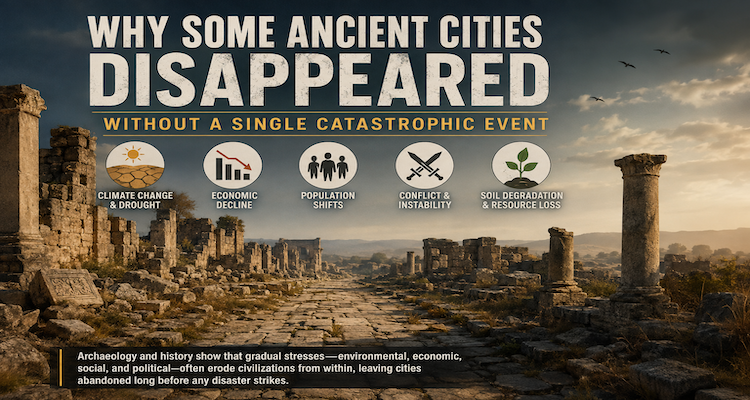
A city can die without being destroyed.
Archaeology increasingly shows that some of history’s most famous abandoned urban centers did not vanish because of one decisive invasion, earthquake, epidemic, or environmental disaster. Instead, their decline unfolded through a chain of smaller changes: unreliable rainfall, weakened agricultural systems, political fragmentation, shifting trade routes, social conflict, migration, and the gradual loss of institutions that once made urban life worthwhile.
Angkor in Cambodia offers one of the clearest examples. Evidence from its central urban core indicates that land-use intensity was already declining more than a century before the 15th-century events traditionally associated with its abandonment. At Cahokia in North America, population decline unfolded over generations alongside changing drought and flood conditions. New research on the Indus Valley Civilization similarly points toward repeated, prolonged droughts and population dispersal rather than a single moment of collapse.
The important distinction is that an abandoned city is not necessarily a vanished civilization. People often moved, reorganized their economies, adopted different crops, joined smaller settlements, or shifted political centers. What disappeared was sometimes the urban system not the society itself.
Key Takeaways
- Ancient urban decline was often a prolonged process rather than one identifiable disaster.
- Environmental stress became dangerous when it interacted with political, economic, and social weaknesses.
- Angkor’s urban core was already declining decades before its traditional 15th-century “collapse.”
- Cahokia’s population fell gradually amid drought, flooding, social tensions, and political reorganization.
- Recent Indus research points to repeated droughts followed by migration and deurbanization rather than sudden disappearance.
- Archaeologists increasingly study how societies adapted, not simply why their cities collapsed.
Cities Usually Become Unviable Before They Become Empty
The physical remains of an ancient city can create a misleading impression.
A visitor sees abandoned buildings, empty streets and monumental architecture and naturally imagines a dramatic ending: an army arrives, a disaster strikes, residents flee, and the city becomes frozen in time.
Human settlements rarely work that way.
Urban life depends on systems that are much less visible than walls and temples. A large population needs reliable food supplies, water, trade, political coordination, labor, maintenance and institutions capable of resolving disputes.
If several of those systems weaken simultaneously, residents have reasons to leave even when no single event forces them to.
That makes urban abandonment a process rather than a date.
Archaeologists therefore look for signals that appear before the final abandonment: declining construction, reduced maintenance, changing settlement density, shifts in agriculture, changes in trade goods, altered burial practices, evidence of conflict and environmental changes recorded in sediments, tree rings, pollen or other natural archives.
The result can be surprisingly different from the traditional “rise and catastrophic fall” story.
Angkor: The City Was Declining Before the Famous Ending


Angkor is particularly revealing because its traditional story has a convenient dramatic ending.
The great Cambodian urban center is commonly associated with the 15th-century decline of the Angkorian state and the arrival of forces from Ayutthaya. But research published in PNAS found evidence that the central urban core had already been losing intensity of use more than a century earlier.
Researchers analyzed sediment cores from the moat surrounding Angkor Thom. Indicators including burning, forest disturbance and soil erosion declined from the early 14th century. By the end of that century, the moat was no longer being maintained.
That matters because it changes the question.
Instead of asking, “What destroyed Angkor?”, researchers can ask, “Why was Angkor becoming less important before its conventional endpoint?”
The answer appears to involve several forces rather than one.
Climate variability affected the region’s water-management system. Political power was shifting. Other urban centers offered advantages, while access to maritime trade closer to the Mekong and Tonle Sap could make alternative locations more attractive. The enormous urban system itself may also have become increasingly difficult to manage.
The Ayutthayan presence in the 15th century may therefore have been part of the final stage rather than the original cause of the city’s decline.
That distinction is important. An invasion can accelerate a decline without creating the underlying vulnerability.
Cahokia Shows How Environmental Stress Can Cascade Through a City


Cahokia, near present-day St. Louis, became one of the largest urban centers in pre-Columbian North America.
Its decline was not instantaneous.
Research published through the U.S. Geological Survey and American Antiquity connects Cahokia’s long decline with persistent droughts beginning after a particularly wet period. By around AD 1150, a severe 15-year drought coincided with abandonment of the Richland farming complex, an important part of the agricultural system supporting the region. Around the same period, a large palisade was constructed around Cahokia’s central precinct, suggesting rising social tensions. By about AD 1200, the study estimates that Cahokia’s population had fallen by roughly half; the wider center was abandoned by about AD 1350.
But drought alone does not explain the entire story.
Other research has identified changes in Mississippi River flooding. Cahokia emerged during a period when major floods were relatively infrequent; the return of large floods after about AD 1200 coincided with its decline.
Another study using fecal stanols preserved in lake sediments found that a shift toward reduced summer precipitation and a major Mississippi River flood around AD 1150 coincided with population decline. The researchers emphasize the interaction of environmental pressures with societal tensions rather than a single environmental cause.
This is a crucial pattern.
The same environment that helps a city grow can later become a vulnerability.
A settlement optimized around particular rainfall patterns, crops and river conditions may become less resilient when those conditions change. The problem is not simply “climate change.” It is the mismatch between a society’s infrastructure and institutions and a changing environment.
The Indus Valley Shows That “Collapse” Can Mean Transformation


The Indus Valley Civilization provides perhaps the strongest modern challenge to the idea that an ancient civilization simply disappeared.
A 2025 study in Communications Earth & Environment combined paleoclimate records with hydrological modeling to reconstruct water availability across the Indus basin. The researchers identified severe and persistent river droughts lasting decades to centuries between roughly 4,400 and 3,400 years ago. They concluded that reduced water availability likely contributed to population dispersal from major Harappan centers while stressing that social and economic factors also shaped the transformation.
The accompanying analysis found evidence for multiple prolonged droughts rather than one decisive event. A particularly severe drought lasting about 113 years coincided with widespread deurbanization. Populations shifted toward smaller settlements and different regions, while agricultural practices changed.
That is not the same thing as people simply disappearing.
The urban system changed.
Large cities became less dominant. Communities adapted to different water conditions, changed crops and migrated toward areas with better opportunities. The civilization’s material culture and settlement patterns transformed over time.
In other words, deurbanization can be an adaptation strategy as well as a symptom of decline.
That distinction is often lost when historians describe the end of an urban civilization as “collapse.”
The Maya Reveal Another Complication: Climate Can Become Political
The Maya world demonstrates why environmental explanations should not be separated from political history.
Research on Classic Maya societies has linked periods of sociopolitical disintegration and population decline with decreasing predictability of seasonal rainfall and severe drought between roughly AD 700 and 800. The researchers argue that unpredictable rainfall may have been especially damaging because agricultural societies needed not only enough rain, but reasonably predictable seasonal conditions.
But Maya history does not support a simple “drought caused collapse” explanation.
At Mayapan, a major Postclassic Maya capital, researchers combined archaeological, historical and paleoclimate evidence and found a relationship between drought, civil conflict and political instability. Drought appears to have intensified existing tensions between rival factions rather than acting as an independent mechanism of destruction.
This provides a useful model for understanding ancient urban decline:
Environmental stress can create pressure; political institutions determine how that pressure is distributed.
A food shortage may produce cooperation in one society and conflict in another. A declining river may trigger migration rather than starvation. A trade disruption may weaken one political center while enriching another.
The environmental event is therefore only part of the story.
Why the “Single Disaster” Explanation Is So Attractive
There is a psychological reason catastrophic explanations survive.
They give history a clean ending.
A city is prosperous. Then something happens. The city falls. The ruins remain.
But archaeological evidence is usually messier.
A city can lose population while surrounding villages remain occupied. Political power can move elsewhere. Trade routes can change. Religious practices can shift. Buildings can remain standing long after their original functions disappear.
Even the word “collapse” can obscure these distinctions.
Researchers studying ancient societies increasingly separate several processes that were once grouped together:
- Political collapse: governing institutions lose authority.
- Urban decline: population or economic activity moves away from a city.
- State fragmentation: a centralized political system breaks into smaller entities.
- Cultural transformation: people adopt new practices while maintaining elements of older traditions.
- Demographic migration: populations relocate rather than disappear.
- Environmental adaptation: communities change crops, settlement locations or resource strategies.
These processes can happen at different speeds.
A state might collapse while people remain in the region. A city might decline while its culture survives elsewhere. A capital might lose political importance while other cities prosper.
That is why the archaeological record rarely provides one neat “death certificate” for a civilization.
The Deeper Pattern: Cities Depend on Networks, Not Just Buildings
The most useful lesson from these cases is that cities are systems.
A monumental temple does not feed a population. A defensive wall does not create a trade network. A reservoir does not maintain itself.
Urban success depends on thousands of relationships operating together.
When those relationships weaken, decline can become self-reinforcing.
A simplified sequence might look like this:
Environmental pressure → lower agricultural reliability → higher food costs → migration or political tension → reduced labor and trade → declining infrastructure → weaker institutions → further migration.
The sequence is not universal, and ancient societies did not experience it in exactly this order. But it illustrates why the final abandonment of a city can occur long after the underlying process has begun.
This also explains why different cities respond differently to similar environmental pressures.
Resilient societies can redistribute food, change crops, relocate populations or restructure political institutions. Less adaptable systems can become trapped by infrastructure, elite interests or dependence on a narrow economic base.
The crucial variable is therefore not simply how severe the shock was.
It is how much flexibility the urban system had when the shock arrived.
What the Ruins Can and Cannot Tell Us
Archaeology is exceptionally good at detecting change over time, but it cannot always identify a single cause with certainty.
Sediment can reveal flooding. Tree rings can reveal drought. Pollen can indicate changing vegetation. Archaeological layers can show changes in settlement activity. Human remains can reveal some forms of violence or demographic change.
But connecting those observations into a causal chain requires interpretation.
This is why responsible research often uses language such as “contributed to,” “coincided with,” or “likely influenced” rather than claiming that one event definitively caused a civilization’s collapse.
The evidence from Angkor, Cahokia, the Indus Valley and Maya societies does not produce one universal theory of urban failure. Instead, it points toward a more complicated conclusion: cities become vulnerable when environmental, economic and political stresses interact with existing weaknesses.
And sometimes the people survive by changing the city.
Ancient Cities Did Not Always “Disappear”
The most misleading image is perhaps the simplest one: an empty ancient city means its people vanished.
In many cases, the evidence points elsewhere.
People migrated. Agricultural systems changed. Political centers moved. Smaller settlements became more important. Trade routes were redirected. New communities emerged in places better suited to changing conditions.
Research on the post-Cahokia region, for example, indicates that Indigenous populations later repopulated the area, demonstrating that Cahokia’s abandonment did not mean the permanent disappearance of people from the landscape.
The Indus evidence tells a similar story at a much larger scale: urban populations dispersed and reorganized rather than simply disappearing.
That changes the historical question from “Why did they disappear?” to something more useful:
“Why did this particular form of urban life stop working?”
That question can reveal much more about ancient societies and about cities generally.
Conclusion
The ruins of an ancient city can look like the aftermath of a single event, but the archaeological record often tells a slower story.
Angkor’s urban core weakened before the event traditionally associated with its abandonment. Cahokia’s population declined through a prolonged period of environmental and social stress. The Indus urban system transformed through repeated droughts, migration and changing settlement patterns. Maya political centers experienced combinations of climate stress, conflict, institutional breakdown and demographic change.
The broader lesson is not that disasters do not matter. They do.
It is that disasters rarely operate in isolation.
A drought becomes more damaging when agriculture has little flexibility. Flooding becomes more dangerous when settlement is heavily concentrated in vulnerable locations. Political conflict becomes harder to contain when food supplies and trade networks are already under pressure.
Ancient cities therefore often disappeared not because one thing happened, but because enough things changed that the old urban arrangement no longer made sense.
The people did not necessarily vanish.
The system that had brought them together did.
This content is published for informational or entertainment purposes. Facts, opinions, or references may evolve over time, and readers are encouraged to verify details from reliable sources.