










The Forgotten Environmental Decisions That Reshaped Ancient Societies
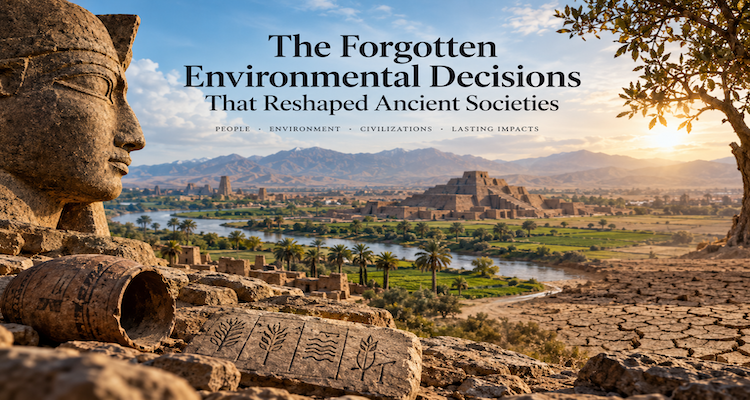
Ancient civilizations are often remembered for what they built: temples, palaces, roads, irrigation canals and monumental cities. But beneath those achievements were thousands of environmental decisions where to farm, how to move water, how much forest to clear, where to build settlements, which landscapes to intensify, and how much maintenance an urban system could absorb.
Those choices could make a society remarkably resilient. They could also create vulnerabilities that became visible only generations later.
The archaeological record increasingly shows that environmental change was rarely a simple story of “nature caused collapse.” Droughts, floods and shifting rivers mattered, but so did the human systems built around them. At Tikal, Maya farmers developed sophisticated agriculture and water-management systems that sustained the city for centuries, while simultaneously pushing parts of the surrounding landscape toward reduced resilience. At Cahokia, settlement and agriculture benefited from a long period of unusually low large-flood frequency before hydrological conditions changed. At Angkor, evidence suggests that land-use intensity and infrastructure maintenance were already declining before the traditionally cited 15th-century endpoint.
The deeper lesson is not that ancient people “destroyed nature.” It is that environmental decisions often produced trade-offs between immediate productivity and long-term resilience a problem that remains recognizable today.
Key Takeaways
- Ancient societies actively engineered landscapes rather than simply adapting passively to environmental change.
- Irrigation, forest clearing and agricultural intensification could increase productivity while creating new vulnerabilities.
- Tikal shows how successful environmental management could eventually operate close to its ecological limits.
- Cahokia’s history demonstrates that environmental risk can emerge when settlements depend heavily on a particular hydrological regime.
- Angkor’s decline appears more gradual than the traditional story of a sudden collapse.
- Rapa Nui shows why environmental history can change when new evidence complicates simple “ecocide” narratives.
Ancient Environmental Decisions Were Often Investments in the Future
Environmental management is sometimes treated as a modern concept, but archaeology tells a different story.
Early communities altered rivers, constructed irrigation canals, stored water, cultivated wetlands, managed forests and modified soils. These were not merely reactions to environmental problems. They were deliberate investments in making particular landscapes more productive.
Archaeological evidence from northern Peru, for example, documents irrigation canals dating back thousands of years. Their construction required organized labor and coordination beyond individual households, suggesting that water management was also a form of social organization.
Southern Mesopotamia offers another example. Researchers have reconstructed ancient river channels, irrigation landscapes and changing vegetation using sediment, plant remains, climate proxies, archaeological evidence and satellite imagery. The landscape around the Tigris and Euphrates was not static: rivers shifted, channels were abandoned or reused, and irrigation practices changed over millennia.
This matters because an irrigation canal was never simply a canal.
It required decisions about labor, maintenance, water allocation, crop choices and settlement. Once communities became dependent on such infrastructure, environmental management became inseparable from political and economic organization.
A system that worked extremely well under one set of environmental conditions could become difficult to maintain when those conditions changed.
Mesopotamia: Irrigation Solved One Problem While Creating Others
The civilizations of southern Mesopotamia are frequently used to illustrate the dangers of irrigation and soil salinization. The basic idea is straightforward: irrigation can increase agricultural production, but in poorly drained environments, dissolved salts can accumulate in soils and eventually affect crops.
Historical scholarship has long discussed salinization as one possible factor in the changing fortunes of Mesopotamian agriculture. Ancient texts even contain references to saline ground and changing agricultural conditions. But the modern archaeological picture is more complicated than the familiar story that irrigation simply “salted the soil and destroyed Mesopotamia.”
The environmental record shows repeated adaptation.
Communities changed cultivation patterns, shifted watercourses, expanded or contracted irrigation and responded to changing ecological conditions. In parts of southern Mesopotamia, researchers have found evidence for changing emphasis between crops such as grain and date palms, while later periods saw major irrigation expansion.
That makes Mesopotamia particularly useful for understanding environmental decisions.
The important question is not simply whether ancient people damaged their environment. It is whether their agricultural system remained flexible enough to respond when the environment changed.
That distinction is crucial. Environmental pressure does not automatically produce social collapse. The outcome depends partly on institutions, technology, mobility, food diversity and the ability to reorganize.
Tikal: When Successful Intensification Became a Vulnerability
The ancient Maya city of Tikal provides an especially revealing case.
Tikal’s inhabitants developed an extensive system of agricultural and environmental management, including irrigation, terraces, agroforestry, household gardens and water-retention infrastructure. These techniques helped support a substantial urban population in a tropical environment where seasonal water availability posed major challenges.
For centuries, the system worked.
But archaeological and ecological evidence suggests that by the Late Classic period, the productive landscape surrounding Tikal had been managed very intensively. Researchers describe it as approaching its carrying capacity, leaving it less resilient when severe droughts struck in the ninth century.
This produces a paradox.
The same environmental management that helped Tikal prosper could also have narrowed its margin for error.
That does not mean Maya society simply “destroyed its environment.” Research on Maya landscapes also demonstrates extensive forest management, wetland agriculture and adaptation. Ancient Maya communities used forests as managed resources and constructed agricultural systems suited to local conditions.
The more useful interpretation is therefore one of optimization and vulnerability.
A landscape can become highly productive precisely because people have learned how to extract more from it. But greater productivity may come with greater dependence on the conditions that make that system work.
When those conditions change, the system can have fewer reserves.
Cahokia: The Environmental Advantage That Could Not Last Forever
Cahokia, located in the Mississippi River floodplain near present-day St. Louis, presents a different version of the same problem.
The city became a major regional center around A.D. 1050. Research using tree-ring records and floodplain sediments indicates that its emergence coincided with a prolonged period of reduced large-flood frequency and increased agricultural opportunity.
That environmental stability was an advantage.
But a settlement system built around a particular hydrological regime becomes exposed when that regime changes.
Researchers found that the frequency of large Mississippi River floods increased after approximately A.D. 1200, around the period when Cahokia began undergoing major social and demographic changes. Other evidence indicates that changes in precipitation and flooding coincided with population decline.
Importantly, the evidence does not establish a single-cause explanation for Cahokia’s decline.
Archaeologists have also considered drought, environmental disturbance, political instability, conflict and social reorganization. The evidence instead points toward interacting pressures rather than a simple environmental switch that turned civilization off.
Cahokia therefore illustrates another overlooked environmental decision:
choosing where to concentrate people and agriculture can be an environmental bet.
For generations, the Mississippi floodplain could provide enormous advantages. But the same geographic concentration could become a liability when flood frequency and precipitation patterns shifted.
Angkor: Sometimes the Decision Is About What You Stop Maintaining
Angkor reveals an environmental decision that receives less attention than construction: maintenance.
The Khmer capital developed an enormous urban landscape containing reservoirs, canals, embankments and other water-management infrastructure. Such systems required continuing labor and institutional capacity.
Yet archaeological evidence has challenged the older image of Angkor suffering a sudden catastrophic collapse in the 15th century.
A 2019 PNAS study examined sediment cores from Angkor Thom and found evidence that land-use intensity in the city’s economic and administrative core had already been declining during the 14th century. Indicators of burning, forest disturbance and soil erosion decreased, while the moat was no longer being maintained by the end of that century.
That changes the way the story can be understood.
Rather than asking only, “What environmental disaster destroyed Angkor?”, researchers can ask whether changing patterns of settlement, land use, political organization and infrastructure maintenance gradually reduced the city’s ability or need to sustain its enormous urban system.
This is a subtle but important distinction.
Infrastructure does not fail only when it physically breaks. It can also become neglected because populations move, institutions change, economic priorities shift or the benefits no longer justify the cost of maintenance.
In that sense, abandonment itself can be an environmental decision.
Rapa Nui: A Famous Collapse Story Gets More Complicated
Few ancient environmental stories are as famous as Rapa Nui, commonly known as Easter Island.
The island’s deforestation has often been presented as a straightforward warning about human overconsumption. But archaeological research has shown that the explanation is more complicated and recent work has reopened an important part of the debate.
A 2010 study argued that humans were the dominant agents of palm-forest destruction, pointing to evidence of burning and tree removal.
A 2025 study by Terry Hunt and Carl Lipo reached a different conclusion about the role of the Polynesian rat (Rattus exulans). Their ecological modeling and analysis of archaeological rat remains argue that introduced rats could have had a major effect on palm regeneration by consuming seeds, working in combination with human forest clearing.
The disagreement is valuable because it demonstrates how environmental history should work.
The evidence does not require a simplistic choice between “humans caused everything” and “nature caused everything.” Human clearing, introduced species and ecological feedbacks can operate simultaneously.
Rapa Nui therefore offers an important warning about historical narratives themselves: a compelling environmental story can become too simple if later evidence is forced to fit it.
What These Societies Have in Common
These cases occurred thousands of miles apart and across very different ecological systems. They should not be treated as variations of one universal “collapse model.”
But several patterns recur.
1. Environmental decisions created benefits first
Irrigation produced food. Forest management supplied resources. Floodplain agriculture supported population growth. Water infrastructure enabled urban concentration.
Environmental transformation was often the foundation of prosperity rather than evidence of failure.
2. Success could increase dependence
The more productive and specialized a system became, the more closely society could become tied to particular environmental conditions.
Tikal’s agricultural intensification is a strong example of this tension.
3. Environmental pressure was rarely acting alone
At Cahokia, changing floods and precipitation interacted with social and political developments. At Angkor, environmental evidence points toward gradual transformation rather than a single catastrophic event. At Rapa Nui, multiple ecological mechanisms remain part of the debate.
4. Maintenance mattered as much as invention
Building infrastructure can transform a landscape quickly. Keeping it functional for generations requires institutions, labor and continued incentives.
That may be one of the least appreciated lessons of ancient environmental history.
The Bigger Lesson: Resilience Is Not the Same as Productivity
The ancient record complicates a common assumption: that societies become resilient simply by becoming better at extracting resources from their surroundings.
They do not necessarily.
A highly optimized system can be extraordinarily productive under favorable conditions while remaining vulnerable to disruption. Conversely, a less intensive system may sacrifice some short-term output in exchange for flexibility.
The most interesting environmental decisions in ancient history were therefore not necessarily the moments when people “saved” or “destroyed” nature.
They were choices about how much environmental change a society was willing to create in exchange for greater security, food, wealth or political power.
That is why ancient environmental archaeology matters beyond the past. It gives historians and scientists a long record of societies experimenting with the same basic trade-off: extracting more from a landscape while trying to preserve enough flexibility to survive when conditions change.
Conclusion
Ancient civilizations did not simply rise and fall because of climate.
They made choices inside changing environments.
They redirected water, intensified agriculture, cleared forests, engineered wetlands, concentrated settlements and built infrastructure that sometimes lasted for centuries. Those decisions generated extraordinary achievements, but they also shaped the risks those societies would later face.
The most useful lesson is not that ancient people were environmentally wise or environmentally destructive. They were both, depending on the place, period and decision.
Their history shows something more consequential: environmental resilience is partly a social choice. A society’s survival depends not only on what its landscape can produce, but on whether its institutions, technologies and habits leave enough room to adapt when that landscape stops behaving as expected.
This content is published for informational or entertainment purposes. Facts, opinions, or references may evolve over time, and readers are encouraged to verify details from reliable sources.