







The Science Behind Tomorrow’s Environment
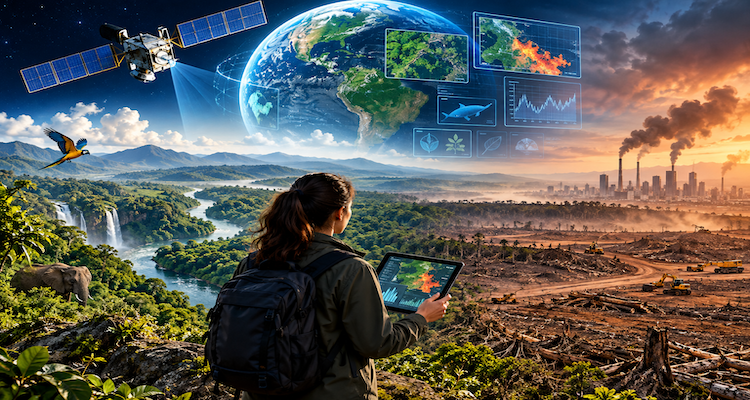
The environment of tomorrow will not be shaped by one invention or a single scientific breakthrough. It is increasingly being shaped by a network of measurement systems, models, sensors, satellites, laboratories and computing infrastructure that allow humans to observe environmental change at a scale that was previously impossible.
That shift matters because environmental science is moving from a largely retrospective discipline measuring what has already changed to one that can increasingly support forecasting, early warning and real-time decision-making. Satellite observations can track changes in forests, ice and atmospheric conditions. Sensor networks can monitor air and water. Earth-system models can explore how the climate may respond under different emissions pathways. Artificial intelligence is beginning to help researchers process enormous volumes of scientific data, although its usefulness depends heavily on data quality, validation and scientific oversight.
The most important development, however, may be the convergence of these tools. Better observation does not automatically solve environmental problems. It changes the quality of the information available to governments, scientists, businesses and communities and that can change how quickly problems are detected and how effectively decisions are made.
Key Takeaways
- Tomorrow’s environmental science will increasingly depend on combining satellites, sensors, advanced computing and human scientific judgment.
- AI can accelerate environmental data analysis, but it does not remove the need for reliable observations and independent validation.
- Early-warning systems can turn scientific monitoring into practical protection when governments and communities can act on the information.
- Earth-system models are essential for exploring future climate risks, but their results depend on assumptions and cannot predict every local outcome precisely.
- The next environmental divide may concern not only who suffers environmental risks, but who has access to the information needed to anticipate them.
The Environment Is Becoming an Information System
For much of modern history, environmental observation was limited by geography. A researcher could measure a river, inspect a forest or collect atmospheric samples, but no individual observation could easily describe what was happening across an entire continent.
That has changed.
NASA’s Earth science program now uses satellites and instruments operating from space, aircraft, ships and land to observe interconnected processes involving the atmosphere, oceans, land, vegetation and ice. The Landsat program alone has built the longest continuous space-based record of Earth’s land, with observations stretching back to 1972.
The important point is not simply that scientists have more images.
Environmental science is increasingly becoming a process of combining multiple forms of evidence. A satellite can reveal a broad spatial pattern; ground instruments can provide local measurements; long-term monitoring networks can help explain change over time; and computational models can integrate those observations with physical understanding.
This combination matters because environmental problems are rarely isolated. A drought can affect agriculture, ecosystems, water supplies and energy systems. A wildfire can change air quality, land cover and carbon emissions. Rising temperatures can interact with infrastructure, public health and economic activity.
The science required to understand these connections must therefore become more integrated as well.
NASA describes its Earth science work explicitly in terms of interconnected systems, while its Earth-observing missions collect information across atmospheric, oceanic, terrestrial and cryospheric processes.
The future of environmental science, in other words, may depend less on discovering a single perfect measurement and more on learning how to connect imperfect measurements intelligently.
Artificial Intelligence Can Accelerate Environmental Science But It Cannot Replace Science
AI has become one of the most discussed technologies in environmental research, and for understandable reasons. Earth observation produces vast and complex datasets. Machine-learning systems can identify patterns, accelerate calculations and help researchers work with information that would otherwise be difficult to process efficiently.
Research published in Nature Communications in 2025 reviewed AI applications for modelling and understanding extreme weather and climate events, including floods, droughts, wildfires and heatwaves. But the review also emphasized the difficulty of building reliable systems from noisy, heterogeneous and sometimes limited datasets.
That limitation deserves as much attention as AI’s capabilities.
Environmental AI does not receive a perfect picture of the planet. It works with observations that may contain gaps, measurement errors, regional biases or incomplete historical records. Extreme events are particularly challenging because the most consequential events can also be relatively rare.
A 2026 npj Artificial Intelligence perspective on machine learning and data assimilation describes an emerging convergence: machine learning can accelerate modelling and pattern recognition, while data assimilation can help incorporate observations, quantify uncertainty and impose physical constraints. The authors also identify continuing challenges involving generalization, consistency and reproducibility.
This suggests that the most useful environmental AI may not be the system that attempts to replace established scientific models.
It may be the system that works alongside them.
That is a more important distinction than it first appears. Traditional Earth-system models encode scientific understanding of physical processes. Machine learning can find patterns and build efficient approximations from data. Hybrid approaches aim to use the strengths of both.
Researchers have described this direction as a potential evolution toward systems that combine data-driven learning with physical modelling rather than treating the two as competing alternatives.
For readers, the practical lesson is straightforward: faster environmental prediction is not automatically the same as better environmental understanding. Scientific reliability still depends on validation, uncertainty analysis and whether a model performs beyond the conditions on which it was trained.
Why “Digital Twins of Earth” Remain a Work in Progress
One of the most ambitious ideas in environmental science is the creation of a highly detailed computational representation of the Earth system often described as a digital twin.
The concept is compelling. A sufficiently capable system could combine observations, physical models and computational analysis to help researchers explore how environmental systems respond to different conditions.
But the term can easily create unrealistic expectations.
A 2023 review in Nature Reviews Earth & Environment noted that progress in big Earth data, machine learning and data assimilation is moving the field toward digital-Earth concepts, while also making clear that a complete digital twin of Earth had not yet been produced.
That distinction matters.
Earth is not a machine with a fixed and fully observable set of inputs. It is a complex system containing interactions across the atmosphere, oceans, land, ice, ecosystems and human societies. Some processes are better understood than others. Observations vary in quality and coverage. Human decisions introduce another layer of uncertainty.
A more realistic way to understand the idea is not as a future “copy” of the planet capable of predicting everything.
It is as an evolving scientific infrastructure that could improve the ability to test scenarios, integrate observations and explore environmental risks.
The value of such systems may therefore lie in better decision support rather than perfect prediction.
Climate Models Explain Futures in Ranges, Not Certainties
Public discussion of climate modelling sometimes falls into two opposite mistakes.
One assumes that a model produces an exact picture of the future. The other treats uncertainty as evidence that modelling is meaningless.
Neither interpretation reflects how climate science works.
The IPCC’s assessments explain that future climate projections are affected by several sources of uncertainty, including future external influences and emissions pathways, imperfect knowledge of aspects of the climate system, and internal climate variability. Regional projections can also accumulate uncertainty through the modelling and downscaling process.
This is why credible climate science often presents ranges, scenarios and confidence assessments.
Uncertainty is not an embarrassing footnote to the science. It is part of the scientific result.
The IPCC’s Sixth Assessment Report also explains that different sources of uncertainty can matter differently depending on the variable, region and time horizon being examined.
That has an important consequence for the future of environmental decision-making.
The goal should not always be to eliminate uncertainty. In many cases, that is impossible. The more useful objective is to understand uncertainty well enough to make better decisions despite it.
A city deciding how to prepare for flood risk, for example, does not need a guarantee about the exact rainfall on a specific day decades from now. It needs scientifically credible information about plausible risks, their range and the consequences of being unprepared.
That is a different and often more useful standard for environmental intelligence.
From Monitoring the Planet to Acting on Warnings
The ultimate test of environmental science is not how much data can be collected.
It is whether useful information reaches the people who need it in time to act.
This is where the connection between environmental observation and early-warning systems becomes particularly important.
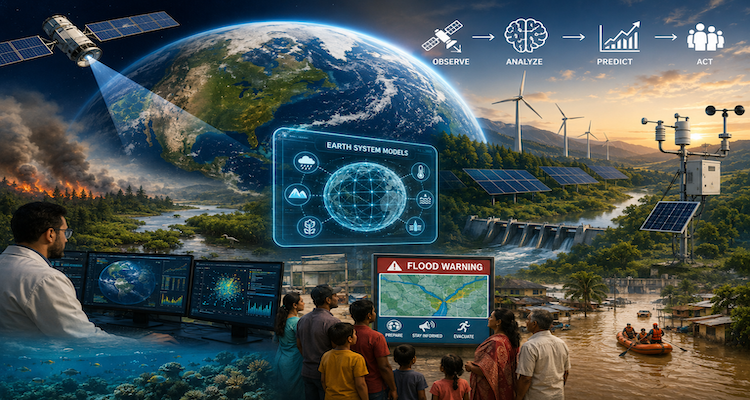
The World Meteorological Organization’s Early Warnings for All initiative aims to ensure universal protection from hazardous weather, water and climate events through early-warning systems by the end of 2027. The WMO describes effective multi-hazard warning systems as requiring more than detection and forecasting: they also depend on risk knowledge, communication and preparedness and response capabilities.
That framework exposes a critical weakness in purely technological thinking.
A highly accurate forecast does not protect anyone if the warning is not communicated. A warning does not protect a community that lacks the ability to respond. A sophisticated monitoring system can therefore coexist with significant vulnerability.
The environmental technologies of tomorrow will be most valuable when they complete the full chain:
Observation → Analysis → Forecast → Communication → Action
Break any link, and scientific capability may fail to produce real-world protection.
This may be one of the defining challenges of environmental innovation: turning increasingly sophisticated planetary information into decisions that work at the scale of actual communities.
The Emerging Environmental Information Divide
There is another consequence that deserves more attention.
Environmental risk is not distributed evenly, and neither is scientific infrastructure.
Some regions have dense monitoring networks, strong computing capacity, well-funded research institutions and sophisticated emergency communication systems. Others have fewer observations, limited technical infrastructure or gaps between national scientific agencies and vulnerable communities.
The WMO states that only about half of countries report having adequate multi-hazard early-warning systems, while its initiative focuses on expanding coverage by 2027.
This points toward a broader question for the coming decades.
Could access to environmental intelligence become a new dimension of inequality?
The issue is not merely whether a country has satellites or advanced AI. It is whether environmental information is available, understandable, locally relevant and connected to institutions capable of acting on it.
A farmer does not necessarily benefit from a global climate model unless its insights can eventually inform decisions about water, crops or changing risks. A coastal community does not benefit fully from sophisticated sea-level monitoring unless that information contributes to planning and protection.
The next stage of environmental science may therefore require an equally serious investment in translation: converting planetary-scale knowledge into local-scale usefulness.
Tomorrow’s Environment Will Be Measured More Closely Than Ever
The scientific infrastructure surrounding Earth is becoming more capable of observing change across multiple scales. NASA continues to operate and develop missions that monitor variables across oceans, land, ice and the atmosphere, while long-running programs such as Landsat demonstrate the importance of consistent observations over decades.
At the same time, machine learning is being integrated more deeply into Earth observation and prediction research. Recent work emphasizes both its potential and its continuing limitations, including the need for systems that are reliable, interpretable and able to work with changing real-world conditions.
This combination points toward a significant shift.
Environmental science is becoming more continuous. Instead of relying only on occasional measurements and retrospective analysis, future systems may increasingly combine ongoing observation with rapid analysis and scenario modelling.
But more information will also create new responsibilities.
Scientists will need to communicate uncertainty clearly. Governments will need to decide how evidence should influence policy. Technology developers will need to demonstrate that AI systems remain reliable beyond controlled benchmarks. Communities will need access not just to warnings, but to the means of acting on them.
Conclusion
The science behind tomorrow’s environment is not a promise that humanity will soon be able to predict every flood, wildfire, drought or ecological change.
The evidence points to something more realistic and potentially more useful.
Satellites are expanding the ability to observe the planet. Long-term monitoring networks are revealing how environmental systems change. Earth-system models are helping scientists examine possible futures while explicitly accounting for uncertainty. AI is accelerating the analysis of complex information, particularly when combined with physical knowledge and observational data.
The larger transformation is therefore not simply technological. It is informational.
Tomorrow’s environmental challenge will increasingly be about what societies do with the ability to see change earlier, model risks more effectively and communicate warnings more intelligently. Science can improve the quality of the signal. Whether that signal leads to better environmental outcomes will still depend on institutions, investment, access and human decisions.
That may be the defining lesson of tomorrow’s environment: the planet can be observed with increasing precision, but observation alone is not adaptation. Knowledge becomes protection only when it is understood and acted upon.
This content is published for informational or entertainment purposes. Facts, opinions, or references may evolve over time, and readers are encouraged to verify details from reliable sources.