










Microplastics Are Everywhere But What Do We Actually Know About Their Impact?
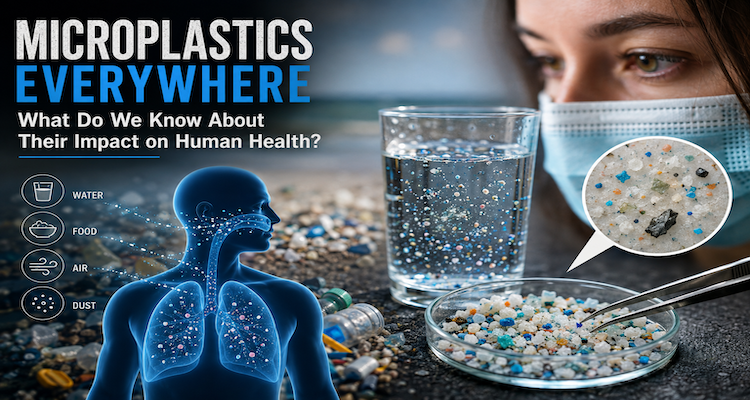
Microplastics have become one of the most visible symbols of modern pollution. They have been detected in oceans, rivers, soil, food, drinking water, indoor dust and air. Researchers have also reported plastic particles in human biological samples, raising an unsettling question: if microplastics are reaching the human body, what are they actually doing there?
The honest scientific answer is more complicated than many headlines suggest.
There is now little doubt that human exposure to microplastics occurs. What remains far less certain is the scale of the health risk, which types and sizes of particles matter most, how much exposure people experience over a lifetime, and whether the particles themselves cause specific diseases in humans.
That distinction matters. The science is moving from a relatively straightforward environmental question Where are microplastics? to a much harder biomedical one: Which exposures produce meaningful biological harm in real people?
The evidence is concerning enough to justify serious research and efforts to reduce plastic pollution. But it is not yet strong enough to support many of the more dramatic claims circulating online.
Key Takeaways
- Microplastics are widespread in the environment, and people can be exposed through food, water and air.
- Detecting plastic particles in human tissues does not by itself prove that they cause disease.
- Laboratory and animal studies suggest inflammation, oxidative stress and other biological effects, but translating those findings to humans remains difficult.
- A 2024 cardiovascular study found an association between plastic particles in arterial plaque and worse outcomes, but it did not establish causation.
- The biggest scientific challenge is measuring real-world exposure consistently and linking it to health outcomes over time.
- Reducing unnecessary plastic pollution is supported by environmental evidence even while major questions about human health risks remain unresolved.
The first thing to understand: “microplastics” are not one substance
One reason the science is difficult is that the word microplastics can create a false impression of a single pollutant.
Microplastics are generally defined as plastic particles smaller than 5 millimetres. But particles within that broad category can differ dramatically in size, shape, chemical composition and surface properties.
A particle may be made of polyethylene, polypropylene, polystyrene, polyvinyl chloride or another polymer. It may be a fragment, fibre, film or pellet. Some particles may carry chemical additives or interact with pollutants and biological material in their environment.
Then there are nanoplastics particles smaller still which may behave differently because of their size.
This means that asking whether “microplastics are harmful” is somewhat like asking whether “chemicals are harmful.” The answer may depend heavily on the specific material, dose, route of exposure and biological context.
The World Health Organization has emphasized these uncertainties in its assessments of exposure through drinking water, food and inhalation. WHO’s work has highlighted the need for better information on exposure levels, particle characteristics and potential health effects.
How do microplastics enter the human body?
The two exposure routes that receive the greatest scientific attention are ingestion and inhalation.
People may encounter plastic particles in food and beverages, including drinking water. They may also inhale particles present in indoor and outdoor air.
A 2024 review of human exposure research noted that ingestion and inhalation are important potential routes, while also stressing that the exact contribution of different exposure pathways remains difficult to determine. The same review identified a major problem across the field: methods for detecting and measuring microplastics are not yet sufficiently standardized.
That methodological problem is more important than it may sound.
If two laboratories use different sampling procedures, contamination controls, detection instruments or definitions of particle size, their results may not be directly comparable. A study reporting a high concentration of particles cannot automatically be compared with another study using a different method.
This is one reason estimates of human exposure can vary so widely.
The science does not simply need more studies. It needs studies that can reliably speak the same analytical language.
Finding microplastics in the body is important but it is not the final answer
Reports of microplastics detected in blood, lung tissue, placental samples and other human tissues have understandably attracted attention.
These findings are scientifically significant because they suggest that at least some plastic particles can enter biological systems rather than simply passing through the digestive tract.
But detection and harm are two separate questions.
A substance can be measurable in the body without causing clinically meaningful disease. Conversely, some substances can cause harm at low concentrations under specific conditions.
To establish a human health risk, researchers need to understand several additional questions:
- How much exposure occurs?
- Which particles enter particular tissues?
- How long do they remain there?
- What biological processes do they trigger?
- Are those processes harmful at environmentally realistic exposure levels?
- Do exposed populations experience more disease after accounting for other risk factors?
Those questions require different types of evidence. Laboratory experiments can investigate mechanisms. Animal studies can test biological effects. Human observational studies can identify associations. Stronger conclusions emerge when these different forms of evidence begin pointing in the same direction.
At present, that convergence is still incomplete.
What laboratory and animal studies are telling us
Experimental research has identified several mechanisms through which microplastics and nanoplastics could potentially affect biological systems.
Depending on the particle and experimental conditions, researchers have reported effects involving oxidative stress, inflammation, immune responses and cellular damage.
A rapid systematic review published in Environmental Science & Technology in late 2024 examined evidence relating microplastic exposure to digestive, reproductive and respiratory health. The review found relatively few human observational studies compared with the much larger body of animal research.
The authors concluded that some adverse effects were suspected based on the available evidence, including effects related to sperm quality, immune function, respiratory injury and inflammation. However, the human evidence base remained limited.
That wording suspected is important.
It does not mean the health effects are imaginary. But it also does not mean that a causal relationship has been established in humans.
One of the persistent challenges is dose.
Experimental studies may expose cells or animals to concentrations that are useful for identifying possible biological mechanisms but may not correspond directly to the exposures experienced by people in daily life.
The New England Journal of Medicine study on plastic particles in arterial plaque explicitly noted the difficulty of extrapolating from experimental studies, particularly when laboratory exposure levels differ substantially from those observed in human environments.
The cardiovascular study that changed the conversation
In 2024, a study published in the New England Journal of Medicine brought the human health debate into sharper focus.
Researchers examined carotid artery plaques removed from patients undergoing surgery. Polyethylene was detected in the plaque of 150 of the 257 patients who completed follow-up, while some also had measurable polyvinyl chloride.
Patients whose plaque contained detectable microplastics or nanoplastics experienced a higher rate of a combined outcome involving heart attack, stroke or death during an average follow-up of about 34 months. The study reported an adjusted hazard ratio of 4.53 for that composite outcome.
It was an important finding but it was not proof that microplastics caused those events.
The researchers themselves acknowledged that the observational study could not establish causality. Other factors, including unmeasured environmental exposures, health conditions and lifestyle variables, could potentially contribute to the association. The study population also consisted of patients with existing carotid artery disease undergoing surgery, meaning the findings cannot automatically be generalized to the broader population.
The study also prompted scientific debate about the possibility of contamination during sample collection and analysis. A subsequent correspondence published by the journal questioned whether external plastic contamination could have influenced the findings.
That debate is not a reason to dismiss the research. It is an example of science working as it should.
A striking finding should be tested, challenged and independently replicated especially when measuring contaminants that are already widespread in laboratories, hospitals and everyday environments.
The key lesson is that association is a signal for further investigation, not the same thing as proof of causation.
The biggest problem may be measurement
Microplastics research faces a challenge that resembles an early-stage scientific mapping problem.
Researchers are trying to study a contaminant that varies enormously in:
- particle size
- particle shape
- polymer type
- chemical additives
- environmental source
- route of exposure
- biological behavior
At the same time, plastic contamination can potentially occur during sampling and laboratory analysis.
A 2024 review in the Journal of Hazardous Materials Advances emphasized the lack of standardized and validated methods for measuring microplastics in human tissues. Without greater consistency, comparing studies and estimating real-world exposure remains difficult.
This creates an important editorial distinction often lost in public discussion.
The question is no longer simply whether scientists can detect plastic particles.
They can.
The harder question is whether researchers can measure those particles consistently enough to determine who is most exposed, what level of exposure matters and what health outcomes follow.
Until that measurement problem improves, risk estimates will remain uncertain.
What recent reviews suggest and what they still cannot prove
A 2025 review in The Lancet Planetary Health described microplastics and nanoplastics as pervasive environmental contaminants and reviewed potential disease risks involving several body systems.
The review noted that experimental evidence increasingly suggests biological effects. At the same time, it emphasized a central limitation: direct evidence connecting real-world microplastic exposure to human disease remains scarce.
Another systematic review of in vivo human evidence, published in 2026 and indexed in PubMed, similarly focused on the gap between laboratory concerns and direct human evidence.
The emerging picture is therefore neither reassuring nor conclusive.
There are enough biological signals to justify concern.
There is not yet enough high-quality human evidence to confidently quantify the health risk for the average person.
That middle ground can feel unsatisfying, particularly in an era accustomed to simple health headlines. But uncertainty is sometimes the most accurate scientific answer.
Should people be worried about everyday exposure?
Concern is reasonable. Panic is not supported by the evidence.
People cannot realistically eliminate all exposure to microplastics. Plastic particles are already widely distributed across environmental systems, and individual consumer choices alone cannot solve the problem.
There are, however, practical actions that make sense without assuming that every exposure carries a known medical risk.
Reducing unnecessary single-use plastics, improving waste management and supporting policies that prevent plastic from entering ecosystems can reduce pollution at its source.
On an individual level, consumers may also choose to reduce avoidable plastic use where practical. But there is currently no scientifically established “microplastic detox,” supplement or treatment that has been shown to remove plastic particles from the human body.
Claims that a particular product can cleanse the body of microplastics should therefore be treated cautiously unless supported by strong clinical evidence.
The more meaningful solution is likely to be upstream rather than individual: reducing the production, release and environmental fragmentation of unnecessary plastics.
Why this issue is bigger than personal health
The microplastics debate is often framed as a question about what happens after particles enter the human body.
But the broader story begins much earlier.
Microplastics are the downstream consequence of a larger material system built around extensive plastic production, consumption and disposal. By the time particles are found in drinking water, agricultural soil, marine ecosystems or human tissues, the pollution has already moved through multiple environmental pathways.
This is why the scientific uncertainty around human disease does not mean the environmental problem is uncertain.
Plastic pollution can damage ecosystems, and microplastic contamination has become widespread enough that researchers are now investigating its movement across environmental and biological systems. WHO’s assessments have consistently identified major knowledge gaps regarding human health while also supporting the need for better monitoring, research and pollution management.
The health question and the environmental question are related, but they should not be confused.
We do not need definitive proof that every microplastic particle causes human disease before deciding that reducing unnecessary environmental plastic pollution is a rational goal.
What research needs to happen next
The next phase of microplastics research will need to move beyond simply demonstrating that particles are present.
The most useful studies will likely focus on several areas:
Standardized detection
Researchers need methods that allow results from different laboratories and countries to be meaningfully compared.
Better exposure measurement
Scientists need to understand how much exposure occurs through air, food, water and other pathways—and which sources contribute most significantly.
Long-term human studies
Large population studies following people over time could help determine whether higher exposure is associated with specific diseases.
Particle-specific research
Different plastics may not behave the same way biologically. Size, shape and chemical composition could all matter.
Stronger contamination controls
Because plastics are so widespread, rigorous procedures are essential to distinguish environmental or biological exposure from contamination introduced during research.
These are not minor technical details. They will determine whether the field can move from alarming observations to reliable risk assessment.
Conclusion
Microplastics are everywhere, and human exposure is real. The scientific challenge is no longer proving their presence it is determining their significance.
Laboratory and animal research has identified plausible mechanisms through which some particles could cause biological harm. Human studies have produced important and sometimes concerning associations, including findings involving cardiovascular disease. But association is not causation, and the direct evidence linking everyday microplastic exposure to specific human diseases remains limited.
The most responsible interpretation is neither complacency nor alarmism.
Microplastics deserve serious attention because exposure is widespread, environmental contamination is extensive and biological concerns are scientifically plausible. At the same time, readers should be cautious about claims that suggest scientists have already calculated the precise damage microplastics are causing to human health.
The real story is more important than a simple headline: humanity is conducting a large, uncontrolled environmental experiment with a material designed to persist. Science is only beginning to understand what that experiment may mean for ecosystems—and for us.
This content is published for informational or entertainment purposes. Facts, opinions, or references may evolve over time, and readers are encouraged to verify details from reliable sources.