










Faith and Science: Do They Have to Be in Conflict?
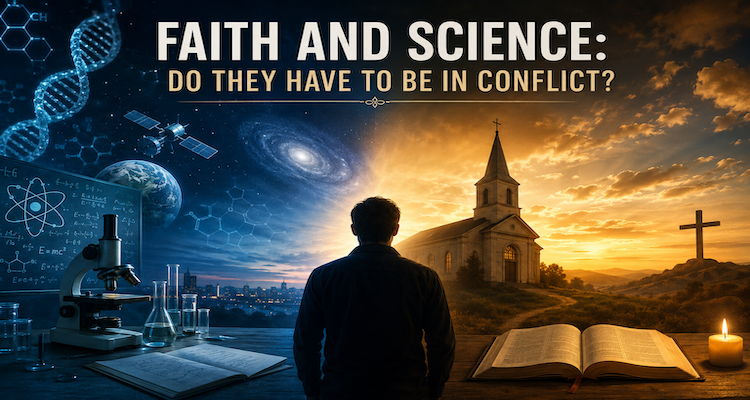
The idea that faith and science are locked in an endless war is one of the most familiar stories in modern culture. Galileo is often presented as science’s martyr. Evolution is framed as a direct challenge to religious belief. New discoveries about the universe are sometimes treated as victories for reason over faith or, from the opposite direction, as threats to spiritual meaning.
The historical and philosophical record is more complicated.
Science and religion have certainly collided, and some conflicts remain genuine. But the claim that they must always be enemies is difficult to sustain. Historians and philosophers have challenged the popular “conflict thesis,” while research on how people actually hold scientific and religious beliefs suggests that the relationship is more varied than a simple choice between laboratory and altar.
The more useful question, then, is not whether faith or science should win. It is where their methods, claims and limits genuinely overlap and where they do not.
Key Takeaways
- Science and religion have sometimes conflicted, but historians reject the idea of a single, continuous war between them.
- Science is uniquely equipped to test claims about the observable natural world through evidence and revision.
- Religious traditions often address meaning, values and purpose, though conflicts arise when they make incompatible empirical claims.
- Evolution remains a real point of disagreement for some believers, but many religious people and traditions accept evolutionary science.
- Research suggests scientific and religious beliefs are often more nuanced and less mutually exclusive than public debate implies.
- The most productive approach is neither forced harmony nor permanent hostility, but intellectual honesty about what each kind of claim can support.
The Myth of an Inevitable War
The popular story of permanent warfare between science and religion owes much to arguments developed in the nineteenth century. Works such as John William Draper’s History of the Conflict Between Religion and Science and Andrew Dickson White’s A History of the Warfare of Science with Theology in Christendom helped popularize the idea that scientific progress and religious authority were natural adversaries.
Modern scholarship has treated that narrative with considerably more caution.
The Stanford Encyclopedia of Philosophy notes that the relationship between science and religion has taken multiple forms, including conflict, independence, dialogue and integration. It also observes that most scholars working specifically on the subject criticize the sweeping conflict model as an overly simple reading of history.
That does not mean the historical conflicts were imaginary. Galileo’s case was real. Disputes over evolution were real and continue in some communities. Religious institutions have, at times, resisted scientific conclusions, while scientific arguments have also been used to challenge religious doctrines.
The problem begins when these episodes are turned into a universal rule.
History is rarely so neat. Religious institutions have sometimes resisted scientific ideas, supported them at other times, and often contained internal disagreements. Scientists themselves have held widely different religious and philosophical beliefs. The relationship has changed across periods, cultures and disciplines.
The evidence does not support replacing a simplistic story of eternal conflict with an equally simplistic story of permanent harmony. Both have existed.
Where Science Has a Distinct Authority
A key distinction is methodological.
Science investigates the natural world through observation, measurement, experimentation, evidence and explanations that can be tested against further evidence. Scientific conclusions are always open to revision when stronger evidence emerges. That does not mean every scientific question is easy to answer or that scientific institutions never make mistakes. It means that scientific claims are accountable to evidence about the natural world.
This has an important consequence: when a religious, philosophical or cultural claim makes a specific empirical assertion about nature, that assertion can come into conflict with scientific evidence.
The age of the Earth is an example. So are claims about biological evolution, disease or astronomy. A belief system does not become scientifically valid simply because it is sincerely held. If a claim concerns how the physical world works, it can be investigated against evidence.
The National Academies makes a similar distinction in its discussion of evolution: scientific explanations must be based on evidence from the natural world, and explanations that conflict with observation and experiment may need to be modified or abandoned.
This is not a declaration that science can answer every meaningful human question. It is a recognition that different questions require different forms of justification.
Where Faith Enters a Different Conversation
Religious belief often concerns questions that cannot be settled by a laboratory experiment alone: questions of meaning, purpose, moral obligation, spiritual experience and humanity’s relationship to what believers understand as the sacred.
Whether the universe has an ultimate purpose is not equivalent to asking how stars form. Whether human life has inherent meaning is not the same type of question as determining the age of a fossil.
This distinction has led some thinkers to argue for partial independence between science and religion. Stephen Jay Gould famously described science and religion as addressing different domains of authority, with science focused on empirical questions and religion concerned with questions of value and meaning.
That approach is useful, but it has limits.
The two domains cannot always be kept perfectly separate. Religious traditions sometimes make historical or empirical claims. Scientific developments can also influence philosophical assumptions about human origins, consciousness and humanity’s place in nature.
The boundary, therefore, is not a permanent wall. It is better understood as a question of intellectual jurisdiction: What kind of claim is being made, and what evidence could reasonably support it?
That question is more useful than simply asking whether someone is “pro-science” or “pro-faith.”
Evolution Shows Why the Debate Is More Complicated
Evolution is often presented as the decisive battleground between science and religion. In reality, it reveals the diversity within religion itself.
The National Academies states that many religious people accept evolution and that most religions do not have a direct conflict with the idea. Some believers understand evolutionary processes as compatible with their understanding of divine creation, while others reject evolution because they interpret sacred texts more literally.
This creates an important distinction.
There is a difference between saying:
“Science and religion are inherently incompatible.”
and saying:
“Certain interpretations of particular religious doctrines conflict with particular scientific conclusions.”
The second statement is often easier to defend.
A literal interpretation of a creation account may conflict with the scientific evidence supporting evolution. But that does not establish that every form of religious belief conflicts with evolutionary biology. Nor does accepting evolution require a person to adopt every philosophical conclusion that some people draw from evolutionary theory.
Science can explain mechanisms and evidence. It does not automatically settle every metaphysical interpretation people build around those findings.
The Real Conflict Is Often About Authority
Some of the deepest tensions between faith and science are not simply about facts. They are about who or what gets to decide what counts as knowledge.
Science relies on empirical evidence and methods designed to test explanations. Religious traditions may rely on scripture, revelation, tradition, philosophical reasoning, spiritual experience or communal authority.
These approaches can coexist when they address different questions. Conflict becomes sharper when they make competing claims about the same subject.
That is why the relationship cannot be reduced to a slogan.
If a scientific theory is supported by strong evidence, rejecting it solely because it conflicts with a preferred belief does not make the scientific evidence disappear. At the same time, the fact that science cannot measure or test a metaphysical proposition does not automatically prove that proposition false.
“Not scientifically established” and “scientifically disproved” are not identical statements.
That distinction is particularly important in public debates, where both sides sometimes claim more certainty than their methods allow.
What Research Says About How People Actually Think
Recent research also complicates the stereotype that people must choose between scientific and religious worldviews.
A 2023 study involving three studies and 707 participants found that scientific and religious beliefs can be held within different epistemic frameworks. The researchers reported differences in how participants justified beliefs, including greater roles for ethical considerations, affiliation and intuition when thinking about religious beliefs. They also found that some contentious scientific beliefs could take on characteristics resembling religious beliefs.
Another study using a nationally representative American sample of 300 adults found that scientific and religious beliefs were separate dimensions that were only modestly negatively correlated. The research does not prove that science and religion are naturally compatible, but it does challenge the assumption that stronger commitment to one necessarily eliminates the other.
A more recent study examining perceptions of religion and science also found a more nuanced relationship than a simple conflict narrative suggests. Perceptions of conflict were associated with lower confidence in science, while perceptions that religious values aligned with protecting the planet were associated with higher confidence in science.
These findings should not be overstated. Surveys of belief do not settle philosophical questions about whether religious claims are true or whether particular scientific theories are correct.
What they do show is that human beings do not always organize their beliefs according to the neat categories imagined by public debate.
Why the Question Matters Beyond Philosophy
The science-and-faith debate has practical consequences.
When scientific institutions are perceived as hostile to religious identity, some audiences may become more distrustful of scientific communication. Research on science communication has emphasized that disagreements about scientific issues can involve values, identity, trust and perceived interests not simply a lack of information.
That does not mean scientific institutions should soften or alter evidence to avoid disagreement. Evidence should not be negotiated to make it more comfortable.
But communication matters.
Telling people that accepting a scientific finding requires abandoning every aspect of their identity can create a false choice where none is necessary. Conversely, pretending that every scientific conclusion can be made compatible with every religious interpretation is equally misleading.
The more honest approach is more demanding: respect people without pretending that incompatible claims are compatible.
Science Cannot Be Replaced by Faith And Faith Cannot Be Reduced to a Failed Experiment
A mature relationship between faith and science requires limits on both sides of the argument.
Science is the strongest available method for investigating many questions about the physical world. Religious conviction cannot substitute for empirical evidence when the question is how a virus spreads, how planets move or how species change over time.
But science, by itself, does not automatically generate a complete system of moral values. Scientific knowledge can help explain the consequences of human actions, but deciding what people ought to value involves philosophical, ethical and cultural reasoning.
That distinction does not place religion beyond criticism. Religious ideas can be examined philosophically, historically and ethically. Specific factual claims can be tested when they concern the observable world.
Nor does it place science beyond scrutiny. Scientific institutions are human institutions. Research can be flawed, incentives can distort behavior, and scientific conclusions can be revised. The strength of science lies not in claiming infallibility but in creating methods through which errors can, in principle, be identified and corrected.
The most useful lesson is not that faith and science are secretly the same thing.
They are not.
Conclusion
Faith and science do not have to be in permanent conflict, but neither can their differences always be dissolved with a slogan about “harmony.”
Conflict is real when incompatible claims are made about the same reality. If evidence strongly contradicts an empirical claim, faith alone does not transform that claim into science. At the same time, scientific knowledge does not automatically answer every question people ask about meaning, value or purpose.
The deeper challenge is intellectual discipline: knowing what a method can establish, where a belief goes beyond available evidence, and when disagreement is genuine rather than manufactured.
Perhaps that is the more useful alternative to the old image of warfare. The goal is not to force science and faith into agreement. It is to understand where evidence should have the final word, where philosophical and spiritual interpretation begins, and where honest people may continue to disagree.
This content is published for informational or entertainment purposes. Facts, opinions, or references may evolve over time, and readers are encouraged to verify details from reliable sources.
Related News
- Why Mark Zuckerberg Visited Kainchi Dham: The Neem Karoli Baba Connection Behind a Silicon Valley Story
- Kainchi Dham: How a Himalayan Ashram Became a Global Spiritual Landmark
- How Religious Architecture Continues to Shape Human Emotions Long After Belief Fades
- The New Search for Silence and Why It Is Becoming a Spiritual Movement