









The Questions Children Stop Asking When School Teaches Them to Be Correct
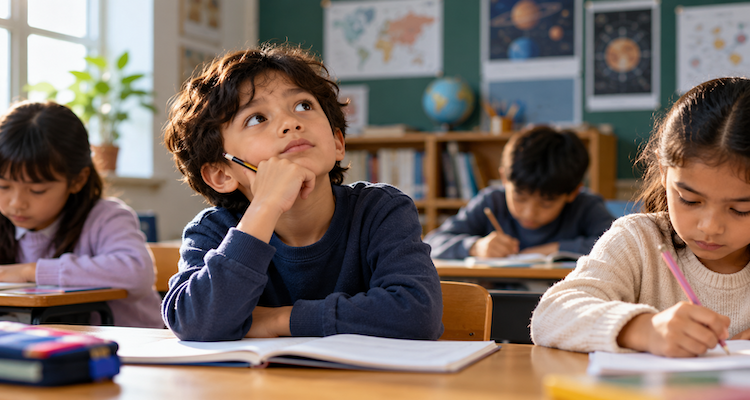
A child can enter school with hundreds of questions and leave a classroom knowing exactly which answers the teacher expects. Somewhere between those two moments, something important can change. Curiosity, once expressed freely, may become more cautious. Questions that once came naturally may begin to feel unnecessary, embarrassing or risky.
This does not happen in every classroom, and it is not the intention of most teachers. Schools help children develop essential knowledge, discipline and the ability to distinguish accurate information from mistakes. Yet when being correct becomes more important than exploring an idea, learning can gradually turn into a search for approval rather than understanding.
The difference is subtle. A child may continue completing assignments, memorising facts and achieving good grades. From the outside, everything appears to be working. But the questions that make learning personal and meaningful may become less frequent.
When the Right Answer Becomes the Main Goal
Imagine a classroom where a teacher asks why the sky appears blue. One student gives the expected scientific explanation. Another asks why the sky sometimes turns orange at sunset, whether the atmosphere changes colour, or why the sky looks different on another planet.
The first student has answered the question. The second has opened several new ones.
Both responses have educational value. However, in a classroom dominated by limited time, fixed lesson plans and examinations, the expected answer may receive immediate recognition while the additional questions remain unexplored.
Children are remarkably attentive to the reactions of adults. They notice which responses earn praise, which mistakes attract correction and which questions interrupt the lesson. Over time, they can learn to focus on what is rewarded.
The problem is not that correct answers matter. They do. A child learning mathematics needs to understand accurate calculations, just as a student studying science needs reliable evidence. The difficulty begins when correctness becomes the only visible measure of intelligence.
Learning then risks becoming a performance. Instead of asking, “What can I discover about this?”, a child may begin asking, “What answer will make me look capable?”
That shift can change the way a student approaches unfamiliar ideas. Questions become less about discovery and more about avoiding mistakes.
How Fear of Being Wrong Changes Curiosity
Children do not need to be told directly that questions are unwelcome. Sometimes, a single uncomfortable experience is enough to make them hesitate.
A student asks something that seems obvious to classmates and receives laughter. Another offers an unusual explanation and is quickly dismissed. A third asks a question that takes the lesson in an unexpected direction, only to hear that there is no time for it.
None of these moments necessarily reflects a teacher’s broader intentions. Classrooms are busy environments, and teachers must balance individual needs with the progress of an entire group. Nevertheless, repeated experiences can influence whether children feel comfortable expressing uncertainty.
Research in educational psychology has long examined the importance of psychological safety, motivation and students’ beliefs about their abilities. When children believe that mistakes are a normal part of learning, they may be more willing to attempt difficult tasks. When mistakes feel like evidence of inadequacy, avoiding them can become more attractive than exploring something unfamiliar.
This is where some of the most valuable questions begin to disappear.
A child who once asked, “Why does this happen?” may start thinking, “What if everyone laughs at me?”
A student who wonders whether a textbook explanation leaves something out may decide that questioning it sounds disrespectful.
Another child may have an original idea but remain silent because the answer has not been covered in class.
These children have not necessarily lost their curiosity. They may simply have learned to protect it from situations in which it feels unwelcome.
The Questions Children Learn to Keep to Themselves
The questions most easily overlooked are not always complicated scientific problems. Many concern everyday assumptions, personal experiences and the relationship between what children are told and what they observe.
“Why do we have to learn this?”
This question is sometimes treated as resistance to work. Yet it can also express a genuine desire to understand how knowledge connects to life. Explaining the purpose of a lesson can help children recognise its relevance rather than treating it as another requirement to complete.
“What happens if the book is wrong?”
A textbook provides structured knowledge, but education should also help students understand how knowledge is tested, revised and improved. In science, historical research and many other disciplines, conclusions can change when better evidence emerges. Teaching children how to evaluate reliable sources is more useful than suggesting that every printed statement is beyond question.
“Can there be another answer?”
Some questions have precise answers. Others involve interpretation, competing explanations or uncertainty. Children benefit from learning the difference. In literature, history, ethics and social studies, two people may reach different conclusions while offering thoughtful reasons for their positions.
“Why do adults disagree?”
Children regularly encounter differences between what adults say, what they do and what different authority figures believe. Their questions about these contradictions can be opportunities to discuss evidence, values, context and human fallibility. Dismissing every uncomfortable question may leave them with rules but little understanding of how to evaluate them.
“What if I try and fail?”
Perhaps this is the most personal question of all. A child who fears failure may avoid difficult work, conceal confusion or choose only tasks that seem safe. When adults treat mistakes as useful feedback rather than personal defects, they help children develop the confidence to keep learning.
These questions do not need to be encouraged without limits. Children also need boundaries, factual guidance and age-appropriate explanations. The goal is not to accept every idea as equally valid. It is to make room for thoughtful inquiry while teaching children how to examine their own assumptions.
What Schools Can Do to Protect Curiosity
Protecting curiosity does not require schools to abandon examinations, structured lessons or clear learning objectives. It requires a broader understanding of what successful learning looks like.
Teachers can begin by giving students opportunities to ask their own questions before introducing the formal explanation. Even a brief discussion about what a class wants to discover can reveal misunderstandings and unexpected interests.
They can also distinguish between an incorrect answer and an unhelpful attempt. A wrong answer may expose a misconception that needs attention, but it can also reveal how a student is thinking. Asking, “What led you to that conclusion?” often provides more information than simply announcing that the answer is incorrect.
Another useful practice is allowing students to investigate questions that do not have immediate answers. A classroom discussion does not always need to conclude with certainty. Sometimes, the most productive outcome is a clearer understanding of what remains unknown and how it might be investigated.
Assessment matters, too. Examinations can measure important knowledge, but they cannot capture every dimension of learning. Projects, explanations, experiments and open-ended discussions can help teachers recognise reasoning, creativity and the ability to connect ideas.
Parents also have a role. When children ask difficult, repetitive or seemingly impractical questions, adults do not always need to provide an immediate answer. They can ask what the child thinks, explore the question together or admit when they do not know.
Saying “I don’t know; let’s find out” demonstrates something important: uncertainty is not the opposite of intelligence. It is often the starting point of learning.
None of these approaches guarantees that every child will remain equally curious. Children differ in temperament, interests, confidence and learning needs. Some prefer to observe before speaking, and a quiet student is not necessarily an uncurious one. Educators must therefore create different ways for students to participate rather than judging curiosity only by how often a child raises a hand.
Education Should Make Children Better Questioners
The purpose of education is not simply to replace ignorance with information. It is also to help children decide what to do with that information: how to test it, connect it to experience, recognise its limitations and use it responsibly.
Correct answers are an essential part of that process. Without reliable knowledge, curiosity can drift into unsupported assumptions. But without curiosity, knowledge can become a collection of facts that students remember for an examination and struggle to apply elsewhere.
The strongest learning environments bring these qualities together. They teach children what is known while showing them how people discovered it. They correct mistakes without humiliating the person who made them. They encourage independent thought without suggesting that evidence and expertise do not matter.
Most importantly, they leave room for questions that lead beyond the immediate lesson.
A child who asks why a rule exists may eventually learn about fairness. A student who questions a scientific explanation may discover how experiments work. Someone who wonders why people disagree may begin to understand history, psychology or human behaviour.
Not every question will produce a remarkable discovery. Many will lead nowhere, and some will reveal simple misunderstandings. That is part of learning, too.
The danger is not that children might ask too many questions. It is that they might gradually decide that asking questions is less valuable than appearing to know the answers.
A school can teach a child to recognise the correct answer. A better education also helps that child recognise when an answer is incomplete, when evidence needs examining and when a new question deserves attention.
The real measure of education may not be how quickly children learn to answer questions correctly, but whether they still feel confident enough to ask questions that nobody has answered for them yet.
The information presented in this article is based on publicly available sources, reports, and factual material available at the time of publication. While efforts are made to ensure accuracy, details may change as new information emerges. The content is provided for general informational purposes only, and readers are advised to verify facts independently where necessary.