










The Forgotten Infrastructure That Once Connected Entire Civilizations
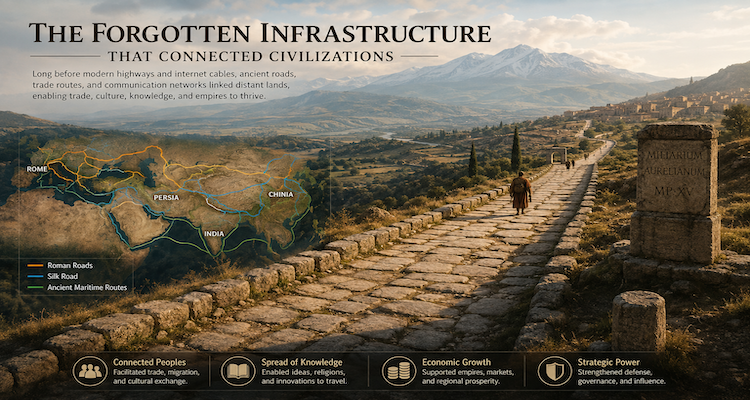
Long before container ships, railways and fiber-optic cables made global connection feel routine, civilizations depended on infrastructure that was far harder to see and far easier to forget.
Across Eurasia, roads, canals, wells, underground water channels, caravanserais, ports, bridges, post stations and fortified waypoints formed the physical systems that allowed people, goods, messages and ideas to move over enormous distances. The Silk Roads were not a single road, and their success did not depend on merchants alone. They depended on an extensive support network that made long-distance movement possible in the first place.
That distinction matters. When we remember ancient connectivity, we tend to remember the commodities silk, spices, metals and precious stones or famous cities such as Chang’an, Samarkand and Rome. The less visible story is about the infrastructure between them: who supplied water, where travelers rested, how roads were maintained, how messages moved, and how rulers kept distant territories connected.
That infrastructure was often as important to civilization as the trade itself.
Key Takeaways
- Ancient connectivity depended on integrated systems of roads, water, accommodation, ports and communications—not simply famous trade routes.
- The Silk Roads operated as shifting networks whose infrastructure helped goods, religions, technologies and ideas travel across Eurasia.
- Water management was especially important because many major routes crossed deserts and other environmentally difficult landscapes.
- Persia, Rome and China developed different infrastructure systems to solve the same problem: moving people and resources across large territories.
- Some ancient systems disappeared from everyday use, while others—including China’s Grand Canal and Iranian qanats remain functional today.
The road was only the beginning
Calling the Silk Roads a “road” can create the wrong mental picture.
UNESCO describes them as an interconnected network of land and maritime routes linking societies across Asia, the Indian subcontinent, Central Asia, Western Asia and the Near East. The routes changed over time according to geography, politics, security, climate and economic conditions. The UNESCO-listed Chang’an–Tianshan corridor alone represents a 5,000-kilometre section of this much larger network.
A traveler moving across this world needed much more than a path.
They needed somewhere to obtain water. They needed food for themselves and animals. They needed shelter, places to exchange goods, ways to cross rivers, and some degree of security. Governments and communities therefore developed supporting infrastructure around the movement of people and commodities.
Caravanserais are a particularly revealing example. These large roadside establishments provided merchants and travelers with places to rest, care for animals, trade and interact with other travelers. UNESCO notes that in well-serviced regions they could be positioned roughly a day’s journey apart, often around 30–40 kilometres from one another.
The “road,” therefore, was actually an ecosystem.
Water may have mattered more than the road
One of the most overlooked parts of ancient connectivity was water infrastructure.
Long-distance routes frequently crossed environments where natural water was scarce or unreliable. A commercial route through a desert could not function simply because merchants were willing to cross it. Settlements, agriculture, animals and travelers all required dependable supplies.
Along the Chang’an–Tianshan corridor, archaeological evidence records sophisticated systems for collecting and distributing water from rivers, wells and underground sources. UNESCO specifically identifies water management as fundamental to the development of settlements, trading centers, forts and caravanserais along the route.
In the Turpan Basin, for example, underground channels helped supply settlements in an extremely arid environment. Around the Hexi Corridor, extensive canals brought river water toward settlements and agricultural areas. These were not secondary conveniences. They were part of the infrastructure that made habitation and trade possible.
Iran’s qanat system offers an even clearer example.
A qanat collects groundwater and carries it through a gently sloping underground tunnel using gravity. Vertical shafts provide access and ventilation, while associated reservoirs, channels and watermills support settlement and agriculture. UNESCO recognizes the Persian qanat system as an important technological response to living in arid and semi-arid environments. Some qanats remain active.
This changes how ancient infrastructure should be understood.
The infrastructure connecting civilizations was not always the thing that physically carried the traveler. Sometimes it was the system that made the landscape survivable.
Persia built connectivity into administration
The Achaemenid Persian Empire illustrates another dimension of infrastructure: communication.
Maintaining a large empire required information to move reliably between distant administrative centers. The Persian Royal Road, described by Herodotus and discussed by modern historians, connected Susa and Sardis across roughly 2,600 kilometres and included a series of royal stations. Roads under Darius were used for the movement of caravans, troops, officials and royal communications.
The significance of such infrastructure was therefore political as well as economic.
A ruler could not effectively govern territory if instructions took months to arrive and information from distant provinces traveled at the same pace. Roads and stations reduced the practical distance between the center and its provinces.
This is one of the most important lessons hidden inside ancient infrastructure: connectivity is a form of power.
The physical network determines not only what merchants can sell, but how quickly governments can respond, how efficiently resources can move and how strongly distant communities remain tied to a political center.
Rome turned roads into an imperial system
The Romans developed the same principle on a different scale.
Roman roads were not merely transportation projects. They formed part of the machinery through which the Roman state moved armies, officials, supplies, communications and trade.
The famous Via Appia began construction in 312 BC, initially linking Rome with Capua before later extensions carried it toward Brundisium on the Adriatic. Ancient sources and archaeological evidence document its importance as a major route toward southern Italy and connections with the eastern Mediterranean.
What made Roman infrastructure particularly powerful was the combination of physical construction and administration.
A road had value because it connected to other roads. A bridge mattered because it completed a route. A military station mattered because it supported movement through a particular landscape. The resulting network made individual pieces more valuable than they would have been in isolation.
That principle remains familiar today.
A highway without bridges is not a functioning highway. A railway without stations and maintenance facilities is not a functioning railway. A digital network without data centers, cables and electricity is not simply “the internet.”
Ancient infrastructure worked in much the same systemic way.
China’s Grand Canal solved a different connectivity problem
Not every civilization depended primarily on roads.
China’s Grand Canal demonstrates the power of water-based infrastructure to integrate a huge agricultural and political territory. Constructed in sections from the 5th century BC onward and developed into a unified imperial communication system during the Sui dynasty in the 7th century, the canal eventually connected five major river basins. By the 13th century, the network extended for more than 2,000 kilometres of artificial waterways.
Its importance went far beyond transportation.
The canal helped move grain and strategic materials, supported the supply of the population and military, and strengthened administrative connections across the empire. Its associated management system linked agricultural production, taxation, storage, transport and government.
That makes the Grand Canal a useful corrective to the popular image of infrastructure as something built primarily to make travel faster.
Infrastructure can instead be designed to make an entire economic system function.
The farmer producing grain, the official collecting taxes, the boat carrying supplies and the city receiving food could all become parts of one logistical network.
The infrastructure of the Silk Roads was also social
There is another reason these systems mattered: they created places where cultures encountered one another.
A caravanserai was not simply a medieval hotel. A port was not merely a place where cargo was unloaded. A trading settlement could become a meeting point for merchants, religious travelers, craftsmen, officials and scholars.
UNESCO’s research on the Silk Roads describes the transmission of religious beliefs, scientific knowledge, technologies, artistic practices and cultural traditions alongside commercial goods. Cities along the routes became centers where travelers could exchange languages, skills, customs and ideas.
This helps explain why connectivity can have consequences that extend far beyond economics.
When infrastructure repeatedly brings different communities into contact, the infrastructure itself becomes part of cultural history.
A road can influence the location of a city.
A water system can determine whether a settlement survives.
A port can change the importance of an entire coastline.
A caravanserai can become a meeting point between communities that would otherwise rarely encounter one another.
The network shapes the map and eventually the culture that develops on it.
Why some of these systems disappeared
Ancient infrastructure was rarely permanent in the modern sense.
Routes shifted. Political borders changed. Rivers altered course. New technologies changed transportation economics. Ports rose and declined. Trade patterns moved around dangerous or politically unstable regions.
UNESCO’s account of the Silk Roads emphasizes this fluidity: different land and maritime routes became more or less important depending on political circumstances, geography and changing conditions.
That means “forgotten” does not necessarily mean abandoned overnight.
A route could gradually lose importance while another became more attractive. A city could decline because its position no longer served the dominant trading pattern. A road might survive physically while losing the economic system that once gave it meaning.
This is an important distinction when looking at ruins today.
A broken road or abandoned water channel is not necessarily evidence that the engineering failed. Sometimes the surrounding economic and political system changed so dramatically that the infrastructure was no longer worth maintaining.
Some ancient infrastructure never truly disappeared
The most surprising part of this history is that some systems described as ancient infrastructure are still functioning.
The Grand Canal remains a major waterway in China. UNESCO notes that it continues to serve as an important means of communication.
Persian qanats also remain active water carriers in parts of Iran, where traditional management practices continue to support settlements and gardens.
This persistence challenges the idea that ancient technology belongs exclusively in museums.
Some engineering solutions survived because they solved enduring problems efficiently. A gravity-fed underground water system, for example, does not require modern digital technology to perform its basic function. Its value comes from understanding terrain, groundwater, slope, construction and maintenance.
In that sense, ancient infrastructure can be less about technological sophistication than about appropriate design.
The larger lesson: civilization runs on the systems beneath the headline
The most famous historical networks are often remembered through their visible products: Roman expansion, Silk Road trade, imperial capitals or legendary merchants.
But connectivity has always depended on less glamorous systems.
Someone had to maintain the road.
Someone had to provide water.
Someone had to operate the station.
Someone had to manage the canal.
Someone had to protect the route.
Someone had to move information.
The same principle applies today.
Modern civilization depends on infrastructure that most people notice mainly when it fails: electricity grids, ports, railways, undersea cables, satellites, data centers, water systems and logistics networks.
Ancient history offers an unusually clear reminder that infrastructure is never merely background scenery. It determines what kinds of movement, commerce, communication and settlement are possible.
The civilizations connected by the old routes were not held together by roads alone. They were held together by systems that made movement repeatable.
And that may be the most useful way to understand the infrastructure we inherit today: not as isolated bridges, cables, canals or highways, but as the invisible architecture that allows civilization to operate at scale.
Conclusion
The forgotten infrastructure of the ancient world was not really forgotten by the people who depended on it. For them, a reliable water source, maintained road, functioning canal, secure station or navigable port could determine whether a community prospered or disappeared.
What has faded is our tendency to see those systems as one connected whole.
The Silk Roads, Persian communication networks, Roman roads, Chinese canals and desert water systems demonstrate the same underlying principle: civilizations become connected when infrastructure turns difficult journeys into dependable networks.
The routes may change, the technologies may change and the empires may disappear. But the fundamental requirement remains remarkably familiar. Civilization needs infrastructure that makes distance manageable.
This content is published for informational or entertainment purposes. Facts, opinions, or references may evolve over time, and readers are encouraged to verify details from reliable sources.