










Why Smaller AI Models May Matter More Than the Biggest Ones
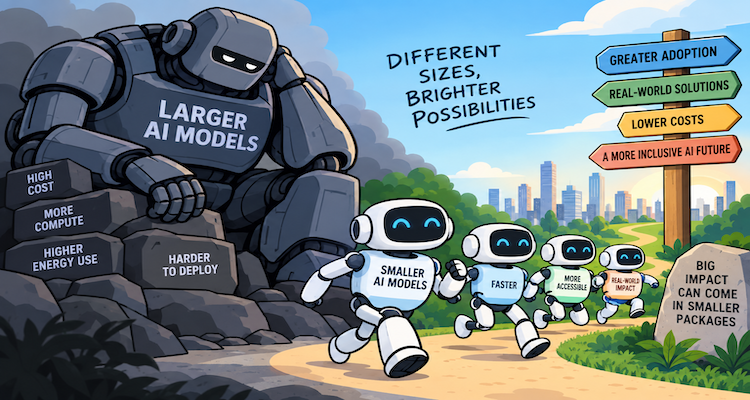
The AI industry has spent years treating model size as a proxy for capability. Bigger training runs, more parameters and larger clusters have produced increasingly powerful systems but the economics of putting those systems to work are changing.
The more consequential question for many businesses may no longer be Which model is smartest? It may be Which is the smallest model that can reliably do the job?
That distinction matters because AI is moving from occasional chatbot interactions toward millions of routine inferences: summarizing documents, extracting information, classifying requests, assisting software, monitoring equipment, translating text and operating features directly on phones and computers. Those workloads do not always require frontier-scale reasoning.
Recent evidence points toward a more nuanced AI landscape. Stanford’s 2025 AI Index found that the smallest model achieving more than 60% on the MMLU benchmark fell from Google’s 540-billion-parameter PaLM in 2022 to Microsoft’s 3.8-billion-parameter Phi-3-mini in 2024. The same report found that the cost of querying a model performing at roughly GPT-3.5’s MMLU level fell more than 280-fold between November 2022 and October 2024.
The implication is not that large models are becoming irrelevant. Rather, AI may be entering an era in which model specialization, efficiency and deployment economics matter nearly as much as raw scale.
Key Takeaways
- Smaller models can now reach useful levels of capability at a fraction of the parameter count once considered necessary.
- On-device models can reduce latency, cloud dependence and the amount of sensitive information sent to remote servers.
- Distillation and quantization allow developers to compress capable models without simply starting from scratch.
- Businesses increasingly have an economic reason to route routine tasks to smaller, specialized models.
- Frontier models will remain important for difficult reasoning, but many everyday AI tasks may not need them.
- The emerging advantage may belong to systems that combine several models rather than relying on one model for everything.
The economics of AI are changing
The first phase of generative AI rewarded scale. Companies competed to train increasingly large foundation models because additional compute could translate into better capabilities.
Inference creates a different problem.
Training happens relatively infrequently compared with serving a deployed model. Once an AI application has millions of users, every request consumes computing resources. A small difference in the cost, memory requirement or latency of each inference can therefore become significant at scale.
Stanford’s AI Index illustrates how rapidly inference economics have changed. The cost of querying a model achieving GPT-3.5-level performance on the MMLU benchmark fell from $20 per million tokens in November 2022 to $0.07 per million tokens by October 2024. Stanford attributes the broader decline partly to increasingly capable smaller models and improvements in hardware and software efficiency.
That does not mean AI has become universally cheap. More capable reasoning systems can consume substantially more tokens, and complex AI agents may make many model calls to complete a single task.
Gartner’s 2026 analysis makes this tension explicit: inference costs for very large models are expected to fall substantially through better chips, model design, utilization and specialized inference hardware, but growing token consumption particularly from agentic systems can offset those savings. Gartner specifically argues that routine, high-volume workloads are increasingly suited to efficient small or domain-specific models.
For businesses, that creates a straightforward strategic question: Why pay frontier-model prices for a task that a smaller model can perform adequately?
Smaller does not simply mean weaker
A small model is not necessarily a large model that has been made worse.
Developers now have several techniques for producing compact systems with surprisingly strong capabilities. These include knowledge distillation, quantization, pruning, specialized training data, architectural changes and task-specific fine-tuning.
Knowledge distillation is particularly important. Instead of expecting a small model to independently learn everything a much larger model knows, developers can use outputs or reasoning patterns from a larger teacher model to train a smaller student.
DeepSeek’s R1 release provided a prominent example. Its researchers released distilled models ranging from 1.5 billion to 70 billion parameters and reported that the distilled models performed strongly on their evaluated benchmarks.
This changes the economics of model development. A company does not necessarily need to choose between building a giant general-purpose model and using somebody else’s giant model through an API.
It can increasingly build or select a smaller model designed around the actual task.
The phone is becoming an important AI computer
The strongest argument for smaller models may not come from data centers at all. It may come from devices already sitting in people’s pockets.
Meta’s Llama 3.2 release included 1-billion- and 3-billion-parameter text models specifically designed for edge and mobile environments. Meta also released quantized versions that reduced model size and memory requirements while increasing inference speed on tested devices.
Google has taken a similar approach with Gemma 3, offering models at 1B, 4B, 12B and 27B parameter sizes and explicitly positioning them for deployment across phones, laptops and workstations.
Apple has also built its AI architecture around a roughly 3-billion-parameter on-device model alongside larger server-based systems. Its research describes optimization techniques including low-precision computation and hardware-aware approaches designed to make the compact model practical on Apple silicon.
The attraction is straightforward.
When a task can be completed locally, the application can potentially avoid a round trip to a remote server. That can improve responsiveness and reduce dependence on network connectivity. It can also allow certain kinds of personal information to remain on the device rather than being transmitted to a cloud service.
But “on-device” should not automatically be interpreted as “private” or “secure.” Privacy depends on the complete application architecture, what information is collected, where it is stored and what other services the software communicates with.
The real advantage may be specialization
Consider a customer-service application.
A company might use a frontier model to answer every question. But much of its traffic could consist of predictable requests: checking an order status, classifying a support ticket, extracting an invoice number or determining which department should receive a message.
Those tasks do not necessarily require the reasoning capabilities of the industry’s largest models.
A smaller model trained or fine-tuned for a particular workflow could potentially handle them faster and more economically, while difficult or ambiguous cases are escalated to a larger model.
This creates a model-routing architecture rather than a single-model architecture.
The idea is becoming increasingly relevant as the AI market becomes more differentiated. Research published in the Journal of Economic Perspectives in 2026 found that the market for AI inference has expanded rapidly, with many models and providers competing across different applications. The researchers also found substantial differences in demand between use cases rather than a single model dominating everywhere.
That finding has an important business implication: AI may become less like buying one universal intelligence and more like assembling a portfolio of specialized tools.
Why latency can matter more than benchmark scores
Benchmark performance is useful, but it does not completely describe a product.
Imagine an AI feature that has to classify an incoming message, trigger an action and return a result within a fraction of a second. A slightly less capable model that responds quickly and reliably may create a better product than a much larger model that requires a remote request and substantially more computation.
This becomes even more important for agents.
An agent may call a model repeatedly: read information, decide what to do, use a tool, inspect the result, decide again and continue. A delay in each step can accumulate.
Microsoft Research is exploring this direction directly. Its 2026 work on MagenticLite describes an experimental agentic system designed around small models, including separate models for orchestration and computer-use tasks. The research reflects a broader shift toward designing the agent, model and execution environment together rather than assuming that the largest general-purpose model should perform every operation.
In other words, the best AI system may be a system in which no individual model does everything.
Smaller models could change who can build AI
Large models require enormous amounts of compute, engineering expertise and infrastructure.
Smaller models lower some of those barriers.
They can potentially run on local servers, workstations, laptops and increasingly capable mobile hardware. They can also be customized for narrower applications without requiring the infrastructure associated with training a frontier model from scratch.
That matters for companies that have valuable proprietary data but cannot justify building a frontier foundation model.
A manufacturer could deploy a model optimized for equipment-related documentation. A financial organization could use specialized models for document processing. A software company could embed a compact model into a desktop application. An enterprise could keep certain workloads within its own infrastructure.
This does not eliminate the need for large models. It changes where they sit in the architecture.
Efficiency is becoming a full-stack problem
The small-model story is also about more than parameter counts.
A model’s practical efficiency depends on the interaction between its architecture, precision, memory, accelerator, software runtime, context length and workload.
Apple’s research, for example, describes a roughly 3-billion-parameter on-device model optimized using techniques including 2-bit quantization-aware training and KV-cache optimization. Meta has similarly reported substantial reductions in model size and memory requirements through quantization of its smaller Llama models.
This is why simply comparing models by parameter count can be misleading.
Two models with similar numbers of parameters can have very different real-world performance depending on how they are trained and deployed.
The same principle applies at the data-center level. OpenAI’s 2026 reporting on its Jalapeño inference accelerator emphasizes performance per watt and latency alongside raw throughput, illustrating the industry’s growing focus on the efficiency of actually serving models rather than merely making them larger.
The biggest models are not going away
There is an important caveat to the small-model argument.
Some problems genuinely benefit from greater reasoning capacity, larger context windows, multimodal capabilities or extensive world knowledge. Scientific research, complex coding, advanced reasoning and sophisticated agentic tasks can demand capabilities that smaller models may not reliably provide.
Stanford’s AI Index also warns that AI systems still struggle with complex reasoning and can fail on tasks for which correct logical solutions exist.
So the likely outcome is not “small models replace large models.”
It is closer to large models become the specialists for difficult problems, while smaller models handle the enormous volume of ordinary ones.
That distinction could become one of the most important architectural choices in enterprise AI.
The emerging AI stack may look more like a team than a single model
The industry’s obsession with finding the single “best” model may eventually prove less useful than evaluating how models work together.
A production system could use:
- a tiny model for classification;
- a small model for extraction and summarization;
- a medium model for everyday generation;
- a specialized vision or speech model for perception;
- a larger reasoning model for difficult cases;
- deterministic software for tasks that do not need AI at all.
This approach has another advantage: failures can be isolated.
If a small classifier cannot confidently categorize a request, it can escalate rather than hallucinate an answer. If a deterministic database query can provide the correct answer, there is little reason to ask a generative model to invent one.
The result could be an AI architecture that uses the least complicated tool capable of reliably completing each step.
That is a very different philosophy from simply attaching the most powerful available model to every problem.
What businesses should watch next
For organizations adopting AI, the practical question is no longer simply which model has the highest benchmark score.
A better evaluation framework includes:
- Task accuracy: Does the model actually perform the required job?
- Reliability: How often does it fail or require escalation?
- Latency: Can it respond quickly enough for the application?
- Inference cost: What does the workload cost at realistic production volume?
- Hardware requirements: Can it run on infrastructure the organization can support?
- Privacy: What information has to leave the organization’s environment?
- Maintainability: Can the model be updated, monitored and replaced without rebuilding the entire product?
This framework can lead to a surprising result: the model with the highest benchmark score may not be the best business choice.
A model that is 95% as capable on the relevant task but dramatically cheaper, faster and easier to deploy can create more value.
The real competition may be efficiency
The AI industry’s first race was largely about capability: bigger models, larger datasets and more compute.
The next race is likely to be about capability per dollar, capability per watt and capability per second.
Stanford’s data already shows the direction: smaller models have become dramatically more capable, inference costs have fallen, and hardware efficiency continues to improve.
Meanwhile, research and commercial development are increasingly treating on-device models, quantization, distillation and specialized inference as first-class technologies rather than compromises for devices that are too weak to run large systems.
That does not diminish the importance of frontier AI. It makes frontier intelligence one layer of a much larger ecosystem.
Conclusion
The most important shift may be that AI is gradually moving beyond the idea that one enormous model should power everything.
Large models will continue pushing the boundaries of reasoning and general capability. But the majority of useful AI interactions may eventually be handled by models that are smaller, specialized, faster and closer to where the work actually happens.
For developers and businesses, that changes the question from “What is the biggest model we can afford?” to “What is the smallest model that can reliably solve this problem?”
That may be a much more important question for the economics of AI than another increase in parameter count.
This content is published for informational or entertainment purposes. Facts, opinions, or references may evolve over time, and readers are encouraged to verify details from reliable sources.