





The New Luxury in Travel May Be Privacy
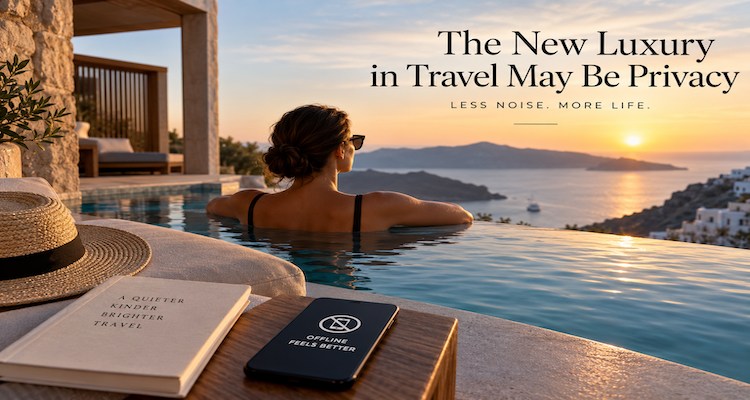
For decades, luxury travel was easy to recognize: the famous hotel, the presidential suite, the private jet, the Michelin-starred restaurant, the destination everyone wanted to see. Increasingly, however, some of the most valuable features of an expensive trip are things other people cannot see.
Privacy and seclusion have become significant considerations in high-end travel, particularly as affluent travelers look for private residences, secluded villas, exclusive-use properties and experiences away from crowds. Capital One Travel’s 2026 Luxury Trendcast found that 86% of surveyed luxury travelers considered privacy and seclusion important when selecting accommodation, while 83% valued exclusive access.
But there is an important qualification. Privacy is not replacing every other definition of luxury. Research from Enchanting Travels’ 2026 Luxury Traveler report points in a different direction: personalization ranked as the most important factor, while privacy ranked near the bottom of its preference hierarchy.
Taken together, the evidence suggests something more interesting than a simple “privacy is the new luxury” narrative. The luxury traveler increasingly wants control over the experience who they encounter, how much space they have, how visible they are, how their time is organized and how closely the journey reflects their individual preferences.
Key Takeaways
- Privacy and seclusion are becoming major accommodation considerations among surveyed luxury travelers.
- Private villas and residences offer control over space, schedules and interactions that conventional hotels cannot always provide.
- The strongest luxury trend may be personalization rather than privacy alone.
- Exclusivity increasingly means access to experiences that feel difficult to replicate, not simply expensive.
- Digital connectivity makes physical privacy more valuable while creating new data-privacy challenges.
- Luxury hospitality is responding by selling discretion, autonomy and tailored service alongside traditional comfort.
Why Privacy Has Become More Valuable
The appeal of privacy in luxury travel is not difficult to understand.
For an ordinary hotel guest, a lobby full of people, a shared pool or a busy breakfast room may be a minor inconvenience. For a traveler paying thousands of dollars for a highly customized trip, those same conditions can undermine the reason for paying a premium.
The value proposition changes when the traveler is not simply buying a better room but buying control over the environment.
A private villa can provide its own entrance, outdoor space, pool, dining area and living rooms. A private residence can allow a family to spend time together without sharing common areas with hundreds of other guests. An exclusive-use property can go further by effectively turning an entire hospitality operation into a private environment.
The luxury industry is responding accordingly. Forbes reported in 2025 that high-end hospitality operators were expanding villa and residence offerings to meet demand for greater privacy, space and personalized service.
This represents an important change in what travelers are paying for.
The expensive part is no longer necessarily the marble bathroom or the recognizable logo above the entrance. Increasingly, it can be the absence of strangers.
The Villa Is Becoming More Than Accommodation
Private villas are particularly well positioned for this shift because they combine several luxury preferences in one product.
They provide space, but they can also provide autonomy.
Guests may have greater control over when meals are served, when staff enter the property, how children and adults use different areas, whether they interact with other guests and how much of their itinerary is visible to outsiders.
That makes villas attractive not only to celebrities or extremely wealthy individuals but also to families and groups traveling together.
Industry reporting has documented growing interest in private vacation homes among affluent American travelers, with high-end operators expanding their portfolios and luxury hotel companies adding villa-style accommodations.
This is an important distinction: the growth of privacy-oriented luxury does not necessarily mean travelers want isolation.
Many still want chefs, guides, wellness treatments, cultural experiences and sophisticated service.
They simply want those things delivered inside a private bubble.
Privacy Is Becoming a Form of Exclusivity
There is a subtle difference between privacy and exclusivity.
Exclusivity traditionally meant having access to something other people could not afford: a particular hotel, restaurant, destination or event.
Privacy goes a step further.
It can mean having access to something other people cannot see.
Capital One Travel’s 2026 research identified privacy and seclusion as a major accommodation consideration and also found that exclusive access was highly valued. The report describes affluent travelers as increasingly interested in escaping crowds and finding experiences unavailable to the general public.
That helps explain the appeal of private islands, secluded estates, yacht charters, exclusive-use villas and after-hours experiences.
The status signal is no longer necessarily “I was there.”
It can be “I didn’t have to share the experience with everyone else.”
That is a significant cultural shift in luxury consumption.
But Privacy Is Not the Whole Story
This is where the “new luxury” narrative needs some restraint.
A separate 2026 report from Enchanting Travels surveyed luxury travelers and found personalization at the top of its hierarchy. Comfort and high-end amenities followed, while privacy ranked much lower, with 45% of respondents placing it last and 72% putting it among their bottom two priorities.
The apparent contradiction is useful.
It suggests that luxury travelers are not necessarily paying for isolation itself. They are paying for an experience that feels designed around them.
Privacy is one way to achieve that.
So are flexible schedules, unusual access, knowledgeable local guides, private dining, cultural immersion, wellness services and accommodations that allow travelers to live according to their own rhythm.
WATG’s 2025 research similarly describes a broader movement toward experience-led luxury, with exploration, personalization, wellness and cultural connection becoming increasingly important.
The more useful conclusion, therefore, is not that privacy has replaced luxury.
It is that control has become part of luxury.
The New Luxury Is About Removing Friction
The idea becomes clearer when privacy is viewed alongside another major luxury preference: convenience.
Affluent travelers increasingly expect travel providers to anticipate problems rather than ask them to solve problems themselves. Privacy fits naturally into that model.
A well-designed luxury trip may involve:
- discreet airport transfers;
- private or low-contact arrivals;
- accommodations with controlled access;
- flexible dining arrangements;
- private guides;
- carefully managed staff interaction;
- secluded outdoor spaces;
- personalized itineraries;
- minimal exposure to crowds.
None of these features is necessarily spectacular.
That is precisely the point.
Luxury increasingly works by removing small sources of friction before the traveler encounters them.
A 2026 analysis from WeWealth, drawing on the Capital One research and conversations with luxury-travel professionals, described discretion and behind-the-scenes planning as increasingly important elements of high-end travel.
The most sophisticated version of luxury may therefore be almost invisible.
When everything works, the guest does not notice the operational complexity behind it.
Technology Creates a Paradox
There is also a technological dimension to the privacy trend.
Modern travel is deeply digital. Reservations, loyalty accounts, mobile check-ins, property apps, smart-room systems, digital payments, location services and social platforms all create additional points at which information about a traveler can be collected or exposed.
That creates a paradox.
Technology can make luxury travel more seamless while simultaneously making privacy harder to guarantee.
A traveler may be physically secluded while leaving a substantial digital trail.
For luxury hospitality providers, this means privacy cannot be reduced to a hedge around a villa or a private entrance. It increasingly involves operational discipline around guest information as well.
The challenge is particularly important for high-profile travelers, but it is not limited to celebrities. Anyone paying for discretion may reasonably want to know who has access to booking information, how guest data is handled, whether smart devices are present and how communications are managed.
Privacy, in other words, has both a physical layer and a digital layer.
What This Means for Hotels
The rise of privacy does not make traditional hotels obsolete.
Instead, it creates pressure for hotels to rethink what their most valuable spaces are.
Some luxury properties are adding villas, residences and standalone accommodations precisely because these products can deliver greater autonomy while retaining hotel-level services. Forbes reported this expansion among luxury hospitality operators in 2025.
That hybrid model could become increasingly important.
A traveler may want the service of a five-star hotel without necessarily wanting to live in its busiest building.
The winning proposition could therefore be:
hotel service + residential privacy + personalized access.
That combination gives luxury brands a way to preserve their service infrastructure while adapting to changing expectations.
The Broader Shift: From Being Seen to Being Unbothered
There is a deeper cultural change underneath the numbers.
Luxury has historically been partly about visibility. A recognizable hotel, designer shopping district, exclusive restaurant or prestigious destination communicated status.
But the modern affluent traveler has access to an enormous amount of visibility already.
Travel itself has become intensely documented. Locations appear on social media, popular destinations become crowded, and experiences that once felt unusual can quickly become highly public.
Against that backdrop, being able to disappear for a few days can acquire its own value.
That does not mean wealthy travelers have stopped wanting beautiful places or extraordinary experiences. It means the experience does not necessarily need an audience.
This may explain why privacy works so well alongside other emerging luxury preferences such as wellness, nature, cultural immersion and longer stays. Skift’s 2025 luxury-travel research identified privacy, space, emotional connection, wellness and a sense of place as important parts of the evolving definition of luxury.
The common thread is not extravagance.
It is intentionality.
What Travelers Should Look For
For travelers who value privacy, the word “private” should not automatically be taken at face value.
A property can advertise a private villa while still being inside a busy resort. A secluded-looking room may overlook a public area. A property can offer a private pool while having staff or neighboring guests nearby.
Before booking, travelers who care strongly about discretion should ask practical questions:
- Is the property completely standalone or part of a larger resort?
- Is the pool genuinely private?
- Are there neighboring villas within direct view?
- Who can enter the property?
- Are staff entrances separate?
- Are cameras present in any areas surrounding the accommodation?
- What guest information is shared with third parties?
- Can meals and services be arranged without unnecessary staff interaction?
- Is transportation handled privately?
- How much of the itinerary is visible to other guests?
These questions are more useful than simply searching for the word “luxury.”
They turn privacy from a marketing adjective into something that can actually be evaluated.
Conclusion
The new luxury in travel may indeed be privacy but the larger transformation is more significant.
Affluent travelers are increasingly looking for control over their surroundings, their time, their interactions and the level of exposure built into a journey. Industry research supports the growing importance of privacy and exclusivity, while other research shows that personalization and meaningful access can matter even more.
That apparent contradiction points toward the real change.
Luxury is becoming less about accumulating visible signs of wealth and more about designing an experience around the individual.
Sometimes that means a private island.
Sometimes it means a villa hidden behind a landscape.
And sometimes it simply means being able to sit somewhere beautiful, with the people you came to see, without anyone else needing to know you are there.
For an industry built around attention, the ability to provide less of it may become one of its most valuable services.
This content is published for informational or entertainment purposes. Facts, opinions, or references may evolve over time, and readers are encouraged to verify details from reliable sources.