










Are We Losing the Ability to Disagree? The Psychology of Online Polarization
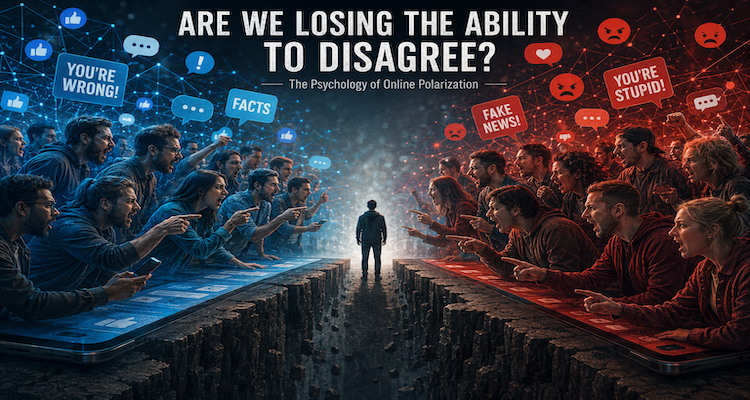
A disagreement once had a natural endpoint: the conversation ended, people went home, and the argument gradually lost its emotional heat. Online, the argument can remain visible, searchable, shareable and continuously reinforced. A political opinion, cultural dispute or even a disagreement about technology can become part of a person’s public identity and criticism of that opinion can begin to feel like criticism of the person.
That shift matters because polarization is not simply a story about people holding stronger opinions. Research in psychology and political science suggests that social identity, emotional hostility and the structure of online information environments can all shape how people interpret disagreement. The overlooked problem may be this: digital platforms do not merely give disagreement more room. Under certain conditions, they can make disagreement more personal, more visible and more rewarding to perform.
Key Takeaways
- Online polarization often involves emotional hostility toward opposing groups, not merely differences in policy or opinion.
- Social identity can make criticism of an idea feel like a threat to belonging or status.
- People naturally gravitate toward information and communities that confirm existing beliefs, although “filter bubble” effects are more complex than often claimed.
- Engagement-driven systems can amplify emotionally charged content without needing to deliberately promote any particular ideology.
- The practical challenge is not eliminating disagreement, but preserving the ability to disagree without treating opponents as enemies.
When Disagreement Becomes an Identity Threat
A useful distinction is often lost in public debate. Ideological polarization concerns how far apart people’s positions are. Affective polarization concerns how they feel about people on the other side.
That difference matters. A society can contain sharp disagreements without citizens automatically viewing opponents with contempt. But when political or cultural identity becomes a strong marker of belonging, disagreement can acquire an emotional charge that goes beyond the subject being discussed. Research on affective polarization describes this as antipathy between opposing political camps.
This helps explain why online arguments can escalate so quickly. A post may begin with a disagreement over policy, technology, education or culture, but the social meaning of the exchange can shift. The question stops being Is this claim correct? and becomes What kind of person would believe this?
That is a far more difficult argument to resolve.
The psychological stakes change when opinions become signals of group membership. Defending a position can then also mean defending one’s place within a community. Conceding a point may feel less like intellectual revision and more like public surrender.
Research on partisan echo chambers supports the importance of social context. An experiment in the United Kingdom found evidence that more politically homogeneous discussion environments can influence both attachment to one’s own political side and hostility toward the opposing side.
The broader lesson extends beyond formal politics. Online communities form around cultural identities, technologies, brands, social causes and lifestyles as well. Not every strong community becomes polarized, but the same social mechanisms can make disagreement costly when group loyalty becomes more visible than curiosity.
The Algorithm Is Part of the Story, Not the Entire Story
It is tempting to describe online polarization as something algorithms simply do to people. The evidence is more complicated.
Recommendation systems influence what people encounter, but users also choose whom to follow, what to click, what to share and which communities to join. A 2025 study in the American Political Science Review found evidence of what its authors call partisan “curation bubbles,” in which users collectively share and consume stories with consistent partisan appeal across different sources. The study also cautions against treating every information environment as a simple, fully sealed filter bubble.
That distinction is important for understanding responsibility.
The problem is not simply:
Algorithm → user → polarization
A more realistic picture is a feedback system:
Human preferences → social networks → platform ranking → engagement → more signals about preferences
People help create the environments that later influence them.
Earlier research reviews have similarly concluded that the effects of algorithms and individual choice cannot be neatly separated. Individual preferences, social networks and platform design interact, and different algorithmic designs can produce different outcomes.
This does not absolve technology companies of responsibility for design choices. But it does challenge a comforting explanation in which users are merely passive victims of an algorithmic machine. We bring our identities, biases and social incentives into the system and the system can then scale and organize them.
Why the Most Hostile Voices Can Seem Like the Majority
One of the most consequential features of online life may be perceptual rather than persuasive.
The loudest participants are highly visible. A hostile reply can attract attention disproportionate to the number of people who actually agree with it. Repeated exposure to conflict can therefore create the impression that society is more uniformly angry than it really is.
Research published in the American Political Science Review tested what researchers called the “mismatch hypothesis”: the idea that features of online environments fundamentally change political hostility. Across eight studies involving cross-national surveys and behavioral experiments, the researchers found limited evidence for selection effects of that kind. Instead, they found evidence that status-driven individuals drawn to political discussion could be hostile both online and offline and that their behavior may feel more prominent online partly because it is more visible.
That finding offers an important correction to the popular narrative.
Online platforms may not need to transform everyone into an extremist or an aggressive debater to make public discourse appear more hostile. A relatively visible minority can shape perceptions of the whole conversation.
This creates a secondary problem: perceived polarization can itself affect behavior.
If people believe that every disagreement will end in ridicule, social punishment or abuse, they may avoid expressing uncertainty. Moderates may remain silent. Nuance may disappear from public view not necessarily because it has vanished, but because the incentives for displaying it have weakened.
What remains visible can look like a population divided into two armies, even when many people occupy more complicated positions.
Exposure to Opposing Views Is Not the Same as Understanding Them
A common solution to polarization is simply to expose people to the “other side.” But exposure alone does not guarantee empathy or productive reconsideration.
A hostile post from an opposing group may increase familiarity without increasing understanding. In fact, political communication research has long raised the possibility that exposure to disagreement can sometimes intensify defensive reactions, depending on the context and identity stakes involved.
The quality of contact matters.
There is a major difference between:
- encountering an opponent’s most provocative viral post;
- watching a stranger insult your group;
- reading a serious argument from someone with a different perspective; and
- participating in a structured conversation where disagreement is expected but personal contempt is not rewarded.
The internet often collapses these experiences into the same category: “exposure to different viewpoints.”
They are not psychologically equivalent.
A 2025 cross-national study of affective polarization also illustrates why caution is necessary when making sweeping claims about its consequences. The researchers examined people across nine democracies and noted that causal evidence about the downstream effects of affective polarization remains limited, particularly outside the United States.
That uncertainty is worth preserving. Online polarization is a serious research subject, but simple claims that social media inevitably causes every form of social division go beyond what the evidence can establish.
The Real Risk Is Losing the Skill of Productive Disagreement
The deepest concern may not be that people disagree more. Democracies, workplaces, families and scientific communities all depend on disagreement.
The danger emerges when disagreement becomes indistinguishable from hostility.
A healthy disagreement contains a distinction that polarized environments often erode: a person can be wrong without being malicious, and an opponent can be frustrating without being an enemy.
Online systems do not always reward that distinction. Outrage is easy to recognize. Certainty is easy to perform. Group loyalty can be publicly demonstrated with a share, a repost or a cutting reply.
Changing one’s mind is harder to display.
So is saying:
- “I agree with part of that argument, but not all of it.”
- “I don’t know enough to take a firm position.”
- “Your evidence is stronger than I expected.”
- “We are talking past each other.”
None of these statements generates the immediate clarity of tribal conflict. Yet they are often signs of stronger reasoning.
The practical challenge, then, is not to create a world without polarization. Some conflicts reflect genuine differences in interests, values and moral priorities. They cannot always be solved by better manners.
The challenge is to prevent every disagreement from becoming a referendum on identity.
What Better Digital Disagreement Might Require
There is no single fix, because online polarization is not caused by a single mechanism. The research points instead toward an interaction between human psychology, social networks, information choices and platform architecture.
That suggests solutions must also operate at more than one level.
For users, the first step may be recognizing that emotional certainty is not always evidence of correctness. Curating a feed is reasonable; treating every unfamiliar view as a threat is less useful.
For platforms, transparency and design choices matter. Ranking systems can influence what becomes prominent, while moderation and interaction design can affect whether disagreement becomes conversation or spectacle.
For institutions and publishers, there is value in resisting the false choice between bland neutrality and permanent conflict. Serious disagreement should not be confused with rage.
And for all of us, there may be a more basic question worth asking before responding online:
Am I trying to understand the argument, persuade the other person, signal loyalty to my group or simply win an audience?
The answer may reveal more about the direction of a conversation than the argument itself.
Conclusion
We are probably not losing the human ability to disagree. Disagreement remains fundamental to how societies test ideas and negotiate differences.
What may be under greater pressure is something more subtle: the ability to disagree without immediately converting disagreement into a judgment about identity, intelligence or moral worth.
The evidence does not support a simple story in which algorithms alone have broken public conversation. Nor does it support dismissing digital platforms as irrelevant. Online polarization emerges from an interaction between human behavior and the systems that organize attention.
That is precisely why the problem is difficult and why it cannot be solved by telling people merely to “be nicer” online.
A healthier digital culture may depend on restoring value to behaviors that polarization tends to hide: uncertainty, revision, curiosity, proportionality and the ability to recognize that understanding an opposing argument does not require surrendering to it.
Disagreement is not democracy’s failure. The inability to separate disagreement from dehumanization is the greater danger.
This content is published for informational or entertainment purposes. Facts, opinions, or references may evolve over time, and readers are encouraged to verify details from reliable sources.