










The Art of Letting Go: Lessons from the Bhagavad Gita for Modern Life
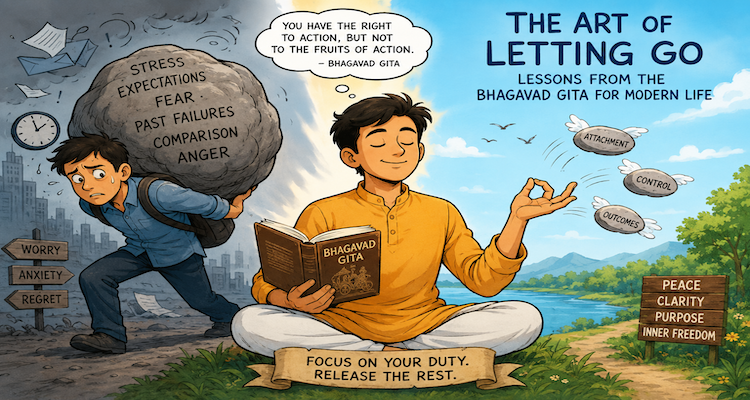
There are few instructions more difficult to follow than “let it go.” We say it after a failed relationship, a lost opportunity, an argument that will not leave our mind, or a result that turned out differently from what we hoped. Yet letting go is often misunderstood as giving up, becoming indifferent, or pretending that pain does not exist.
The Bhagavad Gita offers a more demanding idea. Its teaching is not to withdraw from life, but to remain fully engaged while loosening the grip of attachment to outcomes we cannot completely control. In one of its best-known verses, Chapter 2, Verse 47, the Gita distinguishes between the sphere of action and the sphere of results: a person has responsibility for action, but not complete ownership of its fruits. The same verse explicitly warns against attachment to inaction.
That distinction gives the ancient text an unexpectedly practical relevance. Modern life encourages constant measurement: promotions, likes, income, rankings, admissions, business growth and public approval. The Gita asks a difficult question: What happens when the result becomes so important that it begins to control the quality of the action itself?
Key Takeaways
- The Gita frames letting go as freedom from unhealthy attachment, not withdrawal from responsibility.
- Chapter 2, Verse 47 separates committed action from complete control over results.
- Equanimity can help prevent success and failure from becoming the sole measure of personal worth.
- Modern psychology’s concept of psychological flexibility has meaningful parallels with acceptance and non-attachment, though the traditions are not identical.
- Letting go can mean accepting uncertainty while continuing to act according to one’s values and responsibilities.
Letting Go Does Not Mean Doing Nothing
One of the most common misunderstandings of the Gita’s teaching is that detachment means abandoning ambition or responsibility. The text says something more subtle.
Chapter 2, Verse 47 does not advise a person to stop acting because results are uncertain. It says the opposite: act, but do not make possession of the result the basis of your motivation or identity. The verse also cautions against attachment to inaction.
This matters because much of human frustration comes from treating uncertain outcomes as if they were fully controllable.
A student can prepare thoroughly and still face an unexpected examination. A business owner can make sound decisions and still encounter an economic downturn. A job applicant can perform well and still be rejected. Relationships involve another person’s choices, not just our own intentions.
The Gita’s distinction is therefore practical: commit to what is within your sphere of action, while recognizing that outcomes emerge from factors beyond your individual control.
Letting go, in this sense, is not passivity. It is a more disciplined understanding of responsibility.
The Difference Between Effort and Attachment
Effort and attachment can look similar from the outside.
Two people may work equally hard for a promotion. One is deeply committed to doing good work but understands that the final decision belongs to a larger process. The other becomes consumed by the possibility of rejection and interprets every setback as a personal failure.
Both care about the result. The difference lies in the relationship they have with it.
The Gita develops this idea further in Chapter 2, Verse 48, where it connects action with samatvam equanimity or even-mindedness in success and failure.
This does not mean that success and failure feel identical. Human beings naturally experience disappointment, relief, joy and grief. The deeper question is whether every changing outcome should have the power to completely destabilize one’s sense of direction.
That distinction may be one of the Gita’s most useful lessons for modern readers. Emotional investment is not the problem. The problem begins when the outcome becomes the only measure of whether the effort had value.
Why This Ancient Idea Has a Modern Psychological Parallel
The Bhagavad Gita is a spiritual and philosophical text, not a modern psychology manual. Its ideas should not be treated as scientific theories or as substitutes for mental health care.
However, there is an interesting conceptual parallel between its teaching on non-attachment and the modern psychological idea of psychological flexibility.
Psychological flexibility broadly refers to the capacity to remain in contact with difficult thoughts and emotions while continuing to act in ways connected to meaningful goals or values. Research on acceptance has found that people who habitually accept their mental experiences without judging them may experience less negative emotion in response to stressors, which can be associated with better psychological health over time.
A 2024 systematic and meta-analytic review examining 67 unique studies involving 9,123 participants found that changes in psychological flexibility and inflexibility were significantly associated with changes in psychological distress in research on Acceptance and Commitment Therapy.
The comparison should not be overstated. The Gita’s philosophy includes concepts of duty, self, liberation and spiritual realization that go far beyond contemporary therapeutic models.
Still, the overlap is worth noticing: struggling to eliminate every unwanted thought or guarantee every outcome may be less useful than learning how to respond to uncertainty without abandoning meaningful action.
That is close to the practical heart of letting go.
The Modern Trap: Trying to Control the Uncontrollable
Technology has given people unprecedented ways to monitor outcomes.
We can check whether someone has read a message. We can watch website traffic in real time, refresh investment portfolios, track fitness data, measure engagement and compare our professional progress with hundreds of other people online.
Measurement itself is not the problem. The problem arises when measurement turns into compulsive emotional dependence.
Consider a creator who publishes useful work but checks engagement every few minutes. Or a professional who has already submitted an important application but spends days mentally replaying every detail. Or someone who cannot move beyond an old conflict because the mind continues searching for a version of the past that can no longer be changed.
The Gita’s framework offers a useful boundary:
Action deserves attention. Outcomes deserve perspective.
This does not guarantee peace. But it can prevent a person from wasting energy on a second struggle the struggle against the fact that uncertainty exists.
Letting Go of the Past Without Denying It
Another misunderstanding is that letting go requires forgetting.
It does not.
Some experiences should be remembered because they contain lessons, responsibilities or unresolved consequences. Letting go does not mean denying grief, ignoring injustice, excusing harmful behavior or abandoning necessary action.
A healthier interpretation is to ask: What part of this situation can still be acted upon, and what part now exists only as something to be understood or accepted?
This question can be useful after failure.
Instead of repeatedly asking, “Why did this happen to me?” a person may eventually ask:
- What can I learn from this?
- Is there any action still available to me?
- What am I trying to control that is no longer controllable?
- What value do I want to carry forward?
The past cannot always be repaired. But the next action remains open.
This shift from endless mental possession of an event to responsible engagement with the present is one of the clearest practical ways to understand detachment.
Detachment Is Not Indifference
The Gita’s teaching can sound emotionally distant when reduced to a slogan such as “Do not care about results.” That is not a particularly accurate reading.
A surgeon should care about the outcome of an operation. A parent should care about a child’s wellbeing. A journalist should care about accuracy. A business leader should care about the consequences of major decisions.
Detachment does not remove responsibility. It changes the psychological burden placed on the individual.
You can care deeply without believing that caring deeply gives you total control.
You can prepare carefully without assuming preparation guarantees success.
You can love someone without possessing their choices.
You can pursue an ambition without making your entire identity dependent on achieving it.
This is where the Gita’s teaching becomes more demanding than simple positivity. It does not promise that the right mindset will produce the desired outcome. Instead, it asks whether a person can remain steady enough to continue acting wisely when the desired outcome does not arrive.
A Practical Way to Apply the Teaching
The philosophy becomes more useful when translated into everyday decisions.
Before reacting to a stressful situation, divide the problem into two categories.
What is within my influence?
This may include:
- Preparation
- Effort
- Communication
- Learning
- Discipline
- Ethical choices
- The decision to continue, change direction or stop
What is outside my complete control?
This may include:
- Other people’s decisions
- Economic conditions
- Timing
- Unexpected events
- Public opinion
- The final result of an already completed action
The purpose is not to create a perfect division. Life is more complicated than that. The purpose is to stop treating every uncertainty as a personal failure of control.
A simple question can help:
“What is the next responsible action, even if I cannot guarantee the result?”
That question preserves agency without demanding certainty.
The Hardest Thing to Let Go Of May Be the Need for Certainty
The deepest modern application of the Gita may not concern possessions, relationships or professional goals alone. It may concern certainty itself.
People often postpone action until they know they cannot fail. They delay decisions until every doubt disappears. They replay the past in the hope that enough analysis will produce a different history.
But certainty is not always available before action.
The Gita’s emphasis on action without attachment to results offers another possibility: act with care, judgment and responsibility, while accepting that uncertainty is part of being alive.
Modern research on psychological flexibility similarly points toward the value of changing one’s relationship with difficult internal experiences rather than organizing life entirely around avoiding them.
The connection is not that ancient philosophy has been “proved” by modern psychology. That would be an oversimplification. Rather, two very different intellectual traditions raise a related practical problem: How can a person continue to live according to meaningful commitments when thoughts, emotions and outcomes refuse to obey?
Conclusion
Letting go is often described as release. The Bhagavad Gita suggests something more active.
It is the discipline of releasing the illusion that every important outcome can be controlled while refusing to abandon the responsibilities that genuinely belong to us.
That changes how failure is understood. A failed result may still contain sincere effort, good judgment and meaningful action. Success, meanwhile, does not make a person permanently secure or superior.
The lasting lesson is not to become indifferent to life. It is to participate in life without becoming imprisoned by every result.
Do the work that is yours to do. Learn from what follows. Correct what can be corrected. Accept what cannot be controlled. Then return to the next meaningful action.
That may be one of the oldest and still one of the most practical definitions of letting go.
This content is published for informational or entertainment purposes. Facts, opinions, or references may evolve over time, and readers are encouraged to verify details from reliable sources.