









The Post Office That Delivered Letters From People Who Hadn’t Been Born Yet
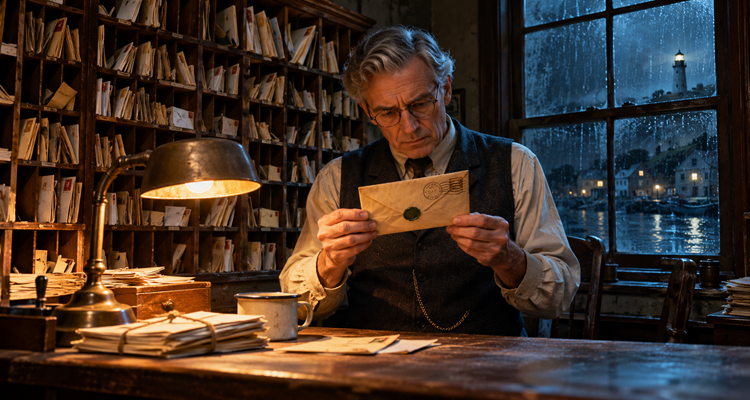
The first letter arrived on a Tuesday morning, thirty-seven years before its sender was born.
It was addressed to a woman who had been dead for eleven years.
And according to the postmark, it had been mailed tomorrow.
Nobody at Bellweather Post Office considered this particularly unusual at first. The building was old, the sorting machinery unreliable, and the town had long accepted that anything passing through its postal system might emerge late, damaged, or smelling faintly of seawater.
But when the second letter arrived, addressed to a child who did not yet exist, the postmaster began keeping records.
By the time the seventh letter appeared, he understood something that would haunt him for the rest of his life.
The letters weren’t arriving by mistake.
They were arriving because someone needed to read them.
The Letter With Tomorrow’s Date
Bellweather was a small coastal town where the streets narrowed toward the harbor and the houses leaned into the wind as though listening for secrets.
Its post office stood between a closed watchmaker’s shop and a bakery that opened before sunrise. Above the entrance, faded gold letters announced:
BELLWEATHER POST OFFICE — EST. 1891
For twenty-six years, its postmaster, Arthur Vale, had arrived at precisely six forty-five each morning.
He sorted parcels, inspected damaged envelopes, and drank tea from a chipped blue cup. Arthur believed in schedules, addresses, and the comforting certainty that yesterday always came before tomorrow.
On November 14, 1963, that certainty ended.
The envelope lay alone at the bottom of the incoming mailbag.
It was cream-colored, sealed with dark green wax, and addressed in delicate handwriting:
Mrs. Eleanor Whitcomb
17 Mariner’s Lane
Bellweather
Arthur recognized the name immediately.
Eleanor Whitcomb had died in 1952.
He turned the envelope over.
The postmark read:
BELLWEATHER — NOVEMBER 15, 1963
Arthur checked the wall calendar.
November 14.
He assumed the cancellation machine had malfunctioned. Then he noticed the sender’s address.
Clara Whitcomb
17 Mariner’s Lane
Bellweather
Eleanor had never had a daughter named Clara.
Arthur knew because he had delivered the family’s mail for decades.
He placed the envelope in the undeliverable tray.
At precisely noon, it disappeared.
The following morning, it was back in the incoming mailbag.
This time, someone had written a message beneath the address.
Please don’t send me away again.
The Girl Who Would Be Born in 2001
Arthur might have dismissed the incident if another envelope hadn’t arrived three days later.
This one was addressed to a boy named Daniel Mercer, at a house that had burned down in 1948.
Its postmark was dated August 9, 2047.
Inside the post office, Arthur held the envelope against the morning light. The paper was thin enough to reveal several lines of writing, but not enough to read them.
He knew opening someone else’s mail was wrong.
He also knew the intended recipient could not possibly receive it.
For the first time in his career, Arthur broke a seal.
The letter contained only four sentences.
Dear Daniel,
When the river freezes, don’t follow the man in the brown coat. He will tell you he knows your father. He doesn’t.
Love,
Your granddaughter, Clara.
Arthur read it three times.
Daniel Mercer had died as an infant in 1947.
He had never married, never had children, and certainly never had a granddaughter.
Yet the handwriting matched the first envelope.
Arthur searched the town’s birth registers, newspaper archives, and old property records. He found no Clara Whitcomb who could have written the first letter, and no living Clara Mercer connected to Daniel.
Then, on the back of the second envelope, he discovered something he had missed.
A birth date.
March 22, 2001.
The writer would not be born for another thirty-eight years.
Arthur locked both letters in the bottom drawer of his desk.
That night, someone knocked on the post office door.
Three slow knocks.
Then a child’s voice whispered from the other side.
“You’re keeping things that don’t belong to you.”
Arthur did not open the door.
The Room Behind the Sorting Wall
The following morning, Arthur discovered a narrow doorway behind a cabinet in the sorting room.
He had worked in the building for more than two decades and had never seen it.
The door was painted the same dull gray as the wall. Its brass handle was cold, and beneath it someone had scratched a single word:
RETURN
Inside was a room no larger than a pantry.
There were no windows, no electric lights, and no visible entrance for mailbags.
Yet hundreds of envelopes filled the shelves.
Some looked decades old. Others were made of unfamiliar materials, smooth and strangely translucent.
Every envelope carried a date.
Arthur picked one at random.
September 18, 2089.
Another read:
January 4, 2136.
The oldest was dated 1842.
The newest was dated 2291.
Some letters were addressed to people Arthur knew. Others bore names he had never encountered.
On a wooden table stood a ledger bound in black leather.
Its first page contained a handwritten instruction:
The future cannot be delivered to everyone.
Only to those whose past still has room to change.
Beneath the inscription were columns of names, dates, and outcomes.
Arthur recognized one entry.
Daniel Mercer — Delivery refused — 1947.
Another name appeared directly below it.
Clara Whitcomb — Delivery pending — 1963.
Arthur’s hands began to tremble.
Because the final entry on the page was his own.
Arthur Vale — Delivery scheduled — November 21, 1963.
Seven days away.
A Letter From His Unborn Daughter
On November 21, Arthur arrived before dawn.
The post office was silent except for the ticking of the clock above the sorting counter.
At six forty-five, the incoming mailbag moved.
No one had touched it.
Arthur watched as its canvas sides shifted, as though something inside were trying to escape.
He opened it.
There was one envelope.
Mr. Arthur Vale
Bellweather Post Office
Bellweather
The postmark read November 21, 2018.
The sender was listed as:
Margaret Vale.
Arthur sat down.
He had never married.
He had no children.
He had once been engaged to a schoolteacher named Rose Bennett, but she had left Bellweather in 1959 after an argument neither of them had ever resolved.
He opened the letter.
Dear Dad,
You never believed in miracles, so I don’t expect you to believe this.
But I’m writing because there is something you need to know.
On November 22, 1963, you will receive a telegram telling you that Rose Bennett has died.
It will be wrong.
She will be alive, waiting at the railway station, afraid to come home.
If you believe the telegram, you will never see her again.
If you go to the station, I will be born.
I know this sounds impossible.
But I have spent my whole life listening to you tell the story of how you nearly missed the train.
Please don’t miss it.
Love,
Margaret
Arthur remained at his desk until the clock struck noon.
He wanted to dismiss the letter as a cruel joke.
But no one knew about Rose’s last words to him.
No one knew she had asked him to meet her at the railway station if he ever changed his mind.
And no one knew that Arthur had spent four years regretting his refusal.
The next morning, at nine seventeen, a telegram arrived.
ROSE BENNETT REPORTED DECEASED. STOP.
Arthur stared at it.
Then he put on his coat and ran.
The Train That Almost Left Without Him
Bellweather Railway Station had two platforms, a waiting room, and a clock that had been seven minutes slow for as long as anyone could remember.
Arthur reached the station just as the eleven-ten train began to pull away.
He searched the platform.
No Rose.
Then he saw a woman standing beside the luggage office, holding a brown suitcase.
She was older than he remembered. Her hair was shorter. Her expression carried the guarded exhaustion of someone who had practiced being disappointed.
“Rose!”
She turned.
For several seconds, neither spoke.
Then Arthur said the only words that mattered.
“I should have come sooner.”
Rose looked at him, bewildered.
“How did you know I was here?”
Arthur thought about the letter, the impossible postmark, and the daughter who had written from a future that did not yet exist.
“I received some good advice,” he said.
Rose smiled uncertainly.
And the train departed without either of them.
The Price of Changing Yesterday
When Arthur returned to the post office, the hidden doorway was gone.
The cabinet stood flush against an ordinary plaster wall.
The ledger had vanished.
So had the envelopes from the future.
Only one remained.
It lay on his desk, sealed in dark green wax.
The address was written in a child’s handwriting.
To the Postmaster Who Finally Listened.
Inside was a single sheet of paper.
Every letter creates a possibility.
Every possibility closes another door.
You have chosen yours.
Do not come looking for the others.
Arthur folded the paper and placed it in his pocket.
For the first time in his life, he left work early.
He never told Rose about the letters.
They married the following spring.
Their daughter, Margaret, was born in 1965.
She grew into a curious child who loved books, thunderstorms, and asking questions that adults could not answer.
At thirteen, she announced that she wanted to become a writer.
At twenty-four, she moved to London.
At fifty-three, she returned to Bellweather to care for her aging father.
Arthur never asked her whether she had written the letter.
He was afraid that asking might change something.
The Last Delivery
Arthur Vale died peacefully in November 2018.
He was eighty-one years old.
Among his possessions, Margaret found a small wooden box containing an old railway ticket, a faded photograph of her parents, and a cream-colored envelope.
The envelope was addressed to Arthur.
It carried a postmark from November 21, 2018.
Margaret recognized the handwriting.
It was hers.
She opened it.
Inside was the letter she remembered writing as a teenager, during a winter when her father had been seriously ill.
She had written it after hearing the story of how her parents reunited at the railway station.
She had never posted it.
At least, she didn’t remember posting it.
Yet there it was, in her father’s belongings, its paper yellowed with age.
Margaret turned it over.
On the back, in Arthur’s careful handwriting, were six words:
Thank you for giving me tomorrow.
She sat for a long time, listening to the rain against the window.
Then she noticed another envelope beneath the box’s lining.
It was addressed to someone named Eleanor Whitcomb.
The postmark read November 15, 1963.
And written beneath the address were the words:
Please don’t send me away again.
Margaret looked toward the window.
Across the street, the old Bellweather Post Office had been closed for nearly thirty years.
Its windows were boarded.
Its sign had faded.
But as she watched, a light appeared behind the glass.
A moment later, she heard three slow knocks at her front door.
She opened it.
No one was there.
Only a small canvas mailbag rested on the doorstep.
Inside was a letter addressed to a child named Clara Whitcomb.
Its postmark was dated March 22, 2101.
Margaret held it in her hands.
For the first time, she understood why her father had never spoken about the impossible letter.
Some messages weren’t meant to explain the future.
They were meant to make sure it happened.
And somewhere across the street, behind the boarded windows of a forgotten post office, the sorting clock began to tick again.
This content is published for informational or entertainment purposes. Facts, opinions, or references may evolve over time, and readers are encouraged to verify details from reliable sources.