









The Satellites That Navigate Space Without GPS by Watching Dead Stars
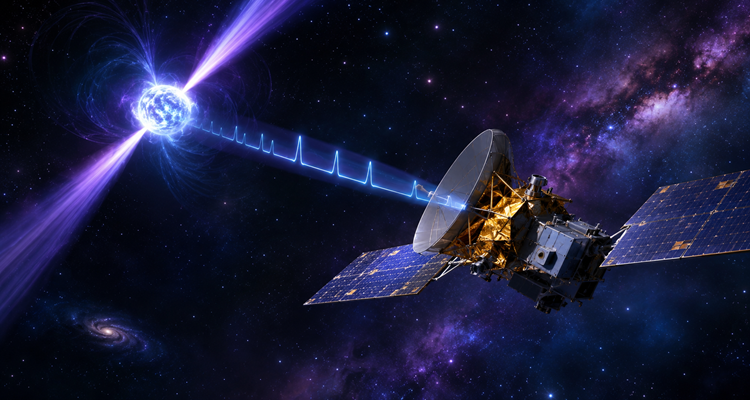
Far beyond Earth’s GPS network, a remarkable navigation technology could allow spacecraft to determine their own location using signals from rapidly spinning stellar remnants. The secret lies in pulsars dead stars that behave like extraordinarily precise cosmic clocks.
Imagine a spacecraft traveling toward Jupiter, hundreds of millions of kilometers from Earth. There are no GPS satellites nearby, no familiar navigation signals, and no convenient way to ask Earth for an instant position update.
Yet the spacecraft could potentially determine where it is by observing the rhythmic flashes of stars that died millions or billions of years ago.
This is the idea behind pulsar navigation, also known as X-ray pulsar navigation (XNAV). Instead of relying entirely on signals transmitted from Earth, a spacecraft uses the predictable pulses of radiation emitted by rapidly rotating neutron stars to calculate its position.
The technology is more than a theoretical proposal. In November 2017, NASA successfully demonstrated autonomous X-ray pulsar navigation aboard the International Space Station using an experiment called SEXTANT. The system determined its orbital position using signals from four pulsars, reaching an error of less than 10 kilometers during the demonstration.
More recently, research published in 2026 has explored how this approach could work with smaller instruments and on future interplanetary missions.
The larger possibility is fascinating: spacecraft could eventually navigate across the solar system using natural signals that have been traveling through space long before humanity existed.
Why GPS Cannot Guide Spacecraft Across the Solar System
GPS works because satellites orbiting Earth transmit precisely timed radio signals. A receiver compares the arrival times of signals from multiple satellites to calculate its position and correct its clock.
This system is exceptionally useful on Earth and in nearby space, but it was not designed to provide navigation coverage throughout the solar system.
As a spacecraft travels farther from Earth, the signals from GPS satellites become increasingly difficult to use. Deep-space missions therefore depend primarily on other navigation techniques.
NASA’s Deep Space Network, for example, uses powerful ground-based radio antennas to communicate with distant spacecraft and measure their motion. Radio tracking can provide highly accurate information about a spacecraft’s trajectory.
However, there is a fundamental limitation: radio signals travel at the speed of light, not instantaneously.
A spacecraft near Mars may need to wait several minutes for a signal to travel between itself and Earth, depending on the planets’ positions. For spacecraft exploring the outer solar system, communication delays become substantially longer.
These delays do not make traditional navigation ineffective. They do, however, create a strong incentive to develop systems that allow spacecraft to calculate their positions independently.
Pulsars offer a possible solution because their signals originate from natural objects distributed throughout the galaxy rather than from a satellite network surrounding Earth.
What Are Pulsars, and Why Are They So Useful?
Although the original star has ended its normal life, its compact remnant can continue rotating and emitting intense electromagnetic radiation.
Some neutron stars rotate several times per second. Others, called millisecond pulsars, spin hundreds of times every second.
Their magnetic fields can produce beams of radiation that sweep through space as the star rotates.
When one of these beams crosses Earth’s line of sight, astronomers detect a pulse. The effect resembles a lighthouse whose rotating beam periodically illuminates a distant observer.
The star is not necessarily switching its radiation on and off. Instead, its rotation makes the radiation appear to flash from our viewing direction.
What makes certain pulsars particularly valuable for navigation is the extraordinary regularity of their rotation.
Some millisecond pulsars have timing stability comparable to highly precise clocks over suitable observation periods. Astronomers can model their pulses and predict when future signals should arrive at a particular reference location.
That predictability turns an astronomical object into something potentially useful for engineering.
A spacecraft does not need the pulsar to know where the spacecraft is. It only needs to know when the pulsar’s next pulse should arrive.
How a Spacecraft Calculates Its Position Using Dead Stars
The principle behind pulsar navigation is surprisingly elegant.
Suppose a spacecraft observes a particular pulsar. Scientists have already established a timing model describing when that pulsar’s signals should arrive at a reference point in the solar system.
The spacecraft records the actual arrival times of X-ray photons from that pulsar.
If the spacecraft is closer to the pulsar along the direction of the incoming radiation, its signals arrive slightly earlier than they would at the reference point. If it is farther away, they arrive later.
That difference provides information about the spacecraft’s location.
How pulsar navigation works
-
Detect: An onboard X-ray telescope collects photons from known pulsars.
-
Time: Software measures the pulse arrival times using an accurate clock.
-
Compare: The observed timing is compared with predicted pulse patterns.
-
Calculate: Navigation algorithms combine measurements from multiple pulsars to estimate position and motion.
Why multiple pulsars are necessary
A single pulsar primarily provides positional information along one direction.
Observations of several pulsars spread across the sky allow navigation software to constrain a spacecraft’s three-dimensional position. The calculations also need to account for clock errors and spacecraft motion.
In practice, navigation software combines pulse measurements with a mathematical model of the spacecraft’s trajectory, repeatedly updating its estimate as new information becomes available.
This is not the same as simply looking at a star and determining its direction.
The important measurement is the timing of the incoming radiation.
A spacecraft’s position affects when a pulse reaches it, and those timing differences can be translated into distance information.
For perspective, light travels approximately 300 kilometers in one millisecond. Even tiny timing errors can therefore correspond to significant uncertainties in position.
That is why accurate clocks, reliable pulsar timing models, sensitive detectors, and sophisticated onboard software are essential.
NASA’s NICER mission documentation describes how the SEXTANT system used individual X-ray photon timestamps, pulse templates, and a navigation filter to estimate the spacecraft’s orbit.
NASA Already Tested the Technology in Space
One of the most important milestones in pulsar navigation occurred aboard the International Space Station.
NASA launched the Neutron Star Interior Composition Explorer, or NICER, in June 2017.
NICER was primarily designed to study neutron stars by measuring their X-ray emissions. But the mission also provided an opportunity to test whether those same observations could be used for navigation.
The accompanying experiment, SEXTANT—short for Station Explorer for X-ray Timing and Navigation Technology—was designed to demonstrate autonomous navigation using X-ray pulsars.
During a roughly two-day experiment in November 2017, the system observed four millisecond pulsars and generated 78 timing measurements.
Its onboard software used those measurements to estimate the position of NICER as the International Space Station traveled around Earth.
The results were significant.
Demonstration
2017
November, aboard the ISS
Navigation accuracy
Under 10 km
Reported position error
Pulsars observed
4
Millisecond pulsar targets
Timing measurements
78
During the flight experiment
Source: NASA’s November 2017 SEXTANT demonstration report.
The system reached an error of less than 10 kilometers after approximately 7.5 hours and remained below that threshold for the rest of the experiment.
NASA later reported additional tests, including a March 2018 demonstration in which navigation error converged to less than 2 kilometers under the tested conditions.
These results established that a spacecraft could calculate its position autonomously from pulsar observations while operating in space.
There is an important distinction, however.
NICER was not a standalone satellite navigating through deep space. It was an instrument mounted on the International Space Station. The experiment proved a navigation technique in Earth orbit, not a complete operational navigation system for missions to Mars or Jupiter.
That difference matters when evaluating how close the technology is to practical deployment.
A 2026 Study Brings Pulsar Navigation Closer to Smaller Spacecraft
The next challenge is making pulsar navigation practical beyond a large scientific instrument attached to a space station.
A study published in the September 2026 volume of Acta Astronautica examined how different pulsars could be selected for autonomous X-ray navigation.
Researchers from Politecnico di Milano and the Institute of Space Sciences in Spain used observational data from NASA’s NICER mission to develop more realistic navigation simulations.
Their work considered two environments: low Earth orbit and a hypothetical spacecraft trajectory from Earth to Jupiter.
The researchers evaluated pulsars according to several characteristics, including signal brightness, timing stability, visibility, and their distribution across the sky.
One finding was especially important: the brightest pulsar is not necessarily the best navigation reference.
For example, the Crab Pulsar can produce a relatively strong X-ray signal, potentially supporting accurate measurements over shorter periods. But its rotational behavior is less stable over long periods than that of many millisecond pulsars.
Millisecond pulsars, meanwhile, can provide more reliable long-term timing references, although their weaker signals may require longer observations.
According to the researchers’ reported simulations, some configurations using the Crab Pulsar achieved positioning errors below 7 kilometers in low Earth orbit. That figure is a simulated result, not a newly demonstrated deep-space flight capability.
The study offers a path toward developing XNAV instruments suitable for smaller satellites, with future work expected to include an engineering model.
This represents progress, but it does not mean that operational spacecraft are already routinely navigating between planets using pulsars.
Why Scientists Cannot Simply Put Pulsar GPS on Every Satellite
If pulsars are such useful cosmic reference points, why are they not already standard equipment on spacecraft?
The answer involves several engineering challenges.
X-ray signals are extremely faint
Pulsars may emit enormous amounts of energy, but their radiation spreads across vast distances.
By the time X-rays from a distant pulsar reach a spacecraft, the number of detectable photons can be small.
Sensitive instruments must collect enough photons to identify the pulse pattern and measure its timing reliably.
Larger detectors generally improve signal collection, but they also introduce mass, volume, power, and cost constraints.
Navigation measurements take time
A GPS receiver on Earth can often obtain a position quickly because GPS satellites transmit signals specifically designed for navigation.
Pulsars do not transmit signals for spacecraft. Their radiation must be detected and statistically analyzed.
Depending on the pulsar and instrument, collecting enough photons may require extended observation periods.
That makes pulsar navigation better suited to certain forms of trajectory estimation than to rapid maneuvering or landing guidance.
The spacecraft needs accurate timing information
Navigation depends on comparing measured pulse arrival times against predicted arrival times.
Errors in the spacecraft’s clock can introduce errors in the position estimate.
The system also needs reliable knowledge of pulsar behavior, including changes in rotation that may affect timing predictions.
Not every pulsar is conveniently visible
A spacecraft’s view can be obstructed by planets, the Sun, or other objects.
Even when several pulsars are visible, their positions in the sky affect how accurately the spacecraft’s three-dimensional location can be calculated.
Researchers must therefore balance brightness, stability, visibility, and geometric distribution.
NASA’s guidance and navigation assessments identify detector size, long observation periods, suitable pulsar availability, and updated timing models as significant obstacles to operational deep-space XNAV systems.
Could Pulsars Eventually Replace Earth’s Deep Space Network?
Probably not entirely—and replacement may not be the most useful goal.
Pulsar navigation and Earth-based radio navigation have different strengths.
| Capability | Earth-based radio navigation | Pulsar navigation |
|---|---|---|
| Main reference | Ground tracking stations | Natural pulsar signals |
| Position estimation | Ground-supported tracking and orbit determination | Potentially autonomous onboard estimation |
| Dependence on Earth | Significant | Reduced for position estimation |
| Communication with Earth | Supports communication and tracking | Does not itself provide communication |
| Current maturity | Operational for deep-space missions | Demonstrated in orbit; deep-space applications under development |
A spacecraft using pulsars would still need communication systems to send scientific data home, receive mission updates, and coordinate complex operations.
Pulsar navigation could instead reduce the frequency of Earth-based position measurements and provide an independent navigation reference when ground contact is unavailable.
It might also work alongside optical navigation, which uses images of planets, moons, asteroids, and stars to estimate spacecraft position and orientation.
Combining these methods could make future missions more resilient than relying on any single navigation technique.
What This Could Mean for Future Space Exploration
The strongest case for pulsar navigation is not that it will make every spacecraft dramatically more accurate.
Its value may lie in allowing spacecraft to operate with greater independence.
A probe exploring Jupiter’s moons could use autonomous navigation measurements to help maintain its trajectory between communications with Earth.
A spacecraft traveling toward Saturn or beyond could periodically update its position without waiting for a new ground-based tracking solution.
Future robotic missions could also combine pulsar measurements with onboard optical sensors and trajectory models to improve their understanding of where they are.
These are potential applications rather than established operational capabilities.
The 2026 research helps clarify the trade-offs involved in building practical instruments, but additional hardware development, testing, and flight demonstrations are needed before such systems become routine.
The long-term possibility extends beyond our solar system.
Because pulsars are distributed across the Milky Way, their signals could theoretically provide navigation references to spacecraft traveling far beyond the region served by Earth’s navigation infrastructure.
Interstellar navigation would introduce further challenges, including signal strength, timing-model maintenance, and the availability of suitable pulsars.
Nevertheless, the underlying principle would remain the same: compare the arrival times of predictable cosmic signals to determine a spacecraft’s position.
The Remarkable Connection Between Dead Stars and Future Spacecraft
Pulsar navigation reveals an unexpected connection between two very different areas of science.
Neutron stars are among the most extreme objects in the universe. They are studied to understand matter under extraordinary densities, intense magnetic fields, and the physics of stellar collapse.
Yet their regular pulses may also become practical tools for exploring space.
The same observations that help astronomers investigate the remnants of massive stars can provide engineers with a reference for spacecraft navigation.
NASA’s SEXTANT experiment established that this principle works in orbit. Research in 2026 has further examined how realistic instruments and carefully selected pulsars could support future autonomous missions.
The remaining challenge is turning a demonstrated scientific technique into compact, reliable equipment that spacecraft can routinely carry.
For centuries, navigators used stars to cross Earth’s oceans. Future spacecraft may use the remnants of dead stars to cross the much larger distances between planets.
And unlike the navigation satellites orbiting Earth, these cosmic reference points were never built for us.
They were already there, waiting to be understood.
The information presented in this article is based on publicly available sources, reports, and factual material available at the time of publication. While efforts are made to ensure accuracy, details may change as new information emerges. The content is provided for general informational purposes only, and readers are advised to verify facts independently where necessary.
Related News
- The Websites That Look Completely Different Depending on Which Country You Visit Them From
- The Internet That Keeps Working Because Someone Still Maintains a System From the 1980s
- The Digital Identity That Outlives the Phone You Created It On
- The Digital Doors You Leave Open Without Ever Clicking “Allow”