










Why AI Safety Is Becoming an Infrastructure Problem, Not Just a Model Problem
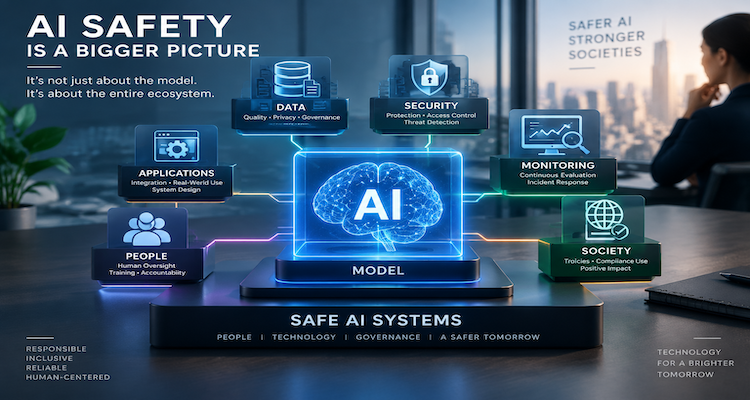
Artificial intelligence safety was once discussed mainly as a question of whether an AI model could produce harmful, biased, inaccurate, or unpredictable outputs. But as AI systems move from research environments into workplaces, healthcare systems, financial platforms, government services, and consumer products, the safety challenge is expanding.
The biggest risks increasingly come not only from the model itself, but from the infrastructure surrounding it: the data used to train and operate systems, the software layers connecting AI to real-world applications, access controls, monitoring systems, human oversight processes, and organizational decisions about deployment.
A highly capable AI model can still create serious problems if it is integrated into an unsafe system. A reliable model connected to poor-quality data, weak security controls, inadequate monitoring, or unclear accountability can become unreliable at scale.
This shift is changing how researchers, regulators, and companies think about AI safety. The question is no longer only “How do we build safer models?” but also “How do we build safer environments in which AI operates?”
Key Takeaways
- AI safety is expanding from model behavior to the wider infrastructure supporting AI deployment.
- Data quality, monitoring, security, and human oversight are becoming central safety requirements.
- Real-world AI failures often involve system design, not only model limitations.
- Businesses increasingly need governance frameworks before deploying AI at scale.
- Regulations are pushing organizations toward measurable AI risk management practices.
AI Safety Has Outgrown the Model Itself
Large AI models attract much of the public attention because they are the visible part of artificial intelligence systems. Users interact with chatbots, image generators, coding assistants, and automated decision tools not with the infrastructure underneath them.
However, a deployed AI system is rarely just a model.
A typical AI application may include:
- Training data pipelines
- Data storage systems
- Model hosting platforms
- Application programming interfaces (APIs)
- User interfaces
- Retrieval systems that provide additional information
- Security controls
- Human review processes
- Monitoring and feedback mechanisms
Each layer can introduce risks.
For example, a language model may generate accurate responses in testing but produce unreliable results when connected to incomplete company documents, outdated databases, or poorly designed automation workflows.
The model may not have changed. The surrounding system did.
This is why AI safety is increasingly becoming an infrastructure challenge.
The Difference Between a Safe Model and a Safe AI System
A model can perform well under controlled evaluations while still creating risks in practical environments.
Researchers often evaluate models through benchmarks that measure areas such as accuracy, reasoning ability, bias, harmful content generation, or robustness. These evaluations are valuable, but they do not capture every condition a model may encounter after deployment.
A business deploying AI must consider additional questions:
- Who can access the system?
- What information can the system process?
- How are mistakes detected?
- What happens when the AI produces incorrect output?
- Is there human review before important decisions?
- Can users understand why a system produced a result?
- Are failures recorded and investigated?
These questions move AI safety closer to traditional engineering disciplines such as cybersecurity, aviation safety, and financial risk management.
In those fields, safety is not achieved by creating one perfect component. It comes from designing reliable systems with safeguards, testing, monitoring, and accountability.
Data Has Become a Major AI Safety Layer
Modern AI systems depend heavily on data. Poor-quality, incomplete, outdated, or biased data can affect system behavior even when the underlying model architecture is technically strong.
Data-related risks include:
- Incorrect information entering AI knowledge systems
- Sensitive information being exposed
- Training data containing unwanted biases
- Data pipelines introducing errors
- Organizations losing track of where information originated
For companies, AI governance increasingly requires understanding the entire lifecycle of information from collection and storage to processing and eventual use.
The challenge is similar to cybersecurity: protecting only the final application is insufficient if weaknesses exist throughout the supply chain.
AI Security and AI Safety Are Becoming Connected
AI safety and cybersecurity have historically been treated as separate areas.
AI safety focuses on questions such as:
- Does the system behave reliably?
- Does it avoid harmful outputs?
- Can humans control its operation?
Cybersecurity focuses on:
- Can attackers exploit the system?
- Can data be stolen?
- Can unauthorized users access capabilities?
In practice, these issues increasingly overlap.
A malicious actor exploiting an AI system could manipulate inputs, extract sensitive information, influence outputs, or interfere with automated processes.
The National Institute of Standards and Technology (NIST) has highlighted the importance of managing risks throughout the AI lifecycle through its AI Risk Management Framework, which provides guidance for organizations developing and deploying AI systems.
Source: NIST AI Risk Management Framework
This approach reflects a broader shift: AI safety is not only about what a model does voluntarily; it is also about how systems around that model are protected and controlled.
Companies Are Moving Toward AI Governance Infrastructure
For many organizations, the first phase of AI adoption focused on experimentation.
Employees tested AI assistants, developers integrated models into applications, and companies explored productivity improvements.
The next phase is operationalization.
Businesses now face questions about:
- AI approval processes
- Risk assessments
- Documentation requirements
- Model evaluation
- Continuous monitoring
- Employee training
- Regulatory compliance
The European Union’s AI Act reflects this movement by introducing a risk-based regulatory approach that places different requirements on AI systems depending on their potential impact.
Source: European Commission Artificial Intelligence Act
For organizations, this means AI deployment is becoming less like installing a software tool and more like managing a critical business system.
Why Monitoring May Become as Important as Testing
Traditional software testing usually happens before release. AI systems require something more continuous.
AI behavior can change because:
- User interactions evolve
- Data changes over time
- New vulnerabilities appear
- Models are updated
- External information changes
A system that performs safely today may require new evaluation tomorrow.
This is why AI monitoring is becoming a major infrastructure requirement.
Organizations are increasingly interested in:
- Detecting unusual outputs
- Measuring performance changes
- Tracking failures
- Reviewing high-impact decisions
- Maintaining audit records
The goal is not to eliminate every possible error an unrealistic expectation for complex systems but to identify problems early and create mechanisms for correction.
Regulation Is Accelerating the Infrastructure Approach
Governments and international organizations are increasingly emphasizing risk management rather than only technical capability.
The Organisation for Economic Co-operation and Development AI Principles encourage responsible AI development based on values including transparency, robustness, security, and accountability.
Source: OECD AI Principles
This regulatory direction suggests that future AI maturity may be measured not only by how powerful a system is, but by how responsibly it can be operated.
A company with advanced AI capabilities but weak governance may face greater operational risk than a company using a less advanced system with stronger controls.
The Business Implication: AI Safety Becomes Operational Discipline
For companies, AI safety is becoming similar to other forms of enterprise risk management.
Organizations that successfully deploy AI at scale will likely need:
- Clear ownership of AI systems
- Defined approval processes
- Strong data governance
- Security protections
- Regular evaluation
- Human oversight for critical decisions
This does not mean every AI application requires excessive bureaucracy.
The challenge is creating proportional safeguards. A marketing assistant generating draft content does not carry the same risks as an AI system influencing healthcare decisions, employment screening, or financial services.
The future of AI safety will depend on matching safeguards with potential impact.
The Next Stage of AI Safety Will Be System Design
The early AI safety conversation focused heavily on making models more capable and less harmful.
That remains important.
But as AI becomes embedded into everyday systems, safety will increasingly depend on engineering practices around those models.
The most important advances may not come only from larger models or better algorithms. They may come from better infrastructure: stronger evaluation systems, clearer accountability, safer deployment methods, improved monitoring, and responsible organizational processes.
AI safety is becoming an infrastructure problem because artificial intelligence is becoming infrastructure itself.
Conclusion
The future of AI will not be determined only by which companies build the most powerful models. It will also depend on which organizations build the safest systems around them.
A model is only one component of an AI system. The surrounding infrastructure data, security, monitoring, governance, and human decision-making will increasingly determine whether AI creates reliable value or introduces new risks.
As artificial intelligence becomes part of essential business and social systems, safety will no longer be a final checkpoint before deployment. It will become a continuous engineering responsibility built into the entire AI lifecycle.
This content is published for informational or entertainment purposes. Facts, opinions, or references may evolve over time, and readers are encouraged to verify details from reliable sources.