










Why History Often Remembers the Winners but Preserves the Evidence of Everyone Else
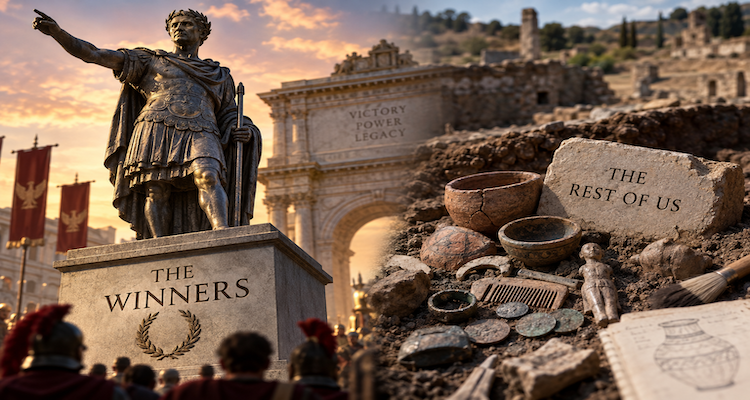
The familiar idea that “history is written by the victors” captures something real about power, but it is too simple to explain how historical knowledge actually survives. Victorious governments can control monuments, official narratives, school curricula, public ceremonies and, sometimes, the archives themselves. Yet the historical record is rarely theirs alone.
The defeated leave letters. Workers leave employment records. Prisoners leave court files. Soldiers leave diaries. Families leave photographs. Governments create paperwork that unintentionally records the people they sought to control. Newspapers preserve arguments that official histories later omit. Archaeology can reveal what written sources ignored entirely.
That creates a revealing tension: power can influence the story that becomes dominant without possessing the power to erase every trace of competing experiences.
Modern historical research increasingly depends on finding those traces, understanding how they were created and asking why some survived while others disappeared. The result is a more complicated picture than the old winners-versus-losers formula suggests.
Key Takeaways
- Victors can shape public narratives, but they rarely control every surviving piece of historical evidence.
- Archives are not neutral containers; what survives reflects institutions, resources, power and preservation choices.
- Defeated or marginalized people often appear indirectly through legal, military, economic and administrative records.
- Recovering forgotten perspectives requires historians to question both what records say and why those records exist.
- Digital archives are expanding access to previously scattered sources while creating new questions about preservation and context.
- The strongest historical accounts compare competing evidence rather than simply replacing one dominant narrative with another.
The “History Is Written by the Victors” Idea Gets One Thing Right
The phrase is widely associated with Winston Churchill, but that attribution is itself a useful warning about how historical sayings acquire authoritative identities. There is no reliable evidence that Churchill originated the exact phrase. Historical investigations have traced versions of the sentiment considerably further back, while Churchill did make a different, documented joke in 1948 about intending to write his own history.
The saying nevertheless survives because its central observation is recognizable.
Political victory can bring control over institutions that shape collective memory. Governments decide which events receive monuments. States publish official histories. School systems select curricula. Newspapers and publishers determine what reaches large audiences. Victorious regimes may also have greater access to the resources required to preserve their own documents and publicize their interpretation of events.
But there is an important distinction between controlling the narrative and controlling the evidence.
A government can describe a rebellion as a criminal disturbance. A court file may still contain testimony from the people accused of participating in it. An official military report may describe a battle as a victory while soldiers’ letters reveal confusion, fear or disagreement. A plantation’s financial records can document the economic system surrounding enslaved people even when the people themselves were denied the ability to publish their own accounts.
History becomes more interesting precisely at that point of friction.
Archives Are Not Neutral Warehouses
It is tempting to imagine an archive as a giant storage room containing an objective version of the past. In reality, archives are products of decisions.
Someone created a document. Someone decided whether to keep it. An institution classified it. Archivists described it. Governments restricted or released it. Later researchers chose which documents to consult.
Every stage can affect what becomes visible.
The National Archives in the United States explicitly recognizes this problem in its historical-records programs. Its current publishing initiatives encourage projects that make primary sources more accessible, particularly collections centered on historically marginalized communities. The agency notes that documentary editions can make overlooked or geographically dispersed records available through transcription, annotation and digitization.
That work matters because the absence of a familiar historical voice does not necessarily mean the person left no evidence.
Sometimes the evidence exists but is difficult to find.
Sometimes it is scattered across institutions.
Sometimes it was catalogued under the perspective of the institution that created it.
And sometimes it survived only because another administrative system happened to record the person’s existence for an entirely different reason.
The People Who Were Not Supposed to Become Historical Actors
One of the most revealing features of historical archives is how often ordinary people appear in records created for purposes that had little to do with preserving their stories.
A person might enter history through a court complaint, a tax record, a military roster, a census, an immigration document, an employment file or a letter to a government official.
The National Archives, for example, preserves extensive federal records documenting African American experiences. Its collections include correspondence, depositions and other documents created by formerly enslaved people and others whose voices were not necessarily central to official narratives at the time.
One particularly striking example is a letter written in 1863 by Hannah Johnson of Buffalo, New York, to President Abraham Lincoln concerning her son, a soldier in the 54th Massachusetts Infantry. The letter survives because it entered the federal record. It was not produced as a historical memoir; it was an appeal from a mother to a president.
Its survival changes what the archive can tell us.
Instead of seeing the Civil War only through presidents, generals and legislation, researchers can encounter an individual making an argument about family, citizenship, military service and freedom.
The record is therefore doing something the official story alone cannot do: it gives historical scale to people who were not among the people writing the official narrative.
The Defeated Sometimes Leave Better Records Than the Victors Expect
There is another complication to the winners-and-losers model: institutions frequently create records precisely because they are exercising power over other people.
Police departments record suspects.
Courts record defendants.
Armies record prisoners.
Colonial administrations record populations.
Employers record workers.
Slaveholders and governments created records about enslaved people.
These documents can be deeply biased. But bias does not automatically make a document useless.
A prison register may tell historians little about how prisoners understood themselves, while still revealing who was imprisoned, when and under what administrative category. A colonial census may reflect the assumptions of colonial authorities while providing evidence about communities the authorities were attempting to govern.
The historian’s task is therefore not simply to “believe the archive.”
It is to interrogate it.
Who created this record? For what purpose? What did the creator want the reader to believe? What information was omitted? What language was imposed? What can the document establish, and what can it not establish?
Those questions can turn an apparently one-sided document into evidence about both the people described and the institution doing the describing.
Evidence Can Survive Even When Memory Does Not
Historical memory and historical evidence are related, but they are not the same thing.
A society may forget a person while an archive preserves their correspondence. A monument may celebrate a political leader while financial records expose the administrative machinery surrounding that leader. A textbook may compress a complicated conflict into a few paragraphs while thousands of primary documents remain available to researchers.
That is why historians often work against the first version of a story they encounter.
The existence of evidence does not automatically guarantee that it will be used. It must be located, authenticated, interpreted and placed alongside other evidence.
Research on historical evidence has also emphasized the difficulties of interpreting sources such as collective memory. Historians have expanded the kinds of material they consider evidence, while simultaneously confronting the problems of reliability and interpretation that come with those sources.
Memory can preserve experiences that official documents omit. But memory can also change with time.
An administrative record can preserve a date while concealing emotion.
A personal testimony can preserve emotion while containing uncertainty about chronology.
Neither automatically cancels the other.
The work lies in comparison.
Recovering Forgotten Voices Is an Archival Project, Not Just a Writing Project
The effort to broaden historical narratives increasingly involves locating and preserving sources that were previously inaccessible, scattered or poorly described.
Recent National Archives programs illustrate how substantial that task can be. Grants have supported projects involving Indigenous histories, African American history, Asian American history, Hispanic American history, labor history, community archives and other collections that might otherwise remain difficult for researchers to access.
One project, for example, has focused on collecting, cataloguing and transcribing records of the Colored Conventions held during the Civil War era. Other initiatives have worked with community archives and collections documenting experiences that were not always adequately represented in traditional institutional collections.
This reveals an important point that is easy to miss in discussions about “rewriting history.”
Sometimes the goal is not to rewrite an established account.
It is to make additional evidence available so that the account can become more complete.
That is a very different enterprise.
The Archive Can Contain the Evidence of Its Own Blind Spots
Perhaps the most interesting consequence is that historical records can reveal not only what happened, but also how societies decided what was worth recording.
A collection that contains thousands of government documents and very few personal accounts may tell researchers something about institutional power.
A scattered collection of community photographs may reveal how official archives failed to preserve certain experiences.
A newly digitized oral-history collection may demonstrate how much historical knowledge depended on sources that were previously difficult to locate.
This is why archival description and preservation are themselves part of historical scholarship.
The National Archives has explicitly supported initiatives designed to broaden whose voices are represented in historical records and who participates in creating, editing and interpreting documentary collections.
The distinction matters because “the archive” is not a single voice.
It is an accumulation of decisions made across generations.
Digital Archives Are Changing Who Gets to Find the Evidence
Digitization has introduced another major change.
A document that once required a researcher to travel to a particular archive can increasingly become searchable from anywhere. Digitization does not solve every problem metadata can be incomplete, collections can remain restricted, and digitized material still requires interpretation but it can dramatically reduce the practical barriers to discovery.
The National Archives now provides online research tools, searchable collections and digital access to records, while its historical-records programs increasingly support digital editions that bring previously scattered materials together.
That changes the relationship between historical evidence and public memory.
A forgotten letter does not necessarily have to remain forgotten simply because it sits in a distant box.
A photograph does not necessarily remain invisible because only specialists know which collection contains it.
A local archive can become relevant to researchers far beyond its geographic home.
But digitization also creates a new risk: people may mistake what is easily searchable for what is historically representative.
The most searchable past is not necessarily the most important past.
Digitization improves access; it does not automatically eliminate archival bias.
Sometimes the “Losers” Become the Most Important Historical Sources
The word “loser” itself can be misleading.
History contains political losers, military losers, displaced populations, defeated movements and marginalized communities. But some of the most valuable sources come from people who were never participants in the contest for formal power at all.
Workers, children, migrants, prisoners, domestic servants, witnesses, family members and local communities can provide evidence that neither side’s official narrative was designed to preserve.
Their historical importance often emerges later.
A person’s diary may have been private when written. A photograph may have been a family possession for generations. A letter may have been intended for one recipient. An oral history may have been recorded decades after the events described.
Only later does someone recognize that the material answers a question the official record could not.
This is one reason historical research can change without the underlying past changing.
The past is fixed.
The evidence available to interpret it is not.
Why “History Is Written by the Victors” Is Too Simple
The aphorism is useful as a warning, but dangerous as a complete theory of history.
It can encourage the mistaken belief that every official account is propaganda and every suppressed account is automatically true.
Neither proposition follows.
Victors can distort history.
Defeated groups can also distort history.
Governments can preserve truthful information.
Private memoirs can contain errors.
Oral testimony can reveal experiences absent from official records while still containing imperfect recollections.
Historians therefore have to resist a tempting reversal: replacing one simplistic hierarchy with another.
The objective is not to decide that the powerful are always wrong and the powerless are always right.
It is to assemble enough independent evidence to understand what each source can actually tell us.
A useful historical account does not simply ask, “Whose side wrote this?”
It asks, “What evidence exists, how was it produced, what does it reveal, what does it conceal, and how does it compare with other surviving evidence?”
That is a much harder question and a much more useful one.
The Past Is Bigger Than the Story That Survives
The most important lesson is not that winners control history.
It is that survival, memory and interpretation are three different processes.
Power can determine which stories receive monuments and institutional support. Archives can preserve documents created by powerful institutions. Marginalized communities can lose records through displacement, destruction or lack of resources. At the same time, fragments of their experiences can survive in places nobody initially considered historical.
That is why historical understanding can expand generations after an event.
A newly discovered letter does not change what happened in the past. A digitized collection does not manufacture a forgotten life. An oral history does not automatically overturn an official account.
What these things can do is change the amount and quality of evidence available to people trying to understand the past.
The deeper irony is that the winners may dominate the first draft of public memory while leaving behind an enormous documentary trail through which later generations can question that draft.
History, then, is not simply the story the powerful managed to tell.
It is also the record they left behind alongside the fragments preserved by everyone they failed to silence completely.
Conclusion
The phrase “history is written by the victors” survives because power genuinely influences historical memory. But history’s evidence is more stubborn than the phrase suggests.
Official narratives can become dominant without becoming complete. Archives can preserve the paperwork of institutions alongside the voices of the people those institutions governed. Personal letters, court records, photographs, oral histories and material remains can complicate stories that once appeared settled.
The responsibility of historical research is therefore not to choose automatically between winners and losers. It is to examine the surviving evidence critically and widen the record wherever credible sources allow.
The most revealing history may not be the one written by the winners or by the losers.
It may be the one reconstructed from everything that both sides, intentionally or otherwise, left behind.
This content is published for informational or entertainment purposes. Facts, opinions, or references may evolve over time, and readers are encouraged to verify details from reliable sources.