










Why AI Agents Could Change the Meaning of “Going to a Website”
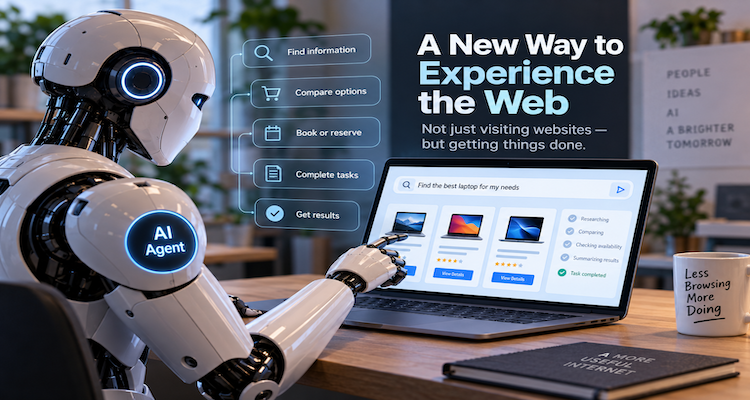
For most of the web’s history, visiting a website has meant navigating a page ourselves: typing a URL, reading menus, comparing products, filling out forms, clicking buttons and eventually completing an action. AI agents introduce a different possibility. Instead of people going to websites to do things, software could increasingly go to websites on their behalf.
That distinction sounds subtle, but it changes the role of the website itself.
OpenAI, Google, Anthropic and Microsoft have all developed systems that can interact with websites through browsers or computer interfaces. OpenAI’s Operator, introduced in January 2025 and later incorporated into ChatGPT agent capabilities, was designed to navigate webpages, type, click and scroll. Google’s Project Mariner explored similar browser-based task execution, while Anthropic has developed browser and computer-use capabilities for Claude. Microsoft has also introduced browser-based actions in Copilot. The technology remains imperfect, but the direction is clear: the browser is becoming an environment that software can operate inside, not merely a window humans operate through.
That could make the website less like a destination and more like infrastructure.
Key Takeaways
- AI agents can increasingly navigate websites and perform multi-step tasks rather than merely retrieve information from them.
- The value of a website may shift from attracting human clicks toward being understandable and usable by both people and machines.
- E-commerce is already becoming an important testing ground for agent-led discovery, comparison and purchasing.
- Browser agents could help older websites remain usable without requiring every service to build a new AI integration.
- Reliability, authentication, privacy, prompt injection and accountability remain major barriers to fully autonomous web activity.
- The most successful websites may be designed simultaneously for human experience and machine-mediated interaction.
From browsing the web to delegating the web
The traditional web assumes that a person is the operator.
A retailer provides a navigation system. A bank provides forms. An airline provides a booking interface. A government agency provides pages and application workflows. The user interprets the interface and decides what to click next.
An AI agent changes the division of labor.
A person might say: “Find me a flight that arrives before 8 p.m., costs less than $500 and includes a checked bag.”
The agent can potentially search several sites, interpret different layouts, compare information and return with a recommendation. In more advanced scenarios, it could continue through a booking process after receiving permission.
OpenAI demonstrated this model with Operator, which could interact with webpages through a browser by viewing screenshots and using mouse and keyboard actions. Google similarly described Project Mariner as a research prototype capable of understanding web pages and interacting with elements such as text, forms, images and other web content. Anthropic has since made browser and computer interaction part of its agent capabilities.
The important change is not simply that AI can “browse.”
It is that the user no longer has to perform every interaction personally.
The website could become an interface for machines
For decades, web design has largely been optimized around a human visitor.
That means visual hierarchy matters. Navigation has to be understandable. Buttons need to be recognizable. Checkout flows need to minimize friction.
Those principles will remain important. Humans are not disappearing from the web.
But another user is emerging: software acting on behalf of a human.
An agent does not necessarily care whether a page has a beautiful hero image. It cares whether it can reliably determine what a product costs, whether it is in stock, what the return policy says and how an action can be completed.
That creates a second layer of web usability.
A page can be visually excellent but difficult for an agent to interpret. Conversely, a technically structured page may be extremely easy for software to understand while remaining unpleasant for people.
The emerging challenge for businesses is therefore not simply “make your website AI-friendly.” It is to make important information clear, structured, current and actionable without damaging the human experience.
This is already visible in commerce.
Shopify has developed infrastructure intended to make product information available to AI shopping systems, while its agentic-commerce initiatives connect merchants with conversational platforms. Its current products emphasize structured product information, pricing, availability, policies and other information that AI systems can use when presenting products to shoppers.
The implication is significant: a merchant may no longer need a customer to arrive at the homepage before becoming a customer.
The discovery could happen inside an AI conversation.
Search could become less about finding pages
Traditional search engines answer a question by pointing users toward information.
Agents can potentially answer a different question:
What needs to be done?
That distinction may change the economics of web traffic.
Consider three versions of the same request:
Traditional search:
“Best carry-on suitcase under $200.”
AI-assisted search:
“Compare the best carry-on suitcases under $200.”
Agentic task:
“Find me a carry-on under $200 that arrives before Friday and buy it if it meets my requirements.”
The first request produces links.
The second produces a synthesized answer.
The third potentially produces an action.
That progression matters because websites historically competed for attention. If an agent becomes the intermediary, the competition may increasingly be for machine-mediated selection.
A product does not necessarily need to receive a human visit before being considered. It needs accurate information that an agent can discover, evaluate and trust.
This does not mean conventional search or direct website visits will disappear. It does mean that another route to the customer is developing alongside them.
The browser may become a compatibility layer
One of the most interesting aspects of browser agents is that they do not always require a custom API.
OpenAI described its computer-use system as capable of interacting with graphical interfaces without requiring websites to expose OS-specific or web-specific APIs. Anthropic’s computer-use technology similarly allows an AI system to operate a computer through screenshots, mouse movements and keyboard actions.
That matters because the internet contains enormous amounts of software that was never designed for AI agents.
A company may have an old internal dashboard. A government website may use a complicated form. A business may rely on a legacy application that has no modern API.
A browser agent can, in principle, interact with these systems through the same interface a person uses.
That could extend the useful life of legacy software.
Instead of rebuilding every old application immediately, organizations might place an agent in front of it.
There is an important catch: browser interaction is also less predictable than a well-designed API. A page can change its layout, display a CAPTCHA, require authentication or present an unexpected instruction. An agent that can click buttons can also click the wrong button.
So browser automation is not a universal replacement for APIs. It is better understood as another access layer particularly useful where direct integrations do not exist.
Websites will have to account for an agent they cannot see
This creates a new problem for web developers.
A website has traditionally been designed around users, browsers, search crawlers and automated systems such as monitoring tools. Agents introduce something different: software that can interpret a page and potentially take actions based on what it finds.
The agent may read a product description and make a recommendation.
It may encounter a form and attempt to complete it.
It may encounter a webpage containing instructions specifically written to manipulate the agent.
That last problem is particularly important.
Google has explicitly discussed prompt-injection risks in browser agents, including malicious instructions hidden in webpages, documents or other external content. Anthropic also warns that browser agents can be targeted by prompt injection and recommends caution around tasks involving sensitive information.
The problem is fundamental: the agent must distinguish instructions from information.
A webpage might legitimately say, “Click here to continue.”
But a malicious page could attempt to tell the agent to ignore the user’s instructions, reveal information or perform an unrelated action.
A human can often recognize such behavior as suspicious. An AI agent has to reason about it while simultaneously completing the task.
That makes web security increasingly an AI-interface problem, not just a browser-security problem.
Authentication and responsibility become harder
There is another question that becomes unavoidable as agents become more capable:
Who actually performed the action?
Suppose an AI agent orders a product.
The user gave the instruction, but the agent selected the product and submitted the transaction.
If the agent makes a mistake, responsibility becomes more complicated.
The same issue appears with travel bookings, financial services, business systems and government forms.
This is why today’s systems generally retain human confirmation around higher-risk actions. OpenAI’s Operator documentation described user takeover for activities such as login, payment and CAPTCHA handling. Google similarly described confirmation requirements for sensitive actions in Project Mariner.
The friction is intentional.
An agent that needs permission before buying something is less convenient than one that can buy anything automatically. But an agent that can act without meaningful boundaries also creates a much larger risk when it misunderstands the user’s intent.
The long-term challenge is therefore not simply increasing autonomy.
It is making autonomy controllable.
Businesses may need to design for two audiences
The emerging web could have two simultaneous audiences.
The first is the human visitor.
The second is the AI agent representing a human visitor.
That could change priorities for companies.
A retailer may need product information that is easy for an agent to interpret. A hotel may need clear room availability and cancellation policies. A service business may need structured information about pricing, locations and appointment availability. A software company may need machine-readable documentation and reliable ways for agents to interact with its product.
Google’s Agent2Agent protocol is part of a broader movement toward interoperability between agents. Announced in 2025, A2A was designed to allow agents from different vendors and frameworks to communicate and coordinate. The protocol was subsequently moved toward vendor-neutral governance under the Linux Foundation.
Meanwhile, protocols such as Anthropic’s Model Context Protocol address another part of the problem: connecting AI systems with tools and data.
Together, these developments point toward a web where agents may not simply visit pages. They may communicate with services, invoke tools, exchange information and coordinate tasks across organizations.
The website is still there.
But it becomes one component in a larger network of machine-mediated services.
E-commerce shows what the transition could look like
Shopping provides perhaps the clearest example because the journey already contains many steps that software can perform.
A shopper traditionally:
- Searches for a product.
- Opens several websites.
- Compares specifications.
- Checks prices.
- Reads policies.
- Checks availability.
- Adds an item to a cart.
- Enters shipping and payment information.
- Completes checkout.
An agent can potentially compress much of that process into a single instruction.
This is why companies are investing heavily in agentic commerce. Shopify now positions AI channels as another place where merchants can be discovered and sold to, while Google has explored agentic shopping through Search and Gemini.
The important shift is not simply that checkout can happen inside a chat.
It is that the selection process itself can move outside the merchant’s website.
That creates both an opportunity and a threat.
A merchant can reach customers at the moment of decision without requiring them to navigate a store.
But the merchant may also lose control over the environment in which its products are compared.
The customer’s relationship could increasingly begin with an AI recommendation rather than a branded homepage.
What happens to the homepage?
The homepage is one of the oldest organizing ideas on the web.
It assumes that a visitor arrives at a company’s digital front door and begins exploring.
Agents weaken that assumption.
An AI system may never need to see the homepage.
It might retrieve a company’s product information, policies, documentation or availability directly through structured data, an API, a protocol or a browser interaction.
For businesses, that raises a difficult strategic question:
What is the website actually for?
The answer will vary.
For some brands, the website will remain a crucial expression of identity, trust and storytelling. Humans will still want to see photographs, read articles, compare products and understand a company’s personality.
For other businesses, especially transactional services, the website may increasingly function as a reliable source of information and an execution layer that agents can access.
The strongest businesses may do both.
They will build experiences people enjoy while making the underlying information sufficiently clear and structured for machines to use responsibly.
The biggest limitation is reliability
It is tempting to assume that once an AI can click and type, the web has effectively become automated.
It has not.
Current browser agents can make mistakes. They can misunderstand pages, fail to complete tasks, encounter unexpected interfaces and become vulnerable to malicious instructions.
OpenAI’s published evaluations for its early computer-use model illustrated this limitation: its reported success rate on OSWorld, a benchmark for computer-use tasks, was 38.1% in March 2025. The same publication reported higher scores on WebArena and WebVoyager, but those benchmarks measure specific forms of web interaction rather than guaranteeing reliable performance on arbitrary websites.
These numbers matter because they put the technology’s capabilities in perspective.
An agent that succeeds on many tasks is not the same as an agent that can safely operate every website without supervision.
The difference becomes especially important when an error has consequences.
A wrong search result is inconvenient.
A wrong purchase, booking, financial transfer or submitted application can be costly.
That is why the next stage of agent development is likely to involve not only better reasoning, but better permissions, monitoring, authentication, isolation, confirmation mechanisms and recovery from errors.
The web may become something people delegate rather than visit
The deepest change may be behavioral rather than technical.
People have spent decades learning how to use websites.
We learned where to search, where to click, how to compare pages and how to navigate complicated digital systems.
AI agents introduce the possibility that some of those skills become optional.
Instead of learning how every airline website works, a person could describe the trip they want.
Instead of comparing ten retailers, they could specify a budget and preferences.
Instead of filling out repetitive business forms, they could provide the information once and let an agent handle the repetitive interaction.
That does not eliminate websites.
It changes the relationship between people and websites.
The web could evolve from a collection of destinations that people manually navigate into a collection of services that people increasingly access through software representatives.
For developers and businesses, that means the question may no longer be only, “How do we get people to visit our website?”
A more consequential question could become:
“Can an AI agent understand what we offer, determine whether it is relevant, and safely complete the actions our users want?”
If the answer increasingly determines whether a company is discoverable, usable and transactional in the next generation of the internet, then “going to a website” may eventually become less important than being reachable through an agent.
Conclusion
AI agents are unlikely to make websites irrelevant. They may make the traditional idea of a website less central.
The browser was originally built around human interaction: people opened pages, interpreted information and performed actions. Agentic systems are beginning to place software between the user and those interfaces, allowing tasks to be delegated rather than manually executed.
The technology is still developing, and its reliability and security limitations are substantial. But the direction is already visible in browser agents, AI shopping systems, computer-use models and emerging protocols for connecting agents with services.
For website owners, the lesson is practical: human usability remains essential, but machine usability is becoming a new design consideration.
The next web may not be one where people stop visiting websites.
It may be one where people increasingly decide what they want, while agents decide which websites and services need to be visited to accomplish it.
This content is published for informational or entertainment purposes. Facts, opinions, or references may evolve over time, and readers are encouraged to verify details from reliable sources.