










AI Search Is Changing How We Find Information But Users May Be Losing Sight of the Sources Behind the Answers
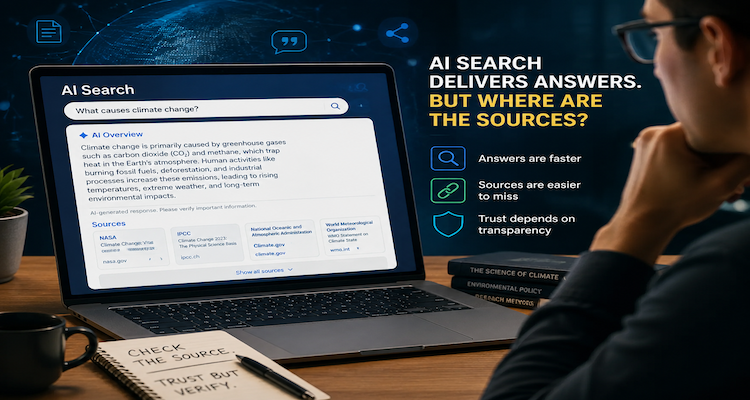
Search engines were built around a simple exchange: users asked questions, search engines provided links, and publishers received visitors when their information helped answer those questions.
AI-powered search is changing that relationship.
Today, many users can ask a question and receive a complete response directly inside an AI-generated answer box. The experience is faster and often more convenient, but it introduces a new challenge: people may get the information they need without ever seeing, visiting, or understanding the original sources that produced it.
The issue is not that AI-generated answers are automatically unreliable. Many systems are designed to cite sources and provide references. The deeper concern is about visibility, context, and trust: when an answer is summarized by a machine, users may pay less attention to where information came from, how it was verified, and whether different sources disagree.
This shift could reshape how people consume knowledge, how publishers create content, and how businesses compete for attention online.
Key Takeaways
- AI search can provide faster answers but may reduce direct visits to original information sources.
- Source visibility is becoming a critical part of digital trust and information quality.
- Publishers face new challenges as search moves from links toward AI-generated summaries.
- Users need new habits for checking evidence behind AI-generated responses.
- The future of search may depend on balancing convenience with transparency.
The Shift From Searching for Links to Receiving Answers
Traditional search engines were designed around discovery. A user searching for a topic would receive a list of pages ranked by relevance, authority, and usefulness. The user then decided which sources deserved attention.
AI search changes this process by adding a new layer between the user and the information.
Instead of presenting only a list of websites, AI systems can analyze multiple sources, summarize information, and generate a conversational response. This approach can be helpful for complex questions because users do not need to open multiple pages to understand basic concepts.
For example, someone researching climate change, a software problem, or a historical event may receive a short explanation immediately rather than navigating through several websites.
However, this convenience creates a new question:
When an AI system transforms dozens of sources into one answer, does the user still understand where the knowledge originated?
The answer depends largely on how clearly sources are displayed and whether users choose to explore them.
Why Source Visibility Matters More in the AI Era
Sources are not just references. They serve several important functions:
- They allow readers to verify claims.
- They reveal different perspectives.
- They show the expertise behind information.
- They help users identify errors or outdated information.
A traditional search result naturally exposed the relationship between a website and its content. Users could see the publisher, read the article, evaluate the writing, and compare multiple viewpoints.
AI-generated answers compress that process.
The technology may correctly summarize information, but the original context can become less visible. A scientific study, government report, expert analysis, or investigative article may all appear as small references beneath a generated response rather than as the main destination.
This creates a difference between information access and information understanding.
People may receive an answer without developing a clear picture of how that answer was created.
The Publisher Problem: When Answers Replace Visits
For online publishers, search traffic has historically been a major way of reaching audiences.
A news organization, research website, educational platform, or specialized publication invests resources into creating original reporting and analysis. Search engines helped connect those efforts with readers.
AI search introduces a different dynamic.
If users receive enough information directly from an AI-generated response, fewer people may click through to the original article. This concern has been raised by publishers as AI systems become more common in search experiences.
The challenge is especially significant for websites that depend on advertising, subscriptions, memberships, or audience relationships.
A publisher does not only create content to provide facts. It builds trust, develops expertise, and creates a connection with readers.
If AI systems become the primary interface between people and information, publishers may need to rethink how they demonstrate value.
Possible responses include:
- Creating more original reporting that AI systems cannot easily replicate.
- Building stronger relationships directly with audiences.
- Providing specialized analysis rather than basic information summaries.
- Developing unique data, research, interviews, and expert perspectives.
The internet may move from a competition for clicks toward a competition for trusted authority.
AI Answers Are Not the Same as Original Knowledge
One important distinction is that AI systems generally do not create knowledge in the same way researchers, journalists, scientists, or institutions do.
They process and generate responses based on patterns learned from available information and, in search-based systems, information retrieved from sources.
This means the quality of an AI answer depends heavily on:
- The quality of the underlying sources.
- The accuracy of retrieval systems.
- The ability of the model to interpret information correctly.
- The clarity of citations and references.
An AI summary can make information easier to understand, but it does not replace the importance of original evidence.
For example, a medical question may require understanding research limitations, patient differences, and professional guidance. A financial question may require considering regulations, market conditions, and personal circumstances. A historical question may involve competing interpretations.
A short answer may be useful, but the source behind the answer often contains the deeper reasoning.
The Rise of “Answer Engines” Changes User Behavior
The growth of AI search reflects a broader change in how people interact with technology.
Users increasingly expect immediate results. Voice assistants, recommendation systems, and conversational AI have trained people to ask questions naturally rather than search through databases.
This creates a behavioral shift:
People are moving from “Where can I find information?” toward “Give me the answer.”
That shift has advantages.
It can save time, improve accessibility, and help people understand complicated topics more quickly.
But it also creates a responsibility for users.
A convenient answer should not become an unquestioned answer.
Good information habits in the AI era may include:
- Checking cited sources for important decisions.
- Comparing multiple perspectives.
- Looking for original research when accuracy matters.
- Understanding whether an answer is based on evidence, opinion, or prediction.
Source literacy may become as important as search literacy.
Businesses Face a New Challenge: Being Visible in AI Responses
The impact of AI search extends beyond publishers.
Businesses increasingly depend on online discovery. A company may appear in traditional search results because it has strong website content, reviews, and online authority.
AI search introduces a new question:
Will a company be mentioned when an AI system recommends solutions?
Visibility may increasingly depend on factors such as:
- Reputation.
- Reliable information across the web.
- Clear documentation.
- Customer trust.
- Recognized expertise.
For companies, optimizing only for traditional search rankings may no longer be enough. The future may involve becoming a trusted source that AI systems can confidently reference.
The Search Industry Is Facing a Trust Challenge
Search has always involved a balance between speed and accuracy.
AI search increases speed dramatically, but transparency becomes more important.
The central challenge is not whether machines can summarize information. They already can.
The challenge is whether users can still understand:
- Who created the information.
- Why the information should be trusted.
- What evidence supports the claim.
- What uncertainty remains.
The strongest AI search systems may not simply provide answers. They may help users understand the evidence behind those answers.
Conclusion
AI search is changing the role of the search engine from a gateway to information into an interpreter of information.
That transformation offers clear benefits: faster access, easier explanations, and more conversational ways to learn. But it also creates a new responsibility for technology companies, publishers, businesses, and users.
The future of information may not depend only on who provides the fastest answer. It may depend on who makes the path behind that answer the clearest.
In an era where machines increasingly summarize knowledge, showing the source may become just as important as providing the answer.
This content is published for informational or entertainment purposes. Facts, opinions, or references may evolve over time, and readers are encouraged to verify details from reliable sources.