









Why “Third Places” Are Changing and What That Means for Everyday Life
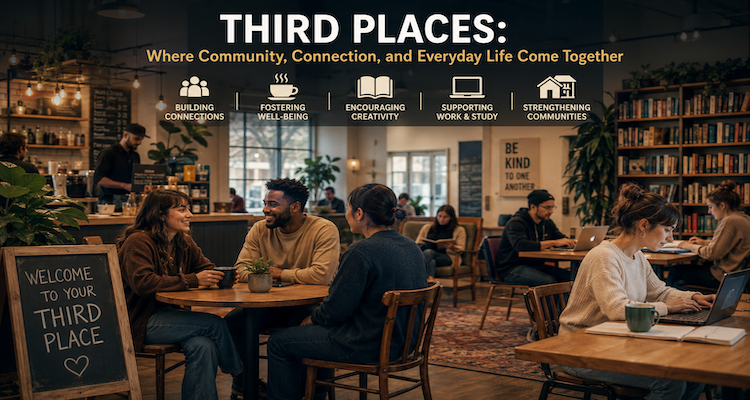
The places where people spend time outside home and work are quietly being redesigned by changes in work, technology, economics and urban life. The familiar café, library, neighborhood park or community center is no longer simply a place to socialize. Increasingly, it can also be an office, classroom, meeting point, cultural venue, service hub or digitally connected gathering space.
That matters because the traditional boundary between home, work and everything in between has weakened. In the United States, Gallup’s 2026 data show that among employees with remote-capable jobs, 52% work in a hybrid arrangement, 26% work exclusively remotely and 22% work fully on-site.
The result is a subtle but important shift: the “third place” is being asked to do more work in people’s lives while the conditions that once made such places easy to access are also changing.
Key Takeaways
- Remote and hybrid work have made cafés, libraries and other shared spaces more relevant to daily routines.
- A useful third place offers more than seating; it creates repeated opportunities for informal social contact.
- Digital technology is turning some physical gathering places into hybrid social and work environments.
- Public libraries and other free spaces can provide alternatives to increasingly commercial forms of social life.
- Access matters: having more third places does not automatically mean everyone benefits equally.
- The most valuable third places may be those that allow people to belong without requiring a purchase, membership or close friendship.
The “Third Place” Was Never Just About Coffee
The term third place comes from sociologist Ray Oldenburg’s work on places outside the home and workplace where informal social life can develop.
A café, bar, library, park, hair salon, bookstore, community center or similar venue can function as a third place when it gives people a reason to return and creates opportunities for interaction beyond their immediate household or workplace.
The distinction is useful because home and work serve fundamentally different purposes. Home provides private life. Work traditionally provides structured economic and professional relationships. Third places occupy the less formal territory in between.
Their value often comes from something deceptively ordinary: repeated, low-pressure encounters.
You might recognize the barista without knowing their name. You might see the same people walking their dogs in the park. You might exchange a few words with someone at the library or community center without becoming friends.
Those relationships can remain weak ties rather than close friendships. But research on older adults, for example, has highlighted the potential importance of these peripheral social connections for social engagement and well-being.
That is why describing third places simply as “places to hang out” undersells their role.
They create opportunities for people to encounter others without having to arrange a formal social event first.
Remote Work Has Changed What a Third Place Is For
The traditional model assumed that work happened somewhere else.
That assumption no longer holds for millions of workers.
Pew Research Center reported in 2025 that 75% of U.S. employees with jobs that can be done from home were working remotely at least some of the time. Its survey also found that 72% of hybrid workers preferred a hybrid arrangement rather than working from home all the time.
Gallup’s more recent figures point in the same direction: hybrid work remains the dominant arrangement among U.S. employees whose jobs can be performed remotely.
This creates a new role for places that Oldenburg’s original framework did not need to emphasize as strongly: the third place as a partial workplace.
A café table may now hold a laptop rather than a newspaper. A library may provide quiet work space, Wi-Fi and access to technology. A coworking space can combine professional infrastructure with opportunities for social interaction.
Research using mobile-phone data and machine-learning methods has even examined where people perform remote work in third places. One 2024 study estimated that 11.27% of employees in its study context opted to work remotely from third places, with commercial third places accounting for 4.35%.
The important point is not the precise percentages which come from a specific research setting but what they reveal conceptually.
When the office disappears from the daily routine, people do not necessarily stop needing places that separate work from home.
They may simply look for different ones.
The New Third Place Is Often a Hybrid Space
The most interesting development may be that physical and digital third places are no longer cleanly separable.
A café can be simultaneously:
- a physical meeting place;
- a remote-work environment;
- a social-media backdrop;
- a community event venue;
- a place discovered through digital maps and reviews;
- and a location whose customers coordinate through online groups.
Technology changes not only what happens inside these places, but also how people discover, choose and use them.
Recent academic research has begun examining this relationship directly. A 2025 study in Sustainable Cities and Society investigated how digital technology differentiates physical third places and described “Digi-Third Places” as physical spaces whose characteristics are shaped by digital technology.
Another study published in the Journal of Retailing in 2026 examined how technology-mediated interaction can create what researchers describe as digital third-place atmospheres. Its findings suggest that physical co-presence is not always necessary for certain forms of third-place sociability, particularly in hybrid online environments.
That does not mean an online community is automatically equivalent to a neighborhood café.
It means the definition of social gathering is becoming more complicated.
A Discord community, multiplayer game, livestream chat, online group or digital retail environment may provide some characteristics associated with third places regularity, conversation, shared identity or informal interaction without providing the physical encounters that define traditional public spaces.
The distinction matters because digital connection and physical presence solve different problems.
Libraries Are Becoming More Important to the Third-Place Conversation
Libraries illustrate another major change: the value of a third place is not necessarily tied to consumption.
A commercial café can provide a welcoming environment, but customers are generally expected to purchase something. A library can offer many of the same basic social functions without requiring someone to buy a coffee.
The American Library Association describes libraries as places where people can access technology, explore interests and careers, meet neighbors and participate in community conversations.
That makes libraries particularly significant as third places because they can combine social infrastructure with public access.
They can host community meetings, educational programs, cultural events and informal encounters while also providing physical resources.
This is especially relevant as more third places become commercially dependent.
If every comfortable place to sit, work, meet or spend an hour requires a transaction, social life becomes partly dependent on purchasing power.
Research on third-place availability in the United States has highlighted this distinction, separating free public places such as libraries and civic organizations from commercial places such as cafés and restaurants. The researchers note that differences in availability and access can have implications for who benefits from these spaces.
The question, therefore, is not simply:
How many third places does a community have?
It is also:
Who can use them, how often, and under what conditions?
Convenience Can Make a Third Place Less Social
There is a paradox in the evolution of third places.
Technology can make them easier to use while simultaneously making them less socially interactive.
A café with excellent Wi-Fi and power outlets may attract remote workers. But if everyone is wearing headphones and staring at individual screens, the space may function more like a collection of private offices than a social environment.
The same tension can appear in libraries, coworking spaces and other shared environments.
Research into the physical characteristics of third places has found that elements such as seating, shelter, permeability and connection with the surrounding street can influence opportunities for sociability.
More recent research on hybrid third places similarly points to the importance of physical, atmospheric, social and functional characteristics in shaping interaction. A 2026 case study of three book cafés, for example, examined how spatial design influences social interaction among users.
This suggests that simply adding desks, outlets and Wi-Fi does not necessarily create a better third place.
Sometimes the most valuable feature is the one that cannot be measured as easily: whether the environment makes interaction feel natural rather than forced.
The Economics of “Free Time” Are Changing
Another change is financial.
Many traditional third places have always depended on a fragile economic model. A café needs customers. A bookstore needs sales. A community center needs funding. A privately operated public-facing space must balance openness with commercial sustainability.
That creates a fundamental tension.
The places that are easiest to access socially may be the hardest to sustain financially.
Research has also found that the benefits associated with third places are not necessarily distributed equally across income groups. A 2026 study examining socioeconomic differences in the well-being benefits of third places concluded that simply having more third places does not mean everyone experiences the same benefits from them.
This is one of the most important qualifications to the popular third-place narrative.
A neighborhood can have numerous cafés and restaurants and still lack genuinely accessible social infrastructure.
A person who cannot comfortably spend money every day may experience the neighborhood very differently from someone who can.
That is why parks, libraries, community centers, markets and other publicly accessible spaces remain important alongside commercial venues.
Third Places May Matter Most When People Are Not Looking for Friendship
Perhaps the most overlooked feature of a good third place is that people do not necessarily have to go there to socialize.
Someone can read.
Someone else can work.
Another person can walk around.
A parent can bring a child.
A retiree can attend an event.
A student can study.
Two neighbors can talk.
None of these activities requires a formal invitation.
That low threshold is part of the third place’s power.
The problem with many attempts to solve social isolation is that they begin with the assumption that people need to make new friends. But making friends can itself be socially demanding.
A more accessible intervention is simply to create places where people repeatedly encounter other people.
Research and policy discussions increasingly treat such spaces as part of broader “social infrastructure” the physical and institutional environments that enable social connection. Research examining the closure of third places has warned that losing these spaces can remove not only amenities but also opportunities for community interaction and support.
That makes the everyday café, library, park or community center more consequential than its appearance suggests.
What the Changing Third Place Means for Everyday Life
For individuals, the shift creates a practical opportunity: reconsider the spaces between home and work.
A third place does not have to be fashionable or expensive. It could be a local library, public park, community garden, neighborhood market, recreation center, café or regular cultural event.
The useful question is not “Where can I go to meet people?”
It may be:
Where can I become a regular?
Regularity matters because social familiarity develops gradually. A place becomes part of someone’s life when returning requires little planning.
For businesses, the lesson is different. A successful third place cannot be reduced to décor and Wi-Fi. People need reasons to stay, return and recognize others. Events, seating arrangements, accessibility, atmosphere and community programming can all influence that experience.
For cities and communities, the issue becomes broader still.
Third places are part of the infrastructure of everyday life. Decisions about libraries, parks, public seating, pedestrian areas, community facilities and neighborhood development can therefore affect not only convenience but opportunities for social interaction.
The Urban Institute has highlighted this accessibility problem, noting that third places can be unevenly distributed and that design, funding and maintenance can influence who gets to benefit from them.
The Next Third Place May Be a Combination of Several Places
The old mental model was simple:
Home → work → third place.
The emerging model is messier:
Home ↔ office ↔ café ↔ library ↔ park ↔ community space ↔ digital community.
People may move among these environments throughout the same day.
A person can start work at home, take a video call from a café, meet someone at a library event, walk through a park and finish the evening in an online community.
That does not mean physical third places are becoming obsolete. The evidence points in the opposite direction: researchers continue to investigate their relationship with social connection, work, well-being and urban life precisely because their function remains significant.
What is changing is their job description.
The third place is increasingly expected to accommodate work without becoming an office, provide community without demanding membership, support digital connectivity without eliminating physical interaction, and remain accessible in an economy where space is expensive.
That is a difficult balance.
It also explains why the future of third places will probably not be defined by one ideal venue.
Conclusion
The changing third place is really a story about what happens when the boundaries of everyday life become less fixed.
Remote work has weakened the traditional separation between workplace and elsewhere. Digital platforms have extended social interaction beyond physical locations. Commercial pressures have made some gathering spaces less accessible, while libraries, parks and other public institutions continue to provide alternatives.
The deeper lesson is that social connection requires infrastructure.
People do not build community only through organized events or close friendships. They also build it through repeated, ordinary encounters: recognizing a familiar face, sharing a public space, talking briefly with a neighbor or simply spending time around other people.
The best third places make those encounters possible without demanding much in return.
As work becomes more flexible and technology becomes more embedded in everyday social life, that quiet function may become even more valuable. The future of the third place is therefore unlikely to be about choosing between physical and digital life. It will be about designing everyday environments in which the two can coexist—while preserving something technology cannot easily replace: the chance to simply be around other people.
This content is published for informational or entertainment purposes. Facts, opinions, or references may evolve over time, and readers are encouraged to verify details from reliable sources.