










The Lost Professions That Reveal How Earlier Societies Actually Worked
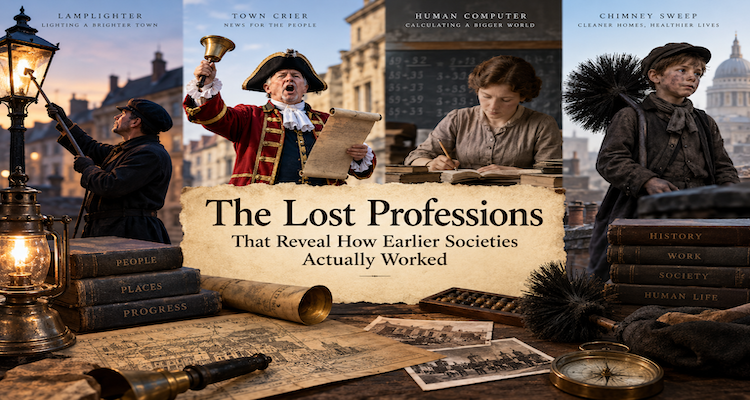
A profession can disappear without the work itself disappearing. The task may be absorbed by a machine, a government office, a new industry, or an entirely different occupation. That makes obsolete jobs unusually useful historical evidence: they show us what earlier societies had to organize manually, person by person.
Consider the ancient Egyptian scribe. The job was not simply “writing.” Scribes recorded taxes, legal documents, correspondence, harvest calculations, and administrative information that allowed a large state to function. In Roman cities, fullers cleaned and finished textiles in specialized workshops. Centuries later, lamplighters maintained the infrastructure that made nighttime streets usable, while human “computers” at NASA performed calculations that are now handled by electronic machines.
Looking at these occupations together reveals something easy to miss when history is told mainly through rulers, inventions and wars: societies are built around thousands of specialized tasks, and the disappearance of a job can tell us exactly what changed underneath everyday life.
Key Takeaways
- Lost professions often reveal the infrastructure and institutions that earlier societies depended on.
- Ancient scribes show how literacy became an administrative technology long before computers.
- Roman fullers demonstrate that ordinary urban services could support complex specialized economies.
- Lamplighters disappeared because lighting infrastructure changed, not because cities stopped needing illumination.
- NASA’s human computers show how technological change can eliminate a job while creating entirely new forms of skilled work.
- Studying obsolete occupations makes social and technological change easier to see at human scale.
The Scribe Was an Information Worker Before Information Technology
Few professions demonstrate the connection between work and state power more clearly than the ancient Egyptian scribe.
The surviving evidence shows that scribes occupied an important position in Egyptian administration. The Grand Egyptian Museum describes royal scribes as being involved in royal correspondence, tax records, religious texts and legal contracts. The Egyptian Museum in Cairo similarly notes that scribes recorded tax collection and harvest calculations, accompanied military campaigns and helped with private correspondence and wills.
That changes how the profession should be understood.
A scribe was not simply an ancient equivalent of a modern author. Writing was infrastructure. Someone had to convert harvests, taxes, orders, contracts, inventories and correspondence into durable records that administrators could use.
The Met’s material on the tomb of Meketre offers a particularly revealing example. Its model of a granary shows scribes recording grain as it entered and left storage, allowing administrators to calculate supplies. Grain itself could function as a measure of value in an economy before coinage became widespread in Egypt.
The implication is important: bureaucracy required people who could turn physical activity into information.
Modern societies still perform the same basic function. The difference is that databases, scanners, software and automated systems increasingly perform tasks that once required dedicated clerks.
The occupation changed because the information system changed.
Mesopotamia Shows That Specialization Was Already Deep
The ancient Near East provides another warning against imagining early economies as simple collections of farmers and kings.
Cuneiform records preserve evidence of merchants, builders, musicians, weavers, bricklayers, administrators and other specialized workers. Oxford historian Amanda H. Podany’s Weavers, Scribes, and Kings uses written records and archaeological evidence to reconstruct the lives of people across the ancient Near East, including a woman who worked as a weaver and eventually became a workshop supervisor.
This matters because occupational specialization is sometimes treated as a feature of modern economies.
It is not.
Large settlements have long depended on people doing different things well. As cities grew, someone had to produce textiles, construct buildings, manage inventories, transport goods, maintain religious institutions, keep records and coordinate labor.
The surviving tablets make this especially visible. The Metropolitan Museum of Art, for example, holds cuneiform administrative records concerning labor for irrigation work as well as records of rations distributed to messengers.
The deeper lesson is that a job title can be evidence of an entire economic system.
When a profession appears repeatedly in documents, it tells historians that the activity was sufficiently important, organized and recurrent to require specialists.
The Fuller: A Dirty Job at the Center of a Clean City
The Roman fuller is another occupation that sounds obscure until its economic importance becomes clear.
Fullers cleaned and finished textiles. Archaeological remains of fullonicae specialized fulling workshops survive at Roman sites including Pompeii and Ostia. Archaeologist Miko Flohr has used these workshops, alongside inscriptions and literary evidence, to study the economic and social context of production in Roman cities.
The work could be unpleasant. Fulling involved washing, cleaning and treating cloth, and urine was used as a cleaning agent because its ammonia content could help process textiles. But the unpleasantness of the job should not obscure its economic importance.
Clothing does not become a finished product simply because someone can weave fabric.
It needs to be cleaned, treated, finished and maintained.
That distinction reveals something fundamental about older economies: many essential services existed between the production of a raw material and the object people actually used.
Modern consumers rarely see those intermediate occupations. Industrial production has hidden much of the chain.
A Roman city, by contrast, left some of that chain physically visible.
The fuller’s workshop was therefore more than a laundry. It was part of an urban manufacturing system.
When a Job Disappears, the Need May Survive
The lamplighter offers a different kind of disappearance.
The Metropolitan Museum of Art records that New York’s municipal authorities began installing whale-oil lamps in the 1760s and employed lamplighters to maintain them. By the 1820s, gas lighting was replacing those earlier lamps.
The White House Historical Association provides another unusually concrete glimpse of the occupation. A surviving 1888 job description shows that the White House lamplighter was responsible not only for lighting and extinguishing lamps but also for tasks such as lighting fires, removing ashes, cleaning the basement and maintaining ranges. Electric lighting did not reach the White House until 1891.
The important point is not simply that electric lighting “killed” the lamplighter.
The underlying requirement reliable illumination remained.
What changed was the infrastructure required to provide it.
This is a useful pattern for understanding occupational change:
The disappearance of a profession does not necessarily mean society stopped needing the service. It can mean society found a different way to deliver it.
That distinction is often lost when obsolete occupations are presented as amusing relics.
The Human Computer Was a Job Title
Perhaps the most striking example for a modern reader is the human computer.
Before electronic computers became capable of handling large quantities of calculations, “computer” could describe a person whose occupation was to calculate.
NASA’s history of Langley Research Center documents the development of human computing from the 1930s onward. Women were employed to perform mathematical calculations, read experimental data, plot results and support aeronautical research. During the Second World War, the demand for this work expanded significantly.
At NASA’s Jet Propulsion Laboratory, human computers performed calculations involving launch windows, trajectories, fuel consumption and spacecraft telemetry. NASA notes that many of these workers later became some of the earliest computer programmers.
The story of Annie Easley makes the transition particularly clear. She began at NASA in 1955 as a human computer, performing calculations by hand. As machines took over more of that work, she became a computer programmer and later worked on software and scientific research.
This is more than an interesting historical coincidence.
It demonstrates that technological automation can transform occupations in at least two ways:
- It can eliminate repetitive tasks.
- It can shift human workers toward tasks the new technology cannot perform as easily.
The “computer” did not simply vanish.
The meaning of the word changed.
That is one reason the history of human computers is especially relevant to the modern debate about automation and artificial intelligence.
Obsolete Jobs Can Reveal Who Held Power
Occupations also expose social hierarchy.
In ancient Egypt, literacy was limited, and scribes occupied a respected position because written knowledge was scarce and administratively valuable. Egyptian museum sources describe scribes as a distinct and highly regarded group whose skills included writing, mathematics and administrative work.
Roman professional associations offer another perspective. Cambridge scholarship on Roman collegia describes professional associations as important elements of economic and social life, particularly among lower and middle social groups. These organizations could have professional, economic, religious, social and welfare functions.
That means an occupation was not necessarily just a way to earn money.
It could determine:
- who someone worked alongside;
- what training they received;
- what social networks they entered;
- how they interacted with authorities;
- what institutions supported them;
- and how they understood their place in the city.
The loss of an occupation can therefore represent the disappearance of an entire social arrangement.
The Most Interesting “Lost Jobs” Are Really Lost Systems
This is why lists of obsolete occupations can be misleading.
A list might place scribes, fullers, lamplighters and human computers next to one another as historical curiosities. But they belong to very different periods and systems.
What connects them is not the work itself.
It is the function the work performed.
| Profession | What the worker actually provided | What changed |
|---|---|---|
| Egyptian scribe | Records, calculations and administrative information | Administrative and information systems evolved |
| Mesopotamian specialist | Skilled production and institutional labor | Economic organization changed over centuries |
| Roman fuller | Textile cleaning and finishing | Industrial and modern textile systems transformed the process |
| Lamplighter | Maintenance of public and household lighting | Gas and electric systems changed the infrastructure |
| Human computer | Mathematical calculation and data processing | Electronic computing absorbed much of the calculation |
The pattern is striking.
A profession tends to become obsolete when the system around it changes enough that its specialized function can be performed differently.
Sometimes a machine does it.
Sometimes an institution does it.
Sometimes several occupations are merged into one.
Sometimes the task remains but becomes so automated that no separate profession is required.
What These Professions Tell Us About the Present
This historical perspective also offers a more useful way to think about automation.
When people hear that a technology may eliminate jobs, the natural question is: Which occupations will disappear?
History suggests another question may be more revealing:
Which functions are becoming cheap, automatic or invisible and what new occupations will organize everything around them?
The human computer is an obvious example. Calculation did not disappear when electronic computers arrived. It became cheaper and faster, while some workers moved into programming and other technical roles. NASA’s historical record documents this transition directly.
The lamplighter offers the same lesson from infrastructure.
The city still needed light. It simply stopped needing thousands of individual workers to carry out the same maintenance process manually.
The scribe provides an even broader lesson.
Societies will always need information to be recorded, interpreted, transmitted and acted upon. But the people and tools performing those functions can change dramatically.
That distinction matters when thinking about artificial intelligence as well. It is too early to assume that a modern occupation will simply disappear because one of its tasks can be automated. Historically, occupations often change by shedding some tasks, acquiring others, and becoming reorganized around new technologies.
History Looks Different When You Follow the Worker
Traditional history often gives prominence to kings, generals, inventions and major political events.
Occupational history starts somewhere else.
It asks who counted the grain.
Who cleaned the cloth.
Who copied the documents.
Who maintained the lights.
Who performed the calculations.
Those questions can make a civilization look surprisingly different.
They reveal that large societies depend on layers of specialized labor that are easy to overlook precisely because the system works when those workers do their jobs successfully.
When the occupation disappears, the hidden structure becomes visible.
The Egyptian scribe shows us an administrative state built around scarce literacy. The Roman fuller reveals the specialized services required by an urban textile economy. The lamplighter exposes the labor behind early public lighting. NASA’s human computers show how even cutting-edge scientific institutions once depended on people performing calculations that machines now execute in fractions of a second.
These are not simply stories about jobs that vanished.
They are stories about how societies reorganize themselves when the cost, technology or institution behind a necessary task changes.
That may be the most useful way to understand lost professions: not as ghosts of work that no longer exists, but as clues to the systems that once made everyday life possible.
Conclusion
A lost profession is often a small doorway into a much larger history.
The disappearance of a scribe, fuller, lamplighter or human computer tells us less about nostalgia for old occupations than about changing systems of information, production, infrastructure and technology.
The most revealing question is therefore not “Why did this job disappear?”
It is “What replaced the function this person performed?”
Ask that question often enough, and economic history stops looking like a sequence of inventions and starts looking like what it really was: a continual rearrangement of human tasks, institutions and skills.
The occupations may disappear.
The needs they served rarely do.
This content is published for informational or entertainment purposes. Facts, opinions, or references may evolve over time, and readers are encouraged to verify details from reliable sources.