








When Tourism Becomes Too Successful: The Hidden Infrastructure Crisis Behind Popular Destinations
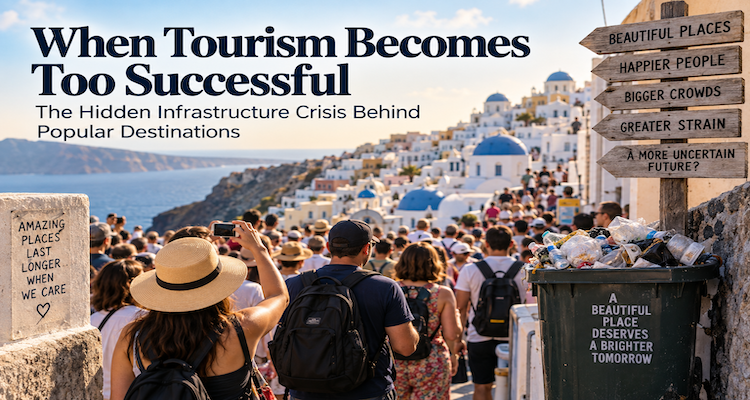
Tourism is supposed to be a sign that a place is thriving. Visitors arrive, hotels fill, restaurants become busy, local businesses earn more and governments collect additional revenue.
But success has a physical limit.
A historic city can welcome more visitors than its streets were designed to handle. An island can attract more people than its water and waste systems can comfortably serve during the busiest weeks of the year. A mountain destination can become internationally famous faster than it can build roads, emergency services, accommodation and public transport. A city can gain tourism income while residents struggle with congestion, housing pressure and increasingly crowded public services.
That is the less visible side of overtourism: the problem is not simply that too many people arrive. It is that visitor demand can grow faster than the systems supporting both visitors and residents.
The scale of tourism makes that mismatch increasingly important. UN Tourism recorded about 1.4 billion international tourist arrivals in 2024, marking the recovery of international tourism to roughly pre-pandemic levels. The OECD subsequently reported that international arrivals to OECD countries rose another 3.4% in 2025, reaching an estimated record 847 million.
The question for destinations is therefore changing. It is no longer simply how to attract tourists.
It is how to remain liveable, functional and resilient when tourism succeeds.
Key Takeaways
- Tourism pressure often exposes weaknesses in public infrastructure rather than being caused by visitor numbers alone.
- Peak-season demand can overwhelm transport, water, waste, housing and emergency services even when annual capacity appears adequate.
- The OECD increasingly treats carrying capacity as a framework for balancing economic, social and environmental pressures, not a single visitor limit.
- Venice and Amsterdam show how destinations are moving from promotion toward active management of visitor flows.
- Better tourism policy increasingly depends on granular data, coordinated infrastructure planning and meaningful resident participation.
The Infrastructure Problem Hidden Behind the Crowd
The most visible symptom of overtourism is usually a crowded street.
The underlying problem is much larger.
Tourists use the same roads, trains, airports, water networks, electricity systems, hospitals, public spaces, waste facilities and emergency services as residents. They also require additional accommodation, food supplies, sanitation, digital connectivity and transportation.
The OECD’s 2026 Tourism Trends and Policies report describes tourism as closely connected to public infrastructure and services, including transport, water, waste, energy, communications, public order and health services. The organization also warns that infrastructure decisions need to be integrated with wider tourism planning because expanding capacity can itself encourage additional tourism demand.
That creates a difficult feedback loop.
A destination becomes popular.
More accommodation and transport are built.
The destination becomes easier to reach.
More visitors arrive.
The new infrastructure begins filling up.
The pressure returns.
This is why simply asking whether a destination has “enough infrastructure” can be misleading. The more useful question is whether infrastructure can cope with where and when demand peaks, while continuing to serve residents.
Capacity Is Not Just a Number
The idea of a destination having a fixed “carrying capacity” sounds straightforward: determine how many tourists can visit, then stop additional visitors once that number is reached.
Real destinations are rarely that simple.
The OECD’s latest research explicitly notes that there is no universally agreed methodology for determining tourism carrying capacity. It describes carrying capacity instead as a framework for identifying critical thresholds and balancing trade-offs across infrastructure, public services, communities and environmental assets.
Consider two destinations receiving the same number of visitors.
One may have frequent public transport, abundant water supplies, modern wastewater treatment, extensive accommodation, multiple hospitals and several alternative attractions.
The other may have a narrow road network, limited water, few waste-processing facilities, scarce housing and one heavily concentrated tourist centre.
The visitor count alone tells us very little about which destination is under greater pressure.
Timing matters too.
OECD data show that around 40% of tourist nights across OECD countries are concentrated in the three busiest months. In some countries, the concentration is substantially higher. Around 47% of tourist nights are also concentrated in just 10% of regions with available data.
That creates an infrastructure paradox.
A destination may have enough hotels, roads and public facilities for an annual average but still experience severe shortages during a few weeks or months.
Building enough infrastructure to accommodate the absolute peak could leave large amounts of capacity underused for much of the year. Building only for the annual average can leave residents and visitors struggling during the busiest periods.
The challenge is therefore partly an engineering problem and partly a planning problem.
Water, Waste and Energy Are Tourism Infrastructure Too
Tourism infrastructure is often imagined as airports, hotels, roads and attractions.
The less glamorous systems may matter more.
Water treatment. Sewage networks. Waste collection. Electricity distribution. Cooling systems. Public toilets. Emergency services.
These systems have to function whether or not visitors notice them.
UNEP has long highlighted the resource intensity associated with tourism, including pressure on energy, water, land and materials alongside waste, sewage, biodiversity loss and greenhouse-gas emissions. Its analysis has also stressed that tourism growth without improved resource management can increase these pressures significantly.
This becomes particularly difficult in destinations where tourism demand is highly seasonal.
A coastal resort may need infrastructure capable of handling a dramatic summer population increase while maintaining it during the quieter months. A small island may have limited land for expanding waste facilities. A historic city may have little physical room for widening roads or installing new utilities without damaging the very heritage that attracts visitors.
The infrastructure crisis can therefore become self-reinforcing: the more attractive and historically significant a place is, the harder it may be to expand the physical systems supporting its popularity.
Housing Turns Tourism Pressure Into a Resident Problem
The tourism debate becomes more politically sensitive when the pressure moves from streets and attractions into housing.
The OECD’s 2026 analysis notes that the growth of short-term tourism accommodation can contribute to housing demand in some destinations. It also stresses that the evidence is mixed and that short-term rentals are not necessarily the main cause of housing problems everywhere.
That distinction matters.
Housing affordability is influenced by many factors, including construction, wages, population growth, interest rates, land availability and local regulation. It would be inaccurate to blame tourism for every housing problem.
But tourism can add another demand for limited residential space.
In heavily visited destinations, accommodation designed for short stays can compete with housing needed by permanent residents and tourism workers. The OECD notes that seasonal and tourism workers themselves can face difficulty securing affordable local housing in some destinations.
This produces an uncomfortable contradiction.
A destination may depend economically on tourism while the workers needed to operate hotels, restaurants, transport and attractions struggle to live there.
At that point, overtourism is no longer simply a visitor-management problem. It becomes a question about how a local economy distributes space and opportunity.
Venice Is Testing Whether Visitor Management Can Work
Venice offers one of the clearest examples of a destination attempting to manage day-trip pressure rather than simply promoting more arrivals.
In 2025, the city expanded its experimental access contribution from 29 days in 2024 to 54 days. The charge was generally €5 for visitors who made the required arrangements early and €10 for later bookings, with the system applying during designated daytime periods.
By the end of the 2025 experiment, Venice reported more than 720,000 paid day-visitor vouchers and approximately €5.4 million in revenue, compared with about 485,000 paying visitors and €2.4 million in revenue during the 29-day 2024 experiment.
The important point is not simply the fee.
Venice is treating visitor movement as something that can be managed, measured and influenced rather than passively accepted.
That distinction matters for other destinations. If the problem occurs because enormous numbers of visitors arrive simultaneously at the same locations, the policy question becomes broader than “How do we build more?”
It becomes:
- Can visitors be spread across different times?
- Can demand be redirected to less crowded areas?
- Can day trips be managed differently from overnight stays?
- Can technology provide authorities with better information about visitor flows?
- Can tourism revenue be directed toward the infrastructure carrying the burden?
Venice’s experiment does not prove that an access fee is a universal solution. It demonstrates something more useful: destinations are increasingly willing to experiment with demand management rather than relying exclusively on additional capacity.
Amsterdam Is Trying to Change the Shape of Tourism
Amsterdam provides another example of the shift from tourism promotion toward tourism management.
The city lists measures including spreading visitors more evenly across the city, introducing new hotel policy, bringing forward hospitality closing times and reducing river cruises.
The significance lies in the strategy.
Instead of treating tourism as a single volume to be increased or reduced, policymakers can influence its distribution.
A visitor who stays longer, spends money with local businesses and explores areas outside a severely congested centre may create a different impact from a short-term visitor who arrives at the same landmark during the busiest hour of the busiest day.
That is why “number of tourists” can be an inadequate measure of tourism pressure.
Where visitors go, when they arrive, how long they stay, what infrastructure they use and how concentrated their activity becomes can matter just as much.
Technology Can Help But It Cannot Build a Missing Sewer
One of the more promising changes in tourism management is the growing use of data.
The OECD’s 2026 report points to mobile-phone data, weather information, digital tools and AI as ways governments can gain more granular insight into visitor flows. It cites initiatives in Austria, France, Costa Rica and Japan that use data or digital technologies to understand and manage tourism distribution.
This could allow destinations to identify congestion before it becomes a crisis.
Real-time transport information could redirect visitors.
Crowding data could encourage tourists to visit alternative attractions.
Forecasting models could help authorities prepare staffing and public services for expected peaks.
Weather data could help anticipate sudden shifts in demand.
But technology has a clear limitation: better information does not automatically create more physical capacity.
An AI system can predict that a historic centre will become overcrowded at 11 a.m. It cannot widen a medieval street.
A dashboard can identify wastewater pressure. It cannot instantly expand a treatment plant.
A mobile application can recommend another attraction. It cannot provide affordable housing for workers.
Technology is therefore most useful when it is connected to actual policy, investment and operational decisions.
The Infrastructure Question Is Also a Governance Question
The deeper lesson from current tourism policy is that no single tourism agency can solve the problem.
Transport planners, housing authorities, water utilities, environmental agencies, emergency services, local businesses and residents all experience tourism differently.
The OECD argues for stronger coordination between governments and the private sector because tourism relies on public infrastructure while also generating revenue that can help finance its maintenance and improvement.
WTTC similarly argued in 2025 that overcrowding is often connected to underinvestment, poor planning and fragmented decision-making, rather than simply visitor numbers. Its proposed approach included stronger destination coordination, better data, infrastructure investment and resident participation.
This changes the policy conversation.
Instead of asking only whether tourists should be allowed to visit, authorities can ask whether tourism revenue is being converted into the infrastructure required to accommodate tourism.
If visitors generate additional pressure on public transport, water systems, waste management and public spaces, those costs should be visible in destination planning.
The objective is not necessarily fewer tourists.
It is a better relationship between tourism demand and local capacity.
The Climate Dimension Makes the Problem Harder
Tourism infrastructure is also facing another pressure that cannot be solved simply by controlling visitor numbers: extreme weather.
The OECD’s 2026 tourism research reports increasing disruption from heatwaves, floods, wildfires and severe storms, including road and airport closures, infrastructure damage, attraction closures and rising operating costs. Extreme heat can also increase cooling requirements and water losses.
This matters because infrastructure designed around historical conditions may no longer be adequate.
A destination that once planned for a predictable summer season may now need to consider extreme heat, wildfire risk, flooding or water scarcity when determining how much tourism it can safely accommodate.
Tourism resilience is therefore becoming inseparable from climate resilience.
A hotel, airport or road network may be perfectly adequate under normal conditions but highly vulnerable during an extreme event.
The destinations most prepared for the next phase of tourism may therefore not be those capable of accommodating the largest number of visitors.
They may be those capable of absorbing shocks without sacrificing residents’ basic needs or destroying the assets visitors came to experience.
What Successful Destinations Should Measure
The traditional tourism scoreboard often focuses on arrivals, overnight stays, hotel occupancy and visitor spending.
Those numbers matter, but they do not reveal the entire picture.
A more useful destination-management dashboard could track indicators such as:
- Peak-day and peak-hour visitor density
- Public transport crowding
- Water demand during tourist peaks
- Waste and wastewater loads
- Emergency-service demand
- Housing affordability and availability
- Seasonal employment pressures
- Visitor distribution beyond major attractions
- Resident satisfaction
- Environmental degradation
- Infrastructure investment relative to tourism-generated revenue
No single indicator can determine whether a destination has “too many” tourists.
Together, however, they can reveal whether tourism growth is beginning to exceed the systems that sustain it.
This is close to the direction in which international tourism policy is moving. The OECD’s current framework treats carrying capacity as a way to understand thresholds and trade-offs rather than as a universal number that applies to every destination.
The Better Goal Is Not Maximum Tourism
There is an important distinction between successful tourism and maximum tourism.
A destination can increase arrivals while making residents less satisfied, infrastructure less reliable and the visitor experience less enjoyable.
At some point, additional volume can weaken the very qualities that created demand in the first place.
That does not mean destinations should simply close their doors.
Tourism provides employment, investment, tax revenue, cultural exchange and opportunities for local businesses. The OECD continues to describe it as an important contributor to economic prosperity and community development when benefits are well managed.
The more sophisticated goal is to make tourism compatible with the place that hosts it.
That may mean spreading visitors geographically, encouraging different travel seasons, managing day trips, investing in public infrastructure, regulating accommodation where necessary, improving transport, protecting water resources, using real-time data and giving residents a meaningful role in tourism planning.
It may also mean accepting that some forms of growth are incompatible with a destination’s physical or social limits.
Conclusion
The hidden infrastructure crisis behind overtourism is easy to miss because tourism’s success is normally measured in arrivals and spending.
But a destination does not experience tourism as a spreadsheet.
It experiences it through roads that become congested, trains that become crowded, water systems that face peak demand, waste facilities that handle seasonal surges, housing markets that compete for limited space and public services that must serve visitors alongside residents.
The most important shift is therefore conceptual.
The question is not simply how many tourists a destination can attract. It is how much tourism the destination can absorb while remaining functional, liveable and resilient.
The strongest tourism economies of the future may be the ones that stop treating infrastructure as something that follows tourism growth and start treating infrastructure, residents and environmental limits as part of the tourism strategy itself.
Tourism can be highly successful without becoming destructive.
But that requires measuring success by more than the number of people who arrive.
This content is published for informational or entertainment purposes. Facts, opinions, or references may evolve over time, and readers are encouraged to verify details from reliable sources.