









Why a Room Can Feel Different After Someone Has Just Left
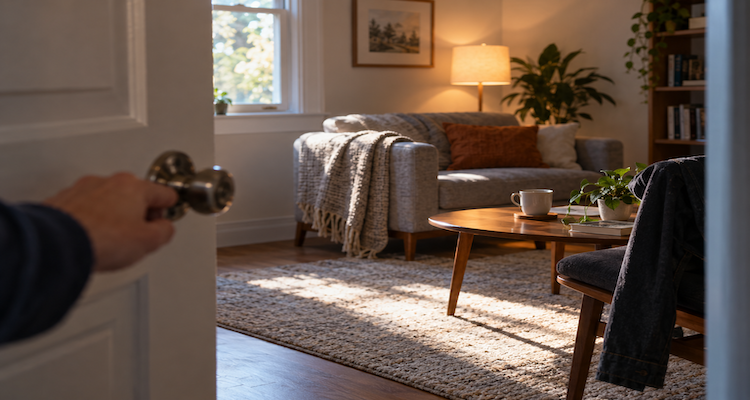
You walk into a room and immediately notice that someone was there.
You may not see the person. You may not hear a voice. Nothing obvious may tell you that the room was occupied moments earlier. Yet the space can feel subtly different warmer, quieter, more familiar, more active, or strangely empty.
Sometimes the impression is so strong that it seems as though the person has not really left.
There is a useful scientific distinction here. An ordinary sense that a room has recently been occupied can arise from environmental clues: changes in sound, temperature, air movement, smell, lighting, the position of objects, or the expectation that another person should still be there. A stronger experience feeling that someone is actually present despite having no clear sensory evidence is known in research as a felt-presence experience.
These are related, but they are not necessarily the same phenomenon.
Research suggests that the human brain continuously combines sensory information, bodily signals, memories and expectations to construct an understanding of what is happening around us. That makes an apparently empty room surprisingly rich in information.
Key Takeaways
- A recently occupied room can retain subtle sensory and environmental cues after the person has left.
- Smell, sound, temperature and air movement can influence how people perceive an indoor environment.
- Expectations and memory can make ordinary environmental changes feel socially meaningful.
- A stronger sensation that another person is present without sensory evidence is called a felt-presence experience.
- Felt presence is documented in both clinical and non-clinical settings, but its mechanisms remain incompletely understood.
- Experiencing a strange feeling in an empty room does not, by itself, establish a paranormal explanation.
The Room May Not Be as Empty as It Looks
When a person leaves a room, the most obvious change is visual: the person is gone.
But vision is only one part of how we perceive a place.
The environment continues to carry information. A chair may still be slightly displaced. A door may remain open. A computer screen may be illuminated. A cup may be on a table. There may be a faint smell of perfume, food, coffee or clothing. The acoustic character of the room may also feel different because a human body is no longer absorbing and reflecting sound in quite the same way.
Temperature and air conditions can also contribute to perception. Research on indoor environments shows that acoustic, thermal, visual and air-quality variables interact in shaping how people perceive spaces rather than functioning as completely independent signals.
None of these clues has to be consciously identified.
The brain can register a collection of small changes without producing a verbal explanation for them. The result may simply be the impression: someone was just here.
That impression can be remarkably convincing because perception is not a passive recording of the environment. It involves interpretation.
Why Smell Can Make an Empty Room Feel Occupied
Smell is particularly interesting because it can remain after its source has disappeared.
An individual does not need to be physically present for traces associated with that person to remain detectable. Fragrance, food, cleaning products, fabric, cosmetics or other airborne compounds can change the sensory character of a room.
Research has also shown that odour can influence a person’s sense of environmental presence and immersion. In one virtual-reality experiment, adding congruent smells increased participants’ reported sense of presence compared with visual and auditory stimulation alone.
That does not mean a person’s lingering smell causes someone to hallucinate their presence. It demonstrates something more basic: olfactory information can meaningfully alter how present or immersive an environment feels.
This may help explain why entering a room shortly after somebody leaves can produce a stronger impression than entering the same room much later.
The sensory evidence has not necessarily disappeared yet.
The Brain Also Remembers Who Was Supposed to Be There
There is another layer that has little to do with the physical room itself.
Imagine walking into your home expecting to find someone in the kitchen. You know they were there a moment ago. Instead, the kitchen is empty.
Your brain does not encounter the scene without context. It encounters an empty kitchen against a prediction of human presence.
Expectation therefore becomes part of perception.
Research into attention and change blindness illustrates how people can overlook changes in environments even when those changes are visually available. What we notice depends partly on where attention is directed and what we expect to find.
This matters because the question is not simply:
“What is physically in the room?”
It is also:
“What does my brain expect this room to contain right now?”
When expectation and sensory information do not line up, the resulting experience can feel unusual.
The person should be there.
The person is not there.
Yet traces associated with the person’s recent presence remain.
That mismatch can create an unusually strong awareness of absence.
Absence Can Become a Form of Presence
One of the more interesting aspects of the experience is that an empty room can make us think more intensely about the person who has left.
This is not necessarily because the room contains an extraordinary stimulus. It can happen because the person’s recent presence has changed the meaning of the environment.
A room where nobody has been expected may simply feel empty.
A room where someone has just left can feel recently occupied.
The physical difference may be small, but the psychological difference can be large.
Environmental psychology has long examined how human presence affects people’s experience of spaces. More recent research continues to show that the presence or absence of other people can influence how spaces are experienced, including whether people perceive them as suitable for solitude, social interaction or other activities.
In other words, people do not experience rooms independently of social context.
We experience places partly through the people we expect to encounter there.
When the Feeling Becomes a “Presence”
There is a more unusual version of this experience.
Someone may enter an apparently empty room and feel not merely infer that another person is there.
There may be no identifiable smell, sound, movement or visual clue.
The sensation can nevertheless feel immediate and real.
Researchers call this a felt-presence experience: the subjective feeling that another person is nearby without clear sensory evidence.
A major review published in The Lancet Psychiatry describes felt presence as a phenomenon observed in both clinical and non-clinical contexts. Researchers have reported it in association with experiences including sleep paralysis, anxiety, bereavement, endurance activities and certain neurological conditions. The review also emphasizes that felt presence remains poorly understood and can have very different meanings depending on context.
That last point is important.
A felt presence is an experience, not automatically an explanation.
Feeling that somebody is nearby does not establish that somebody or something actually is nearby.
What the Brain May Be Doing
One proposed way of understanding felt presence involves the brain’s systems for distinguishing the self from other agents and integrating information about the body and surrounding environment.
Researchers have implicated networks involving regions such as the temporoparietal junction, insula and frontoparietal cortex in theoretical and experimental accounts of felt presence. These areas participate in processes related to multisensory integration, bodily self-processing and distinctions between self and other.
The exact mechanism, however, is not settled.
That uncertainty is important because it prevents a common mistake: taking an interesting neurological hypothesis and presenting it as a complete explanation.
Scientists have evidence that felt-presence experiences exist. They have identified circumstances in which they occur and proposed mechanisms that may contribute to them. But there is not one universally accepted explanation for every experience of sensing someone nearby.
The everyday feeling of entering a recently vacated room is even less specific.
It may involve ordinary sensory traces and expectations without qualifying as a felt-presence experience at all.
Why Quiet Rooms Can Feel Especially Strange
Sound changes the character of a room more than we often notice.
When someone is speaking, walking, typing, breathing heavily, moving furniture or simply occupying a space, the environment contains continual small acoustic events.
When that activity suddenly stops, the change can be noticeable even if we cannot identify what has changed.
The room may seem unusually quiet.
That silence can draw attention inward and make subtle environmental information more noticeable. Research on indoor environments has found that acoustic conditions interact with other environmental factors in shaping perception and comfort.
This does not mean silence creates an illusion of a person.
Rather, it illustrates a broader principle: a change in the sensory background can make the absence of a person more perceptually salient.
The room feels different because the pattern of information has changed.
Why the Feeling Is Not Evidence of the Paranormal
An unexplained sensation and an unexplained cause are not the same thing.
People have many cultural and personal interpretations for experiences involving apparently empty rooms, especially when the sensation is vivid. Some may interpret them spiritually; others may think of them as intuition, memory or an unusual sensory event.
Science does not need to dismiss the experience to question the explanation.
The experience itself can be genuine and psychologically meaningful while its cause remains uncertain.
That distinction is especially important with felt presence. Scientific reviews recognize the phenomenon as a real subjective experience, while also examining neurological, cognitive and environmental explanations.
So if a room suddenly feels occupied after someone has left, the most defensible conclusion is not that something supernatural has happened.
It is that the brain has detected or inferred something about the environment that has changed, and in some cases the resulting experience can be surprisingly powerful.
The Interesting Part Is What Remains After the Person Leaves
A person does not have to remain in a room for the environment to stop carrying information about them.
Their physical presence can leave temporary sensory and spatial traces. Their expected presence can remain in memory. Their absence can change the sound and character of the space. And the brain can combine those signals into a coherent interpretation before we consciously identify the individual clues.
That is why the moment can feel almost uncanny.
Nothing mysterious has to remain in the room for the room to remind us that somebody was there.
The deeper lesson is that human perception is built not only to detect objects, but to detect people, actions, intentions and changes in social environments. An empty room is therefore not necessarily perceived as a blank space. It can be perceived as a space in transition from occupied to unoccupied, from socially active to quiet, from expected presence to absence.
And sometimes that transition is what we feel before we understand it.
Conclusion
The strange feeling of entering a room just after someone has left sits at an interesting boundary between physical environment and human perception.
Temperature, smell, sound, air movement and visible traces can change the room. Memory and expectation can give those changes meaning. In more intense cases, people can experience a genuine sense that another person is present despite having no clear sensory evidence a phenomenon researchers call felt presence.
None of this proves that every unsettling experience has a simple explanation. The science of felt presence remains incomplete.
But it does offer a useful way to think about the ordinary mystery of a recently vacated room: sometimes the person has left, but the sensory and psychological evidence of their presence has not yet disappeared.
The room may be empty.
Your brain may simply not have finished registering that fact.
This content is published for informational or entertainment purposes. Facts, opinions, or references may evolve over time, and readers are encouraged to verify details from reliable sources.