







The Hidden Health Cost of Spending More Time Indoors
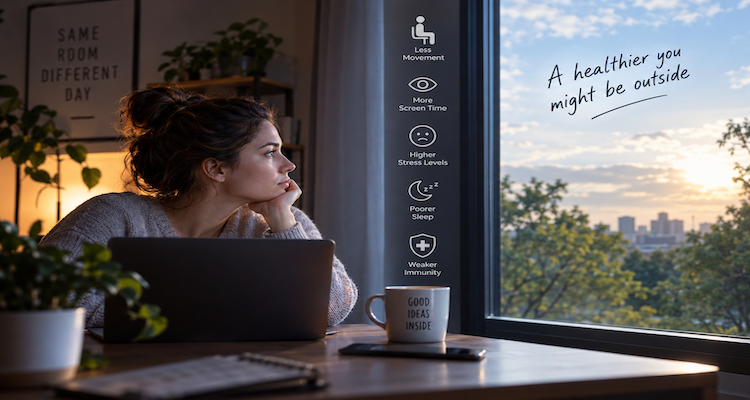
For many people, home has become more than a place to sleep. It is now an office, classroom, gym, entertainment space, dining room and, increasingly, the place where much of daily life happens.
That shift is not automatically harmful. Indoor spaces can protect people from extreme weather, pollution, infectious disease and other environmental hazards. But when more time indoors also means sitting for longer periods, receiving less daylight, spending less time in nature and breathing poorly ventilated air, several separate health risks can begin to overlap.
The important distinction is that researchers do not identify a single medical condition called “indoor living syndrome.” Instead, the health consequences are linked to what prolonged indoor time changes about a person’s behavior and environment. Physical inactivity and sedentary behavior have well-established associations with poorer health, while indoor air pollutants can contribute to respiratory and cardiovascular problems. Daylight and outdoor environments may also influence sleep, mental well-being and daily activity patterns.
The result is a less obvious health equation: the problem may not be the four walls themselves, but what disappears when those walls occupy too much of the day.
Key Takeaways
- Spending more time indoors becomes a health concern when it replaces movement, daylight, outdoor activity and healthier environmental conditions.
- Sedentary behavior is associated with higher risks of cardiovascular disease, type 2 diabetes and other poor health outcomes.
- Indoor air can contain pollutants from cooking, cleaning products, combustion, moisture, mold and other sources.
- Sunlight through a window does not provide the UVB exposure needed for skin to produce vitamin D.
- Research increasingly links outdoor and nature-based activity with aspects of mental well-being, although causal evidence varies by study.
- Small changes more movement, daylight exposure, outdoor time and better ventilation can address several pathways at once.
The Problem Is Bigger Than “Being Inside”
The amount of time people spend indoors matters because the indoor environment controls several exposures simultaneously.
The U.S. Environmental Protection Agency says people spend about 90% of their time indoors on average. That makes indoor conditions an important part of everyday environmental exposure, particularly when homes, offices or other buildings have poor ventilation or pollutant sources.
But time indoors should not be treated as a health risk by itself.
A well-ventilated home with clean air, adequate daylight, opportunities to move and regular outdoor activity is very different from a poorly ventilated environment where a person sits for most of the day and rarely goes outside.
That distinction matters because it changes the practical question. Instead of asking, “How many hours should I spend indoors?” a more useful question is: What am I doing, breathing and experiencing during those hours?
Sitting Can Become the Hidden Cost of Indoor Life
One of the clearest health pathways is physical inactivity.
Working from home, streaming entertainment, gaming, studying and using digital services can make it possible to remain seated for long stretches without noticing how little movement has occurred.
The World Health Organization distinguishes physical activity from sedentary behavior and notes that higher amounts of sedentary behavior in adults are associated with increased risks including cardiovascular disease, type 2 diabetes and mortality.
This does not mean that sitting for a particular number of hours automatically causes disease. Nor does it mean that going outside for a few minutes cancels out an otherwise sedentary lifestyle.
The more useful interpretation is behavioral: indoor convenience can remove incidental movement.
A commute may once have involved walking to a car, train or bus. An office environment may require walking between rooms. Shopping, errands and social activities can create additional movement. When those activities are replaced by deliveries, remote meetings and entertainment at home, a person can lose many small opportunities to move without deliberately deciding to become inactive.
That is why adding structured physical activity is valuable, but breaking up prolonged sitting also deserves attention.
Daylight Is Different From Indoor Brightness
A room can look bright while providing a very different light environment from being outdoors.
Natural daylight is relevant to the body’s circadian system, which helps regulate the timing of sleep and wakefulness. Research examining light exposure around dawn and dusk suggests that light exposure in the home can influence circadian entrainment, sleep and well-being, although the evidence base is still developing and individual responses vary.
This creates a practical issue for people who spend most of their waking hours inside: indoor lighting may not reproduce the intensity, timing or spectral characteristics of natural daylight.
The relationship is not as simple as “more sunlight is always better.” Excessive ultraviolet exposure increases skin-cancer risk, and health authorities recommend sensible sun protection.
There is also an important misconception about vitamin D.
The body can produce vitamin D when UVB radiation from sunlight reaches uncovered skin. But UVB does not pass through ordinary window glass. Sitting beside a sunny window therefore should not be treated as equivalent to being outdoors for vitamin-D production.
Vitamin D can also come from foods and supplements, and the amount produced through sunlight varies substantially according to season, latitude, time of day, skin pigmentation, age, cloud cover and other factors. There is no universally appropriate “sunlight prescription” that applies to everyone.
The Air Inside Can Be Its Own Exposure
Outdoor air pollution receives enormous attention, but indoor air deserves scrutiny because people spend so much time inside.
EPA identifies numerous potential indoor pollution sources, including tobacco smoke, combustion appliances, household products, building materials, moisture and mold. Indoor particulate matter can also come from cooking, candles, fireplaces, smoking and other activities.
Some indoor pollutants can irritate the eyes and respiratory tract or worsen asthma and other respiratory problems. Certain pollutants have more serious long-term consequences.
This does not mean every home has dangerous air. Indoor air quality varies enormously between buildings.
Ventilation, filtration, building design, moisture control, combustion appliances, cleaning products and outdoor pollution entering the building can all influence exposure.
For readers, that makes indoor air quality a more useful target than simply trying to “spend less time indoors.”
EPA identifies three broad approaches: controlling pollution sources, improving ventilation and using filtration or air cleaning where appropriate.
In practical terms, that can mean using kitchen and bathroom exhaust fans that vent outdoors, addressing water leaks and persistent moisture, maintaining HVAC systems, reducing unnecessary indoor pollutant sources and ensuring adequate fresh-air exchange when conditions allow.
What May Be Missing When Outdoor Time Disappears
The health value of going outside is not limited to sunlight.
Outdoor activity can combine several potentially beneficial exposures at once: walking, standing, daylight, social interaction and contact with green or blue spaces.
Research on green space and mental well-being has found positive associations, although the evidence is not uniform and many studies are observational. More recent systematic reviews of nature-based interventions have reported improvements in outcomes such as depressive mood, anxiety and positive affect in some controlled studies, while also noting differences in intervention types and study quality.
That distinction is important.
It would be misleading to say that simply looking at trees prevents depression or that a daily walk in a park is a substitute for mental-health treatment. The research does not justify those claims.
A more defensible interpretation is that outdoor and nature-based activity can create several conditions associated with better well-being at the same time, particularly when going outside also involves physical activity and social connection.
For someone who spends most of the day at a desk, that combination may be more meaningful than any single benefit.
Why “Go Outside More” Is Not the Whole Answer
There is a temptation to turn this evidence into a simple prescription: spend less time inside.
That advice misses an important point.
Indoor environments are essential. People need safe homes, workplaces, schools and healthcare facilities. Outdoor air can also be hazardous because of heat, wildfire smoke, allergens, infectious exposures and pollution. People with disabilities, chronic conditions, demanding jobs or limited access to safe outdoor spaces may face additional barriers.
The goal, therefore, should not be maximizing outdoor hours.
A better goal is reducing the unhealthy behaviors and exposures that can accumulate during prolonged indoor living.
That could mean:
- Taking walking or movement breaks during long periods of sitting.
- Getting some daylight outdoors during the day when conditions are safe.
- Building regular outdoor physical activity into the week.
- Paying attention to ventilation during cooking and cleaning.
- Addressing dampness, leaks and visible mold rather than simply masking odors.
- Avoiding indoor smoking and minimizing unnecessary sources of combustion pollutants.
- Using appropriate filtration when indoor air pollution is a concern.
- Maintaining a sleep schedule that includes consistent exposure to daytime light.
These measures do not require abandoning indoor life. They make indoor life healthier.
The More Important Question Is What Indoor Time Replaces
The hidden cost of spending more time indoors is therefore difficult to measure as one number.
It is not simply “eight hours inside” versus “eight hours outside.” What matters is what those hours contain.
If an additional hour indoors means working quietly near a window instead of walking outside, the health implications differ from an additional hour spent sitting motionless in a poorly ventilated room.
Likewise, an evening at home with good ventilation, regular movement and adequate sleep is not equivalent to an evening of prolonged sitting in front of multiple screens followed by irregular sleep.
This is why broad claims about indoor living can be misleading. The strongest evidence points toward individual pathways sedentary behavior, air quality, light exposure, physical activity and access to nature rather than a universal biological penalty for being indoors.
A Healthier Indoor-Outdoor Balance
For people whose jobs and responsibilities keep them inside, the solution does not need to be dramatic.
The simplest approach is to deliberately restore what indoor routines tend to remove: movement, daylight, fresh air and outdoor contact.
A short walk can provide movement and daylight. Opening or improving ventilation can reduce some indoor pollutant concentrations when outdoor conditions permit. A regular outdoor activity can provide exercise and a change of environment. Breaking up sitting can be useful even when leaving the building is impossible.
The larger lesson is about design and habit.
Modern life has made it possible to accomplish more without leaving the room. That convenience is valuable—but it also means that activities once accompanied by movement, daylight and outdoor exposure can now happen almost entirely from a chair.
The health question is not whether we should return to a life spent mostly outdoors. It is whether indoor convenience has quietly removed enough healthy behaviors from the day that we need to put them back deliberately.
Conclusion
Spending more time indoors is not inherently unhealthy, and there is no scientifically established threshold at which indoor living suddenly becomes dangerous.
The concern is cumulative.
More indoor time can mean more sitting, less daylight, fewer opportunities for outdoor activity and greater exposure to pollutants generated or trapped inside buildings. Each pathway has different evidence, different risks and different solutions.
That makes the most useful response surprisingly practical: move regularly, seek safe daylight and outdoor activity, pay attention to indoor air quality, and treat the indoor environment as part of your health environment not merely as a place where life happens.
The healthiest indoor life may not be one that keeps us indoors less at all costs. It may be one designed so that being indoors does not require giving up the behaviors and environmental exposures that support health.
This article is intended for general awareness and educational purposes only. It should not be considered medical advice. Readers are encouraged to consult qualified healthcare professionals for personal health decisions.