










Building Tomorrow Through Technology: The Infrastructure, Skills and Choices That Will Shape the Future
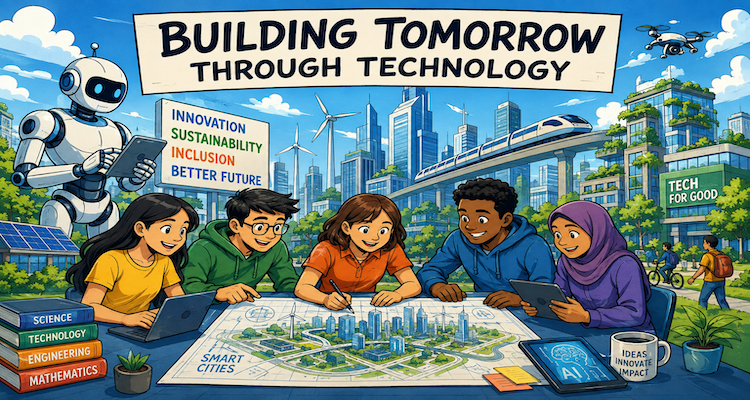
Technology is often described through the products people can see: AI assistants, smartphones, autonomous systems, cloud platforms and increasingly intelligent software. But the more consequential technology story is happening underneath those products.
The future is being built through the less visible systems that allow technology to work at scale digital connectivity, computing infrastructure, data, energy, cybersecurity, skills and institutions capable of adapting to rapid change.
That distinction matters. Artificial intelligence may be advancing quickly, but its benefits depend on whether people and organizations have the infrastructure, skills and trustworthy systems needed to use it effectively. The World Bank’s 2025 Digital Progress and Trends Report identifies four foundations for inclusive AI development: connectivity, compute, context such as relevant data, and competency through skills.
The challenge for the coming years, therefore, is not simply to invent more powerful technology. It is to build an environment in which technology can create useful, sustainable and broadly distributed progress.
Key Takeaways
- Tomorrow’s technology economy depends as much on connectivity, computing, energy and skills as on new software.
- AI adoption is expanding, but unequal access to infrastructure and expertise could widen existing economic divides.
- Data centres are becoming an important part of energy planning as AI increases demand for computing capacity.
- Workers will increasingly need a combination of technological literacy, analytical ability and human skills.
- The strongest technology strategies will focus on solving real problems rather than adopting technology for its own sake.
- Building the future responsibly requires investment in infrastructure, people, governance and resilience at the same time.
Technology Is Becoming Infrastructure, Not Just a Product
Earlier waves of technological change often arrived as identifiable inventions: the personal computer, the smartphone or the commercial internet.
Today’s transformation is more interconnected.
A modern digital service may depend on cloud computing, semiconductor supply chains, data centres, broadband networks, cybersecurity systems, databases, energy infrastructure and skilled workers before a user ever sees the finished product.
This makes technology infrastructure increasingly important to economic development. The World Bank notes that differences between countries and firms are increasingly influenced not simply by whether technologies are available, but by how intensively and effectively they are adopted. Technology adoption can influence productivity, jobs and economic resilience.
The implication is easy to overlook: buying technology does not automatically create technological progress.
A business can purchase sophisticated software and still fail to become more productive if employees are not trained, processes are poorly designed or data is unreliable. A country can have access to advanced AI models while lacking the connectivity, computing capacity or local data needed to deploy them effectively.
The real competitive advantage increasingly lies in the ability to turn technology into useful capability.
AI Is Changing the Meaning of Digital Readiness
Artificial intelligence has accelerated this shift because AI systems require more than an internet connection.
The World Bank’s latest assessment emphasizes the importance of four interconnected foundations: connectivity, compute, context and competency. Connectivity provides access; compute supplies processing power; context provides relevant data; and competency gives people the skills to develop and use AI.
This framework offers a useful way to understand why AI adoption will not happen evenly.
A small business with reliable broadband, cloud services, good-quality data and employees who understand how to use AI can potentially integrate AI into customer service, analysis, marketing or internal operations.
Another business may have access to the same headline technology but lack the skills or data required to make it useful.
The result is an emerging technology divide that is more complicated than the traditional digital divide.
It is no longer only about who has internet access. It is increasingly about who can turn digital access into productive capability.
The Hidden Cost of an AI-Powered Future Is Energy
There is another foundation that is becoming impossible to ignore: electricity.
AI models run primarily in data centres, and the rapid expansion of computing infrastructure is increasing the relationship between technology strategy and energy policy.
The International Energy Agency estimated that data centres consumed around 415 terawatt-hours of electricity in 2024, approximately 1.5% of global electricity consumption. In its 2025 base-case outlook, global data-centre electricity consumption was projected to reach around 945 TWh by 2030.
More recent IEA analysis indicates that data-centre electricity use increased significantly in 2025 and that AI-focused data centres are growing faster than data-centre demand overall. The agency expects data-centre electricity consumption to roughly double from 485 TWh in 2025 to about 950 TWh in 2030 in its central projection.
This does not mean AI is inherently unsustainable. Efficiency improvements are occurring, and the IEA also identifies opportunities for AI to improve energy-system operations.
But it changes the technology conversation.
The future of AI depends partly on the future of grids, generation, transmission, cooling systems, chips and data-centre design. Technology policy and energy policy can no longer be treated as completely separate conversations.
The Future of Work Will Depend on Adaptation
Technology changes workplaces not only by eliminating tasks but also by changing what workers need to know.
The World Economic Forum’s Future of Jobs Report 2025, based on the perspectives of more than 1,000 employers representing over 14 million workers, projects substantial labour-market disruption through 2030. It estimates 170 million jobs could be created while 92 million could be displaced by broader economic and technological trends, producing a projected net increase of 78 million jobs. These are employer expectations and projections, not guaranteed outcomes.
The more important lesson may be the changing composition of skills.
The report identifies AI and big data, networks and cybersecurity, and technological literacy among the fastest-growing skill areas. At the same time, creative thinking, resilience, flexibility, analytical thinking and leadership remain important.
This suggests that preparing for technological change should not mean turning everyone into a software engineer.
Most workers will interact with technology rather than build the underlying systems.
Recent OECD research similarly finds that AI is increasing the importance of digital skills, data use and interpretation, alongside managerial and human capabilities such as problem-solving, creativity and innovation.
The practical goal is therefore broader technological literacy: understanding what a tool can do, where it can fail, how to evaluate its output and how to combine it with human judgment.
The Technology Divide Could Become a Productivity Divide
One of the biggest risks of the next technology cycle is that adoption will become increasingly uneven.
The World Bank reports that AI innovation, computing infrastructure, startup funding and advanced capabilities remain concentrated in high-income economies, while many lower-income countries face gaps in connectivity, compute, relevant data and skills.
This matters because technological inequality can reinforce economic inequality.
A company that successfully uses automation and AI may be able to produce more with the same resources, respond faster to customers and develop new services. Firms that remain technologically immature may struggle to compete even when they have access to the same basic digital tools.
The answer is not simply to distribute more software licenses.
Infrastructure investment, affordable connectivity, skills development, reliable institutions, access to finance and effective technology policies all influence whether adoption translates into productivity.
Technology becomes economically powerful when it is embedded into organizations that know how to use it.
Building Tomorrow Requires Better Technology Choices
The temptation during periods of rapid technological change is to ask, “What should we adopt next?”
A better question is: What problem are we trying to solve?
That shift can prevent technology investment from becoming a race for fashionable tools.
For businesses, it can mean improving a slow process before automating it, establishing reliable data before deploying AI, training employees before introducing new systems, and measuring productivity rather than simply counting software deployments.
For governments, it can mean treating digital infrastructure as long-term economic infrastructure while also considering affordability, cybersecurity, competition, privacy and inclusion.
For individuals, it can mean developing the ability to work with technology rather than attempting to predict exactly which particular tool will dominate five years from now.
The technology landscape will change too quickly for most forecasts to remain precise.
Adaptability is therefore becoming an infrastructure of its own.
The Next Technology Advantage Will Be the Ability to Adapt
The most important technologies of tomorrow may not be the ones with the most impressive demonstrations. They may be the systems that quietly make organizations, communities and economies more capable of responding to change.
That requires a combination of physical infrastructure and human capability.
Connectivity must reach more people. Computing must become more efficient. Energy systems must accommodate rising digital demand. Data must become more useful and responsibly governed. Workers must have opportunities to learn new skills. Businesses must redesign processes rather than simply add software. Governments must create conditions in which innovation can grow without allowing its benefits to become excessively concentrated.
The World Bank’s analysis makes the broader point particularly clearly: closing digital and AI gaps requires strengthening the foundations that allow countries and organizations to adopt, adapt and innovate.
Technology will continue to change rapidly. The harder and more important task is building the capacity to use that change well.
Conclusion
Building tomorrow through technology is not fundamentally a race to produce the most advanced machine or the most powerful AI model.
It is a longer project of building the conditions in which innovation becomes useful.
The next decade will test whether societies can connect technological progress with reliable infrastructure, affordable energy, adaptable workers, responsible data practices and broader access to opportunity. The winners may not simply be those who invent the fastest. They may be the organizations and countries that learn fastest, adapt responsibly and turn technology into lasting capability.
That is what makes the infrastructure beneath technology so important. The future will be shaped not only by what technology can do, but by what people build around it.
The information presented in this article is based on publicly available sources, reports, and factual material available at the time of publication. While efforts are made to ensure accuracy, details may change as new information emerges. The content is provided for general informational purposes only, and readers are advised to verify facts independently where necessary.