









Technology and the New Age of Possibility: Why Convergence Matters More Than Invention
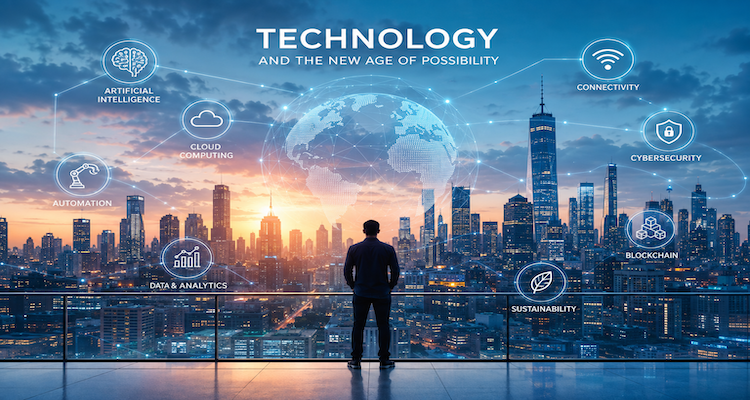
Technology is entering a different phase of innovation. The most important advances are increasingly coming not from a single breakthrough, but from technologies being connected in ways that make previously difficult tasks practical.
Artificial intelligence is becoming embedded in business software, scientific research and physical machines. Robotics is moving beyond isolated factory automation. Digital twins are linking physical operations with continuously updated digital models. New computing approaches, advanced materials, biotechnology and energy technologies are developing alongside them.
The result is a widening field of possibility but also a more complicated question: Which combinations of technology can actually create useful change?
That distinction matters. The 2026 World Economic Forum Technology Convergence report argues that competitive advantage is increasingly shifting from simply owning advanced technologies to integrating them across people, data, workflows and partners.
Key Takeaways
- The next technology wave is increasingly being driven by combinations of technologies rather than isolated breakthroughs.
- AI is becoming a connective layer linking software, physical systems, scientific research and business operations.
- Robotics and digital twins show how digital capabilities are moving deeper into the physical world.
- Expanding technological capability also creates new constraints around energy, infrastructure, skills, governance and integration.
- The organizations most likely to benefit may be those that integrate technologies effectively rather than simply adopting the newest tools.
- For individuals, the valuable skill is increasingly understanding how technologies work together to solve practical problems.
From Individual Breakthroughs to Technology Convergence
For much of the modern technology story, innovation has been explained through individual inventions: the computer, the internet, the smartphone, the semiconductor or the electric vehicle.
That model is becoming less complete.
The World Economic Forum’s 2026 technology-convergence research examines eight technology domains including AI, robotics, spatial intelligence, engineering biology, advanced materials, quantum technologies and next-generation energy and finds that their interaction can create capabilities that individual technologies cannot deliver alone.
Consider a simple example. Artificial intelligence can analyze information, but an AI system connected to sensors, robotics and a physical environment can also act on what it observes. A digital twin can model a factory, but when connected to real-time sensors, AI and automated control systems, it can become part of an operating loop rather than merely a visual representation.
The difference is significant.
Technology becomes more powerful when it moves from tool to system.
That is one of the defining characteristics of the new age of possibility.
AI Is Becoming the Connective Layer
Artificial intelligence remains one of the clearest drivers of this transition.
Stanford University’s 2026 AI Index reports that AI adoption has spread rapidly across organizations, with 88% of surveyed organizations reporting AI adoption in 2025. Generative AI was being used in at least one business function at 70% of organizations, although deployment of AI agents remained relatively early.
Those numbers matter less as a prediction of where every company is headed than as evidence of how quickly AI has moved from experimentation into ordinary organizational activity.
But the more interesting development is what happens when AI stops operating alone.
AI can interpret data from machines. It can help generate designs. It can optimize logistics. It can assist scientific researchers. It can analyze energy demand. It can provide software interfaces for people who previously needed specialized technical skills.
This makes AI less like a standalone destination and more like a connective layer between other technologies.
That distinction could shape the next stage of innovation.
The Physical World Is Becoming More Intelligent
For years, much of the digital economy existed behind screens. The emerging technology landscape is increasingly bringing computation into factories, laboratories, vehicles, energy systems, medical environments and other physical settings.
Robotics provides one of the clearest examples.
The International Federation of Robotics reported that 542,000 industrial robots were installed worldwide in 2024 more than twice the number installed a decade earlier. Asia accounted for 74% of new installations, with China alone representing 54% of global deployments.
The significance is not simply that there are more robots.
Modern robotics is increasingly being connected with computer vision, AI, sensors, simulation and advanced control systems. That combination can make machines more adaptable to changing environments than traditional automation designed around narrowly defined repetitive tasks.
The same principle is appearing elsewhere.
Digital twins can connect physical infrastructure with digital models. In manufacturing, for example, the combination of simulation, generative design, sensors and AI can shift some experimentation from expensive physical prototypes into digital environments before physical production begins. The World Economic Forum identifies digital-twin ecosystems as one of the areas where technology convergence is already changing manufacturing value chains.
This does not eliminate physical constraints. It changes where and when they appear.
Scientific Discovery Is Becoming More Computational
The convergence of AI, automation and scientific infrastructure could also change how research is conducted.
Stanford’s 2026 AI Index reports that AI-related scientific publications in the natural sciences reached approximately 80,150 in 2025, up 26% from 2024. The report also describes growing use of AI across biology, chemistry, physics and astronomy.
Yet the same evidence offers an important warning against technological hype.
AI systems can perform impressively on some scientific benchmarks while struggling with replication, experimental validation and end-to-end research tasks. Stanford reports that the strongest AI agents still perform substantially below PhD-level experts on certain complex research evaluations.
That distinction matters.
AI can expand the range of hypotheses researchers can investigate, automate portions of analysis and help process enormous datasets. But scientific discovery still depends on evidence, experimentation and validation.
The possibility is therefore not that machines simply replace scientists. A more credible possibility is that researchers gain new computational instruments that change the scale and speed at which questions can be explored.
Every New Possibility Creates a New Constraint
Technological optimism can obscure an important reality: removing one bottleneck often creates another.
Artificial intelligence provides a powerful example.
The International Energy Agency estimates that data centres consumed about 415 terawatt-hours of electricity in 2024, around 1.5% of global electricity consumption. In its base case, global data-centre electricity consumption could reach around 945 TWh by 2030.
That does not mean AI alone is responsible for all of this demand. Data centres support many digital services, and the IEA identifies AI as the most important driver of the projected growth alongside other digital demand.
The larger lesson is about infrastructure.
A technology can be technically possible while remaining difficult to scale because of electricity supply, grid connections, cooling, semiconductor availability, data, regulation, skilled workers or capital.
The IEA also estimates that around 20% of planned data-centre projects could face delays if grid-related risks are not addressed.
Possibility, therefore, is not simply about what engineers can build.
It is about what an entire system can support.
The New Competitive Advantage May Be Integration
This may be the most important business implication of the current technology cycle.
The World Economic Forum’s 2026 research argues that organizations gaining advantage from technology convergence are not necessarily those with the most technically advanced individual components. Instead, integration capability becomes crucial: connecting technologies with existing workflows, coordinating teams and working across organizational boundaries.
That changes the definition of innovation.
A company does not necessarily gain an advantage because it purchased an AI system, installed robots or built a digital twin. The advantage emerges when those technologies solve a real bottleneck and fit into the way people actually work.
This is why implementation can be as important as invention.
A technically sophisticated system that employees cannot use, managers cannot understand or existing infrastructure cannot support may create less value than a simpler system that integrates reliably.
The new technology race is therefore partly a race to reduce friction.
What This Means for Workers and Consumers
The transition also changes what people need to learn.
Technical specialization will remain important, but the ability to work across technologies could become increasingly valuable.
A software developer who understands business processes can identify better automation opportunities. A designer who understands AI can explore more alternatives. A manufacturing professional who understands data can work more effectively with robotics and digital-twin systems. A scientist who understands computational tools can investigate larger datasets and more complex models.
This does not mean everyone needs to become an AI engineer.
It means technological literacy increasingly includes understanding connections.
People will need to ask not only, “What can this technology do?” but also:
- What problem does it solve?
- What other technology must it connect with?
- What new bottleneck could it create?
- What human judgment remains necessary?
- What infrastructure does it require?
- How should its performance be measured?
- What happens when it fails?
Those questions are becoming more valuable as technology becomes more interconnected.
Possibility Needs Governance as Much as Innovation
Greater capability also increases the importance of responsible deployment.
Stanford’s 2026 AI Index reports that documented AI incidents rose to 362 in 2025, compared with 233 in 2024. It also finds that responsible-AI evaluation has not advanced at the same pace as capability evaluation.
This creates a practical tension.
The more technologies are connected, the greater the potential benefit but also the possibility that failures can move across systems.
An error in an isolated software tool may affect a document. An error in an AI system connected to financial operations, industrial equipment, healthcare workflows or critical infrastructure can have a different scale of consequence.
That does not make technological convergence inherently dangerous. It means that reliability, transparency, cybersecurity, human oversight and governance need to become part of system design rather than afterthoughts.
The Next Age Will Be Defined by What We Can Connect
The most interesting technology story of the coming years may not be the arrival of one spectacular invention.
It may be the gradual connection of capabilities that already exist.
AI can interpret. Sensors can observe. Robots can act. Digital twins can simulate. Advanced materials can change physical performance. Biotechnology can manipulate biological systems. New energy technologies can expand the available power base. Quantum computing may eventually address specialized problems that conventional systems struggle to solve.
Individually, each has limitations.
Together, under the right conditions, they can create new systems.
But convergence is not guaranteed to produce progress. It works when the combination addresses a meaningful problem, when infrastructure can support it, when people can use it, when costs make sense and when risks are manageable. The World Economic Forum’s research emphasizes precisely this point: technology combinations create potential, but integration and orchestration determine whether that potential becomes operational value.
That may be the defining idea behind the new age of possibility.
The future of technology will not be measured only by how powerful individual machines become. It will also be measured by how intelligently people connect machines, data, energy, biology, software and human expertise.
The greatest opportunities may therefore emerge at the boundaries between fields where one technology removes a limitation and makes another technology useful in a way that was previously impractical.
Conclusion
Technology is moving from an era dominated by individual breakthroughs toward one increasingly shaped by convergence.
AI’s rapid adoption, the expansion of robotics, the emergence of intelligent physical systems and the growing computational role in science all point in the same direction: the value of technology increasingly comes from how capabilities work together.
That creates enormous opportunities, but it also changes the nature of the challenge. The difficult question is no longer simply what can be invented. It is what can be integrated, scaled, governed and made genuinely useful.
For businesses, that means looking beyond technology ownership toward orchestration. For workers, it means developing the ability to connect technical capabilities with real problems. For consumers and society, it means judging innovation not by novelty alone, but by whether it improves outcomes people actually care about.
The new age of possibility is therefore less about having more technology.
It is about making more meaningful connections between the technologies we already have—and the ones still emerging.
The information presented in this article is based on publicly available sources, reports, and factual material available at the time of publication. While efforts are made to ensure accuracy, details may change as new information emerges. The content is provided for general informational purposes only, and readers are advised to verify facts independently where necessary.