









Inside the Technology Revolution: AI, Robots and the Infrastructure Reshaping Everyday Life
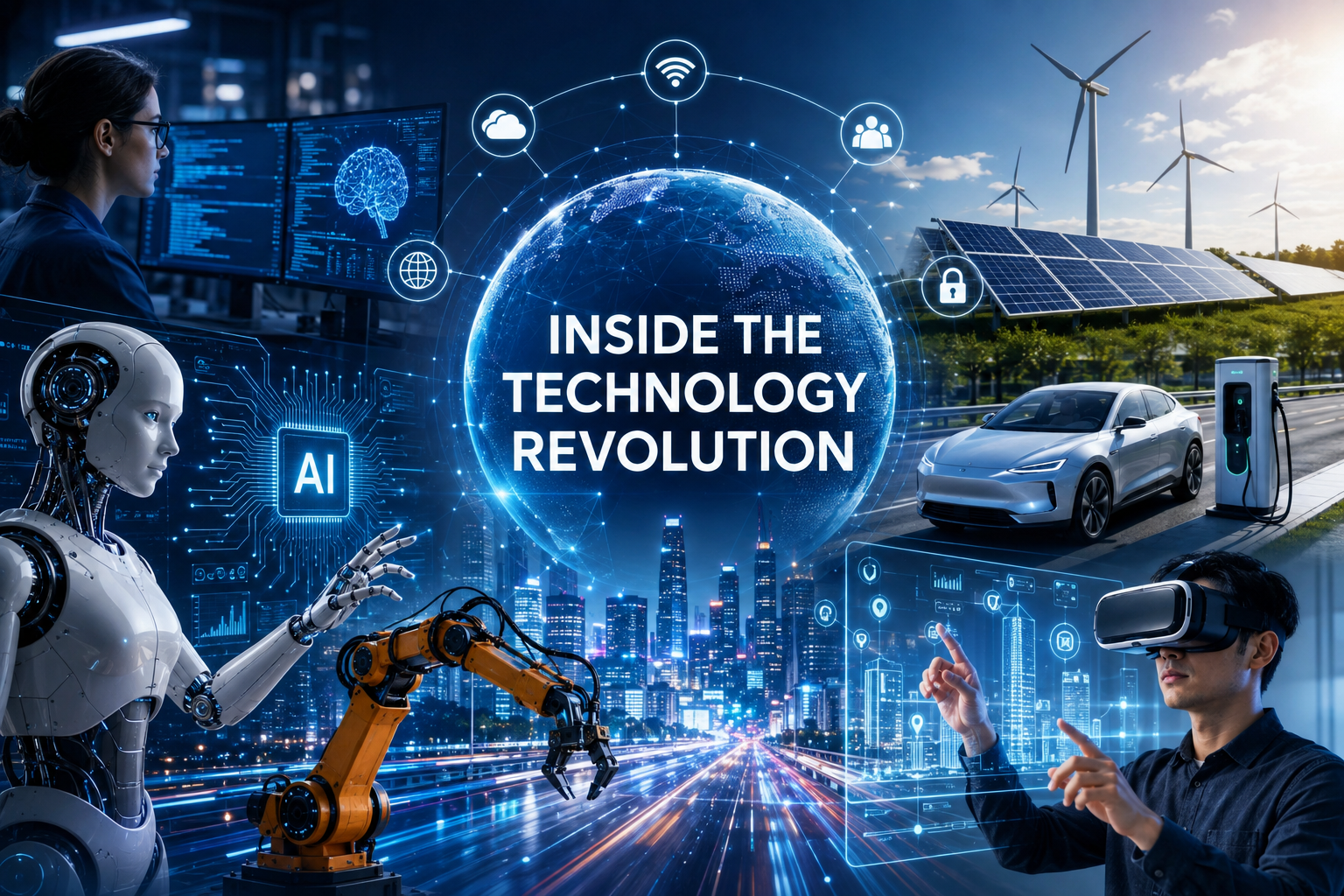
The technology revolution is no longer defined by a single breakthrough device or a new software platform. It is increasingly about the convergence of artificial intelligence, robotics, high-speed connectivity, cloud computing, advanced chips and the physical infrastructure required to run them.
That shift is already measurable. Stanford’s 2026 AI Index reports that organizational AI adoption reached 88% in 2025, while generative AI reached 53% population adoption within three years. At the same time, the International Federation of Robotics recorded 542,000 industrial robots installed worldwide in 2024, more than twice the level of a decade earlier.
But the less visible part of the revolution may be just as important. AI requires data centers, electricity, networks, specialized hardware and skilled workers. The International Energy Agency projects that global data-center electricity consumption could more than double from about 415 TWh in 2024 to around 945 TWh by 2030.
The result is a technology transformation that is simultaneously digital and physical—and one whose benefits will depend heavily on who can access the infrastructure behind it.
Key Takeaways
- AI adoption is spreading rapidly, but the broader technology revolution also depends on robotics, connectivity, chips and computing infrastructure.
- Data centers are becoming an important part of the global energy system as AI increases demand for computing power.
- Industrial robots are moving deeper into manufacturing, changing how productivity and human-machine collaboration are organized.
- Digital access remains uneven, with billions of people still offline despite major advances in connectivity.
- The next phase of technology will be shaped as much by infrastructure, affordability and skills as by software innovation.
The Revolution Is Bigger Than AI
Artificial intelligence has become the most visible symbol of today’s technology shift, but focusing exclusively on AI can obscure the larger transformation.
Modern digital systems increasingly work as interconnected layers. AI models depend on specialized processors and data centers. Data centers depend on electricity, cooling systems and high-capacity networks. Connected devices depend on telecommunications infrastructure. Robotics combines software intelligence with sensors, motors, batteries and industrial systems.
This means that technological progress is becoming less about isolated products and more about ecosystems.
The smartphone illustrates the earlier model well: a powerful device brought computing, cameras, communications and software together in one object. The emerging model is broader. Intelligence is increasingly distributed across cloud infrastructure, edge devices, factories, vehicles, workplaces and consumer applications.
That makes the technology revolution harder to see but potentially more consequential.
AI Has Moved From Experiment to Infrastructure
AI is increasingly being incorporated into ordinary organizational processes rather than remaining confined to research laboratories.
Stanford’s 2026 AI Index estimates that 88% of surveyed organizations used AI in at least one business function in 2025, while generative AI was used in at least one business function by 70%. Yet deployment of AI agents remained in the single digits across nearly all business functions, suggesting that widespread AI adoption does not mean autonomous systems have already taken over business operations.
That distinction matters.
There is a significant difference between using AI to summarize documents, assist customer service, generate software or analyze information and allowing an AI system to independently execute a complex business process.
The technology is therefore advancing along two parallel tracks: increasingly capable models and increasingly cautious organizational integration.
The economics are changing as well. Stanford’s earlier AI Index research found that the cost of querying a model achieving GPT-3.5-level performance on one benchmark fell from $20 per million tokens in late 2022 to $0.07 by October 2024. Falling inference costs can make previously expensive AI applications more practical, although real-world costs vary considerably by model, workload and infrastructure.
This is one reason the revolution may spread beyond headline-grabbing AI products. When a technology becomes cheaper to use, businesses can experiment with more applications and incorporate it into more workflows.
The Physical Infrastructure Behind the Digital Economy
One of the most important changes is happening somewhere consumers rarely see: data centers.
AI models require enormous amounts of computation for training and deployment. The resulting infrastructure demand is turning data centers into increasingly important participants in electricity systems.
The IEA estimates that data centers consumed around 415 TWh of electricity globally in 2024, equivalent to about 1.5% of global electricity consumption. Its base case projects consumption to reach around 945 TWh by 2030, with AI-driven accelerated servers accounting for almost half of the net increase in data-center electricity demand.
This does not mean AI will consume most of the world’s electricity. The IEA expects data centers to account for just under 3% of global electricity consumption in 2030 in its base case. But the geographic concentration of data centers can create local pressure on electricity grids, generation capacity and transmission infrastructure.
That creates a new technological constraint: computing capacity cannot expand independently of the physical world.
Electricity availability, grid connections, cooling, land, networking equipment and hardware supply can all influence how quickly digital infrastructure can grow.
In other words, the future of computing is partly an energy and infrastructure story.
Robots Are Bringing the Revolution Into the Physical World
AI’s impact becomes even more tangible when software intelligence is combined with machines.
The International Federation of Robotics reported that 542,000 industrial robots were installed globally in 2024. That was more than twice the number installed a decade earlier, with Asia accounting for 74% of new deployments. China alone represented 54% of global installations.
The significance extends beyond factory automation.
Robotics can change how repetitive, dangerous or highly precise tasks are performed. In manufacturing, robots can operate continuously and with consistent precision, while people remain responsible for supervision, maintenance, quality control, process design and many tasks requiring flexible judgment.
The important question is therefore not simply whether robots replace workers.
It is how work is reorganized when machines become capable of handling a larger share of predictable physical tasks while software handles a larger share of predictable cognitive tasks.
That combination could change job descriptions, training requirements and productivity measurement across industries.
Connectivity Determines Who Benefits
Technological progress can look universal when viewed from a connected city, but global access remains uneven.
The International Telecommunication Union estimated that about 6 billion people 74% of the world’s population were online in 2025. Yet approximately 2.2 billion people remained offline. Internet use reached 94% in high-income countries but only 23% in low-income countries.
The divide is not simply about whether a signal exists.
The ITU notes that affordability, quality, digital skills and urban-rural differences continue to shape how people benefit from connectivity. More than half of the world’s population was covered by 5G in 2025, but deployment remained concentrated in higher-income markets.
This matters because access to AI and other advanced technologies increasingly depends on access to the underlying digital ecosystem.
A person with fast, affordable connectivity and suitable hardware can use cloud-based AI tools, digital education, online services and increasingly sophisticated applications. Someone without reliable access may remain excluded from the same opportunities.
The technology revolution can therefore widen existing inequalities if infrastructure and skills develop unevenly.
Productivity Gains Come With New Questions
Technology has always promised greater productivity, but the current shift is unusual because software is moving into tasks that previously required human judgment, communication or analysis.
Stanford’s 2026 AI Index reports productivity gains in several structured, measurable forms of work, including customer support, software development and marketing. But it also notes that gains are smaller in tasks requiring deeper reasoning and that heavy reliance on AI may create longer-term learning concerns.
This suggests that productivity should not be measured simply by how much work AI can perform.
A better question is whether the combination of humans and machines produces better outcomes.
If AI allows an employee to spend less time searching for information and more time making decisions, the technology may complement human expertise. If it encourages people to accept incorrect outputs without verification, efficiency can become an illusion.
Stanford’s 2026 Responsible AI research illustrates the problem. Its assessment of 26 leading models found substantial variation in hallucination rates, demonstrating that increasingly capable systems can still produce confidently incorrect information.
The technology revolution therefore creates a new workplace requirement: knowing when to trust a system and when to challenge it.
The New Technology Divide Is About Capability
The next digital divide may not simply separate people who have technology from those who do not.
It may increasingly separate people and organizations that know how to use advanced technology effectively from those that merely have access to it.
A business can purchase AI software without redesigning its workflows. A school can provide students with digital tools without teaching them how to evaluate machine-generated information. A factory can install robots without developing the skills required to integrate automation successfully.
Technology creates possibilities; institutions determine whether those possibilities become useful outcomes.
This is why digital skills, organizational change and education are becoming as important as hardware and software.
What Comes Next Is a Convergence, Not a Single Breakthrough
The next stage of technological development is likely to be defined by systems working together.
AI can provide interpretation and decision support. Robots can perform physical actions. Sensors can collect real-time information. Cloud platforms can coordinate computing. Networks can connect machines and people. Advanced chips can make these systems faster and more efficient.
The important innovations may therefore emerge at the boundaries between technologies.
A factory, for example, may increasingly combine computer vision, industrial robots, predictive maintenance, connected equipment and AI-assisted planning. A logistics operation can combine sensors, automated systems, software optimization and human oversight. Consumer devices can increasingly use on-device or cloud AI alongside conventional applications.
This convergence also creates new risks. More interconnected systems mean that failures, security vulnerabilities and poor decisions can propagate across multiple layers.
The infrastructure question will remain central. The IEA expects renewables to meet nearly half of the additional electricity demand from data centers through 2030, while natural gas, nuclear power and other sources also contribute. That means the expansion of computing is becoming connected to decisions about energy security, grid investment and emissions.
Conclusion
The technology revolution is easy to misunderstand because its most visible products are only the surface.
The deeper transformation is happening through the combination of artificial intelligence, robotics, connectivity, computing infrastructure and increasingly automated systems. Its scale is visible in rising AI adoption, expanding robot installations and rapidly growing demand for data-center capacity.
But technological progress will not be measured only by how powerful the next model or machine becomes.
It will also be measured by whether electricity grids can support new computing demand, whether businesses can integrate automation responsibly, whether workers can develop new skills, whether digital access becomes more affordable, and whether people can distinguish useful machine assistance from unreliable output.
That is the defining tension inside the technology revolution: the machines are becoming more capable, but the systems around them must become more capable too.
The information presented in this article is based on publicly available sources, reports, and factual material available at the time of publication. While efforts are made to ensure accuracy, details may change as new information emerges. The content is provided for general informational purposes only, and readers are advised to verify facts independently where necessary.